Frank
POLIFKA
Windhexe
Windhexe
https://www.youtube.com/watch?v=xxuM7xWL5RQ
Tornado in a can the Windhexe
https://www.youtube.com/watch?v=gMSjYHxPJ2o
Frank Polifka Tornado in a can windhexe // Stillpoint X
Frank Polifka, a retired farmer.
Ever since he was a kid, Polifka has dreamed of harnessing the power of a tornado. Now he's invented something that does, all out back in a Quonset hut on the farm he shares with Ruth, his wife of 47 years.
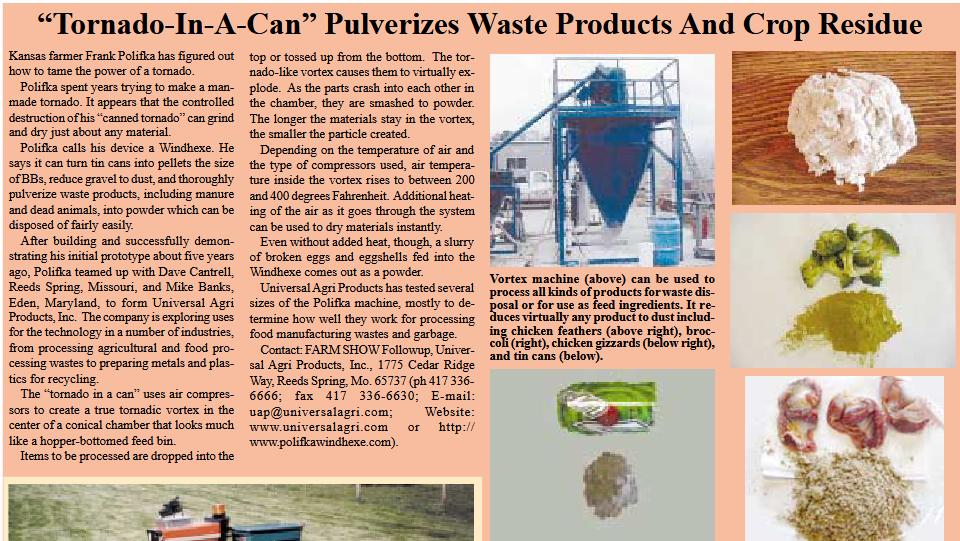
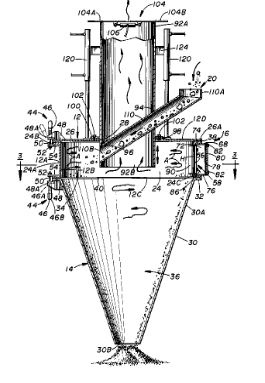
The Windhexe is a squat, six-foot-tall metal contraption comprised of a large funnel supported by four legs. Four jets set around the rim of the funnel blow compressed air into it. As the air whips around the inside of the funnel, it forms into a high-speed vortex. Think of it as a tornado in a can.
Polifka's invention grinds all kinds of things into powder. There's a company in Missouri that's using the Windhexe for poultry processing, and waste disposal and mining firms have shown interest.
https://stillpointx.wordpress.com/wp-content/uploads/2018/06/frank_polifka_25_4_43.pdf
Tornado in a Can
[ PDF ]
https://wiki.opensourceecology.org/wiki/Vortex_Dehydration
Vortex Dehydration
https://en.wikipedia.org/wiki/Windhexe
Windhexe
Windhexe (German, literally: "wind witch") is a grinding and dehydrating apparatus operated with compressed air typically used in waste reduction and food processing. The Windhexe was unveiled in 2002 and operates via compressed air injected into a conical chamber which tumbles material at high speeds causing simultaneous dehydration and disintegration. The limited application of the Windhexe is in waste reduction and in animal processing with more proposed uses being explored commercially.
History
Around 1989, following his retirement, Kansas farmer Frank Polifka began work on what would become the Windhexe.[1]
In 2002, following 13 years of work, Polifka unveiled the Windhexe to a small group of the local press.[2]
On August 23, 2012 (14 years ago), Polifka died of natural causes in Catherine, Kansas.[2]
As of 2013, the commercial use of the Windhexe machine was controlled by Vortex Dehydration Technology LLC, a company co-founded by Polifka. The company licensed and maintained Windhexe machines for industrial and commercial use for a per-tonne fee.[3]
The company currently[when?] employs 12 and has an annual revenue that exceeds US$3,000,000.
Description
The Windhexe operates using heated pressurized air. The pressurized air is forced into a conical chamber where it forms a high speed vortex which tumbles material against the inside wall, pulverizing it into a fine powder while simultaneously dehydrating the finished product.[3]
Compressed air is injected at the top through nozzles. Small deflection plates then force that air to flow in a counterclockwise direction, creating a miniature tornado in the funnel-shaped can. Using just a fraction of the energy employed by conventional crushers and dryers, the Windhexe breaks solid material down to roughly micron size, increasing its surface area so that heated air can dehydrate the material quickly. The Windhexe operates without any moving parts and can quickly and loudly disintegrate and dehydrate materials ranging from shoes, rocks, sludge, concrete, and industrial waste into glass, as well as agricultural and animal waste.[4]
Applications
The patent application[which?] for the Windhexe mentions possible uses in pasteurization, desalinization of salt water, and kitchen appliances.[3]
The Windhexe has yet to be used on a large scale industrially but it has been used in a limited capacity in an array of applications. Windhexe is currently being used to process collagen powder from eggshells, creating a plentiful supply of the expensive protein that is used in cosmetics and medical procedures such as skin grafts. The Windhexe is also being used to dry lignite coal in Australia, a process by which impurities are removed from the coal pre-burn producing a cleaner burning fuel.[3]
Waste reduction
One of the main uses of the Windhexe is in solid waste reduction. The Windhexe processes materials to take up as little as 1/10th of the original volume. The Windhexe is currently being used for this purpose in several large industrial plants throughout the west coast. This process can be done without the use of heat in the compressed air because waste reduction does not typically need the dehydration feature of the Windhexe.[1]
Animal processing
Animal processing was one of the first proposed uses of the Windhexe. The machine can take the remains from meat processing plants, trimmed waste and animal parts that are typically thrown away, and produce what Vortex Dehydration Technology calls highly nutritional "edible systems", such as bouillon, powdered extracts and flavorings, and dried soups. This differs from the current process, which only uses non waste animal products to create edible systems, since it allows parts now classified as waste to be used commercially.[1]
References
Johnson, Alex (2004-05-19). "A good stiff breeze for industry". NBC news. Archived from the original on 2013-11-13. Retrieved 2013-10-24.
Hays Memorial Chapel. "Francis D. "Frank" Polifka". Retrieved 2013-10-24.
"History TimeLine". Vortex Dehydration Technologies. Archived from the original on 2013-11-13. Retrieved 2013-10-24.
Brown, Eryn (2003-12-14). "Tornado in a Can". The New York Times. Retrieved 2013-11-13.
US6971594 -- Apparatus and method for circular vortex air flow material grinding
https://archive.seattletimes.com/archive/20021210/vortex10/tornado-in-a-can-pulverizes-materials
'Tornado in a can' pulverizes materials
Dec 10, 2002
By Anita Huslin
Inside the corrugated tin shed that serves as the top-secret test site for Vortex Dehydration Technology's strange new invention, Frank Polifka cranks open a valve and unleashes the force of a tornado. Compressed air rushes into an 8-foot-tall steel cone and whirls counterclockwise at tremendous speeds, producing winds capable of turning rock into dust.
There's a parade of visitors coming from all over the country to see this machine, to witness for themselves whether it really does what they've heard it can do. They want to know whether it really offers a new technology for mining precious metals, pulverizing trash, grinding concrete into a powder that can be reconstituted with water.
But the keenest interest so far is from poultry people who are watching closely to see whether it can revolutionize the way billions of pounds of chicken byproducts — the feet, feathers, heads and entrails that don't end up in the supermarket — are processed.
Polifka, 73, calls his creation a "tornado in a can," though the official name painted on the side of the cone is Windhexe — a branding inspired by the devil winds that sweep the Kansas plains that he has farmed all his life.
Whether there are riches to be made from pulverizing poultry parts into powder remains to be seen. The trick will be whether the machine can transform the various substances into products worth more than the processing costs.
Several of the poultry companies were impressed enough to donate equipment and share information with Vortex. Though poultry officials are reluctant to speak publicly about the Windhexe for competitive reasons, they say the technology is intriguing.
"It kind of looks like something your uncle might invent in the back yard," said one poultry company executive. "But it really sparks the imagination what you could do with it."
Some day, this machine could make a fortune for Polifka and his partners. But at the moment, it is emitting a knee-buckling shriek. Engineers shut it down and huddle, mulling over a complex mathematical solution they think might help them fix the noise.
But Polifka, a stocky man with a snow-white beard and twinkling eyes, just opens the machine, grabs a broom handle and pokes at a flap of metal inside the cone. The adjustment made, he shuts the machine and starts it again. The noise is gone. In its place is the powerful hum of air, contained in the 6-foot-diameter funnel Polifka modeled after the tornadoes he watched while growing up.
The tornado in a can is back up and ready for business.
Over the next several days, Polifka and his partners will test the Windhexe on a variety of substances.
A ton of chicken backs. Four industrial-size drums containing 2,000 pounds of broken eggshells. A pallet of household garbage.
And eight buckets of jellyfish caught in the Gulf of Mexico just a few days earlier by a scientist who believes the machine can spin them into the pharmaceutical equivalent of gold.
Polifka turns a wheel that controls the flow of air into the Windhexe and climbs up to where engineer Whit Davis prepares to feed the machine. Davis scoops up a handful of jellyfish goo and drops it in.
The machine cranks louder as the goo hits the vortex, and the mysterious process inside begins.
Each year, the U.S. poultry industry generates about 4 million tons of feathers, heads, feet and entrails. An additional 50,000 tons of dissolved solids such as fat are skimmed from the wastewater stream, much of it sprayed on farm fields as fertilizer. And much of the 300 million tons of shells produced by laying hens each year is worked into the soil.
But with environmental laws making land disposal more difficult in some areas, poultry companies have sought new ways of handling that waste.
Enter the tornado in a can.
"The single most important quality of the tornado in a can is whatever goes into it comes out with its nutritional value," said David Winsness, a distributor of material-handling equipment to such poultry giants as Perdue and Tyson Foods. "You can get four times the price of nonedible waste."
Last month, Polifka received a patent on the Windhexe. And word of it has spread worldwide.
Could it dry out huge stores of underground coal, an Australian company has asked, and make it a viable alternative to oil? Would it dehydrate duck manure, some farmers in Ireland wondered. Could it separate gold from sand and gravel, asked another company, thinking this could be a new way to squeeze greater profits from the ground.
You bet, its champions say, the possibilities are endless. To test their theory, the Vortex folks have thrown in rocks, diapers, tomatoes, sweet-potato rejects from the farm down the road, 400 pounds of Oreo cookies, frozen pizza dough, even a dead bird.
The jellyfish, however, are a first.
When Polifka switches on the huge compressor that sits outside the testing shed, the lights inside dim as the huge motor starts sucking air into the tank, enough to fill 50 tires a second.
Polifka cranks up the temperature in the cone as the vortex roars, and the superheated spiral of air evaporates the water in the jellyfish and bludgeons the remains into powder.
Within seconds, a fine white powder starts dropping from the opening at the bottom of the cone into a wheelbarrow...
https://www.youtube.com/watch?v=zAVnz5WECRQ&pp=ygUIV2luZGhleGU%3D
Windhexe vortex video whole wheat
Stillpoint X
https://www.youtube.com/watch?v=tT0Xso
O-Day - Explaining Frank Polifka's Windhexe 'Tornado Machine'
https://www.youtube.com/watch?v=qfECeDbusRQ&pp=ygUIV2luZGhleGU%3D
https://www.youtube.com/watch?v=4acd__EQ1to&pp=ygUIV2luZGhleGU%3D
https://www.youtube.com/watch?v=tT0XsoCYR0I&list=PLYnA9w2HuT4vfthctPHulYi5SXNjb59K0
https://www.youtube.com/watch?v=4M9IfrV7uYE&list=PLBgQorZu_mLn0ziDFvyniFBeg362249zK
https://www.youtube.com/watch?v=T5uJbENwQsI&list=PLBgQorZu_mLn0ziDFvyniFBeg362249zK&index=2&pp=iAQB0gcJCSsMAYcqIYzv
https://www.youtube.com/watch?v=XUoE4ITpicE&list=PLBgQorZu_mLn0ziDFvyniFBeg362249zK&index=3&pp=iAQB
https://www.youtube.com/watch?v=-BUTH2SL5Fc&pp=ygUIV2luZGhleGU%3D
https://www.youtube.com/watch?v=qJkascii1LU&pp=ygUIV2luZGhleGU%3D