Robert L. FORWARD
Statite Satellite
Statite Satellite
https://www.youtube.com/watch?v=jxN--4BKH7g
Statites & Quasites // Cool Worlds
We now have around 5000 satellites in orbit of the Earth and all of them are compelled to follow orbital paths dictated by Johannes Kepler's Laws of Planetary Motion, first written down in the early 17th century. Could there be a way to hack the orbital physics and break away from Kepler's Laws? Today we'll explore a novel space technology called statites, and a twist on it we're calling quasites, that could very well do exactly this.
https://arc.aiaa.org/doi/10.2514/3.25487
Solar sail halo orbits. Part I - Heliocentric case.
Colin R. Mclnnes and John F. L. Simmons
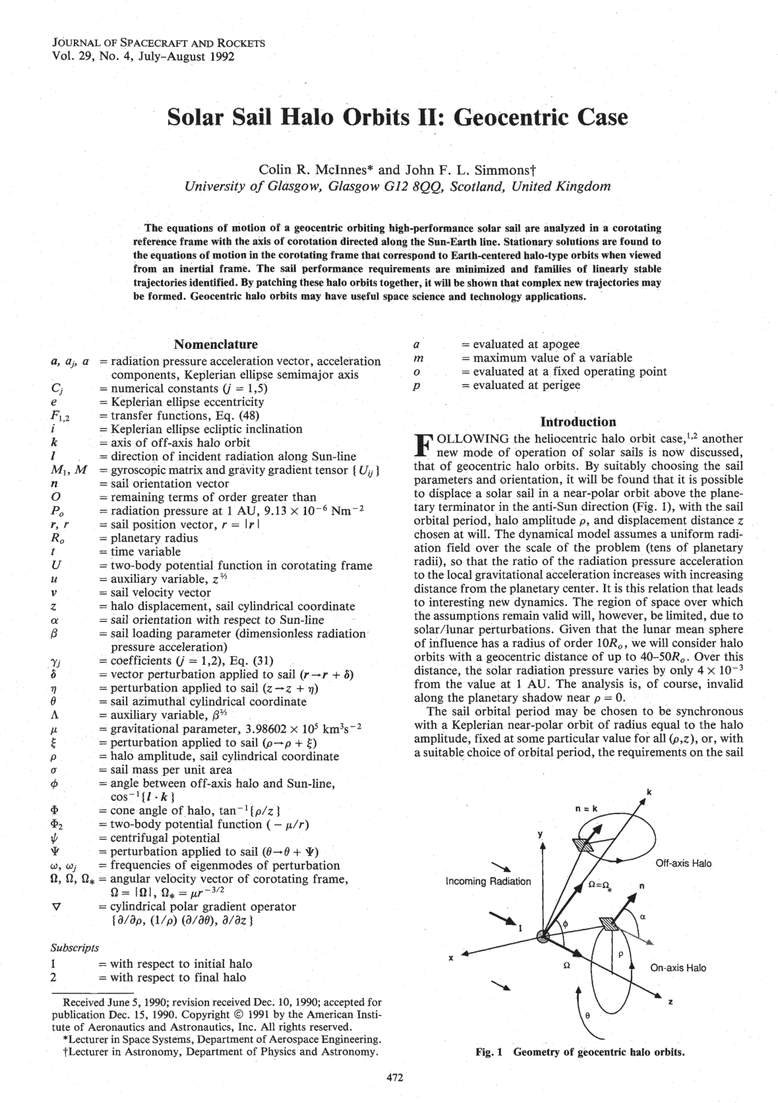
https://arc.aiaa.org/doi/10.2514/3.55639
Solar Sail Halo Orbits Part II - Geocentric Case
Colin R. McInnes and John F. L. Simmons
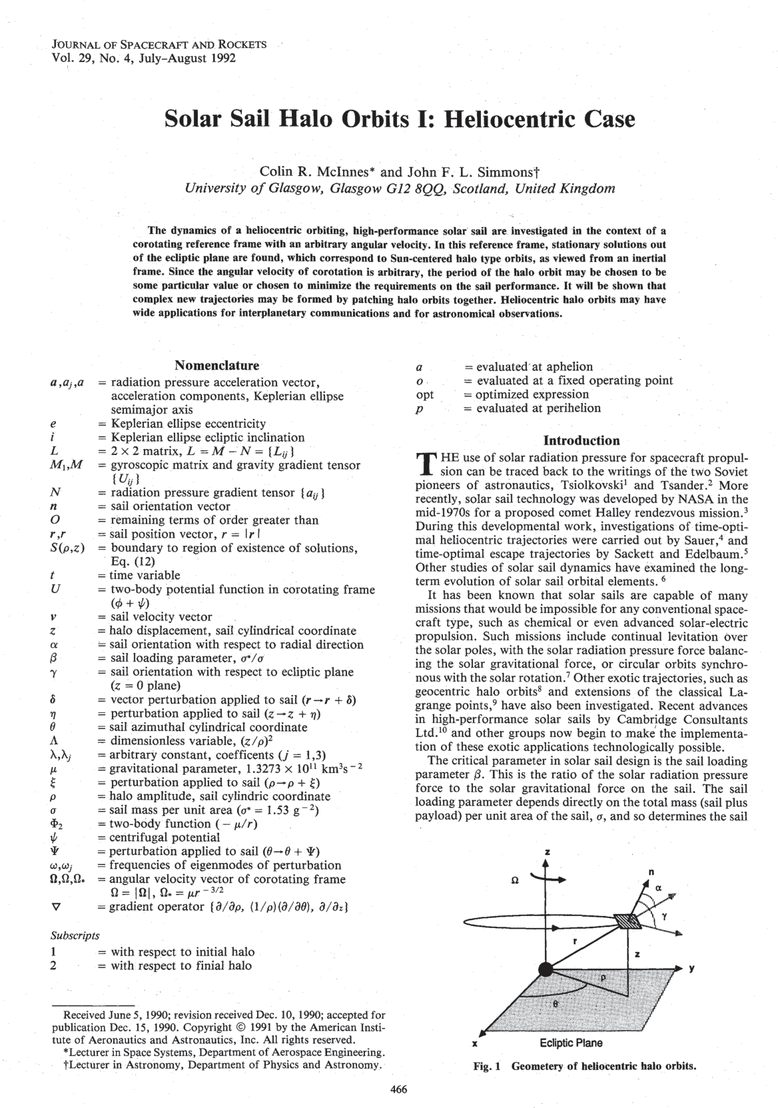
https://strathprints.strath.ac.uk/18865/
Light levitated geostationary cylindrical orbits are feasible
Abstract -- This paper discusses a new family of non-Keplerian orbits for solar sail spacecraft displaced above or below the Earth's equatorial plane. The work aims to prove the assertion in the literature that displaced geostationary orbits exist, possibly to increase the number of available slots for geostationary communications satellites. The existence of displaced non-Keplerian periodic orbits is ¯rst shown analytically by linearization of the solar sail dynamics around a geostationary point. The full displaced periodic solution of the non-linear equations of motion is then obtained using a Hermite-Simpson collocation method with inequality path constraints. The initial guess to the collocation method is given by the linearized solution and the inequality path constraints are enforced as a box around the linearized solution. The linear and nonlinear displaced periodic orbits are also obtained for the worst-case Sun-sail orientation at the solstices. Near-term and high-performance sails can be displaced between 10 km and 25 km above the Earth's equatorial plane during the summer solstice, while a perforated sail can be displaced above the usual station-keeping box (75 £ 75 km) of nominal geostationary satellites. Light-levitated orbit applications to Space Solar Power are also considered.
https://www.ijsciences.com/pub/pdf/V72018031562.pdf
https://www.semanticscholar.org/paper/General-relativistic-gravity-machine-utilizing-Musha-J.Pinheiro/b1d74f520f2674460730c3d3b5ad296aff21a3de
General Relativistic Gravity Machine using Electromagneto-Torsion Field
Takaaki Musha, Mario J.Pinheiro
[ PDF ]
Abstract -- Some field propulsion systems are based on the solution of General Relativity Theory and are related to the connection between gravity and electromagnetic field. For example, Robert Forward proposed a gravity machine working according to the Einstein’s General Relativity Theory, which requires ultra dense matter with the density of a dwarf star to produce useful thrust, but the proposed theoretical scheme cannot be realized by conventional technologies. The authors propose several concepts of a gravity machine utilizing an intense electromagnetic field that produces sufficient thrust to propel the spaceship, in accordance with Einstein’s General Relativity Theory.
Amer. J. Physics, Vol. 31, No. 3, 166-170, March, 1963
Guidelines to Antigravity
ROBERT L. FORWARD
[ PDF ]
Abstract -- This paper emphasizes certain little known aspects of Einstein's general theory of relativity. Although these features are of minor theoretical importance, their understanding and use can lead to the generation and control of gravitational forces. Three distinctly different non-Newtonian gravitational forces are described. The research areas which might lead to methods for the control of gravitation are pointed out and guidelines for initial investigation into these areas are given.
https://gwern.net/doc/technology/1989-forward.pdf
https://arc.aiaa.org/doi/pdf/10.2514/3.26287
Statite -- A Non-orbiting Spacecraft
Robert L. Forward // Forward Unlimited
[ PDF ]
US5183225 -- STATITE: SPACECRAFT THAT UTILIZES SIGHT PRESSURE
Abstract -- An artificial space object capable of operating usefully adjacent to, but not in orbit about, a celestial body such as the Earth, comprising: payload means for providing useful services from a position in space adjacent to the Earth, light pressure propulsion means for intercepting light pressure and directing the resulting force to oppose the gravitational force between the Earth and the space object; and attachment means for attaching the propulsion system to the payload, whereby the force generated by the propulsion system may be transmitted to payload. The invention is designated a "Statite", i.e. a useful space payload maintained by light pressure in a position adjacent to the surface of a celestial body, but not in orbit around it...
Electrodynamic tether and method of use -- US6116544
Measurement of static force field gradients -- US3273397
PASSIVE BEAM-DEFLECTING APPARATUS -- US3612659
High power pulse time modulation communication system with explosive power amplification means -- US3390334
https://en.wikipedia.org/wiki/Statite
Statite
A statite (a portmanteau of the words static and satellite) is a hypothetical type of artificial satellite that employs a solar sail to continuously modify its orbit in ways that gravity alone would not allow. Typically, a statite would use the solar sail to "hover" in a location that would not otherwise be available as a stable geosynchronous orbit. Statites have been proposed that would remain in fixed locations high over Earth's poles, using reflected sunlight to counteract the gravity pulling them down. Statites might also employ their sails to change the shape or velocity of more conventional orbits, depending upon the purpose of the particular statite.
The concept of the statite was invented independently and at about the same time by Robert L. Forward[1] (who coined the term "statite") and Colin McInnes, who used the term "halo orbit"[2] (not to be confused with the type of halo orbit discovered by Robert Farquhar). Subsequently, the terms "non-Keplerian orbit" and "artificial Lagrange point" have been used as a generalization of the above terms.
No statites have been deployed to date, as solar sail technology remains in its infancy. NASA's cancelled Sunjammer solar sail mission had the stated objective of flying to an artificial Lagrange point near the Earth/Sun L1 point, to demonstrate the feasibility of the Geostorm[3] geomagnetic storm warning mission concept proposed by NOAA's Patricia Mulligan.[4] A constellation of statites have been proposed for performing a rendezvous with an interstellar object.[5]
A so-called quasite is a variation of a statite, being slightly unbalanced to allow other forces to balance its position, though having a slow orbit. This is employed in the proposal by David Kipping for a so-called Torqued Accelerator using Radiation from the Sun (TARS) slingshot accelerator,[6] essentially being a light mill in space.[7]
https://ntrs.nasa.gov/api/citations/19910012827/downloads/19910012827.pdf
Exotic Power and Propulsion Concepts
Robert Forward
[ PDF ]
https://oac.cdlib.org/findaid/ark:/13030/c8f76bh3/
Robert Forward Collected Papers
https://www.newscientist.com/article/mg12917594-000-science-polar-satellite-could-revolutionisecommunications/
Polar 'satellite' could revolutionise communications
https://ui.adsabs.harvard.edu/abs/2025AerSy.tmp...95Q/abstract
Continuous high-latitude solar observation using sailcraft
Quarta, Alessandro A.
Abstract -- The peculiar characteristics of a photonic solar sail-propelled spacecraft (sailcraft) enable the design of scientific mission scenarios that are difficult to achieve with conventional propulsion systems, whether chemical or electric. In this context, a particularly challenging case, feasible only through the use of a high-performance solar sail, is the creation and maintenance of an equilibrium point in heliocentric space. At this point, the sailcraft's velocity is zero, and the thrust provided by the photonic solar sail balances the Sun's gravitational attraction. When a sailcraft reaches such a heliostationary point, thus becoming a statite (a term coined by Robert Forward), it can maintain this condition until the sail membrane degrades. This paper analyzes the transfer trajectories and mission performance of a sailcraft targeting a heliostationary point located above the Sun's poles, at a given distance from the star's center of mass. Such a statite would enable both continuous observation of the Sun's poles and high-latitude regions, as well as uninterrupted communication with ground stations without the risk of radio occultation by the solar disk. The study considers a three-dimensional scenario starting from an elliptical parking orbit and accounts for incomplete reflections of the sail's thin membrane in modeling the thrust vector. In particular, a new mission strategy is proposed in which the sailcraft's heliocentric trajectory to the target heliostationary point is divided into two optimized phases.