rexresearch1
Peter N. NISSEN
Nissen Hut
Nissen Hut
JOINT FOR CORRUGATED SHEETS
CA194205
BUILDING
CA194204
BUILDING
CA194203
HOUSE
CA179087
Roof for portable buildings
US1861062
Joint for use in corrugated metal construction
US1351435
Portable building
US1377500
Improvements in and relating to Portable Buildings.
GB118442
Improvements in and relating to Portable Buildings.
GB129777
Improvements in Joints for Corrugated Sheets.
GB116546
Improvements in and relating to Temporary Buildings and Shelters.
GB123887
Perfectionnement dans les constructions transportables
FR485883
https://1lib.sk/book/668709/2e3293/quonset-hut.html
Quonset Hut
Julie Decker, Chris Chiei
https://en.wikipedia.org/wiki/Nissen_hut
Nissen hut
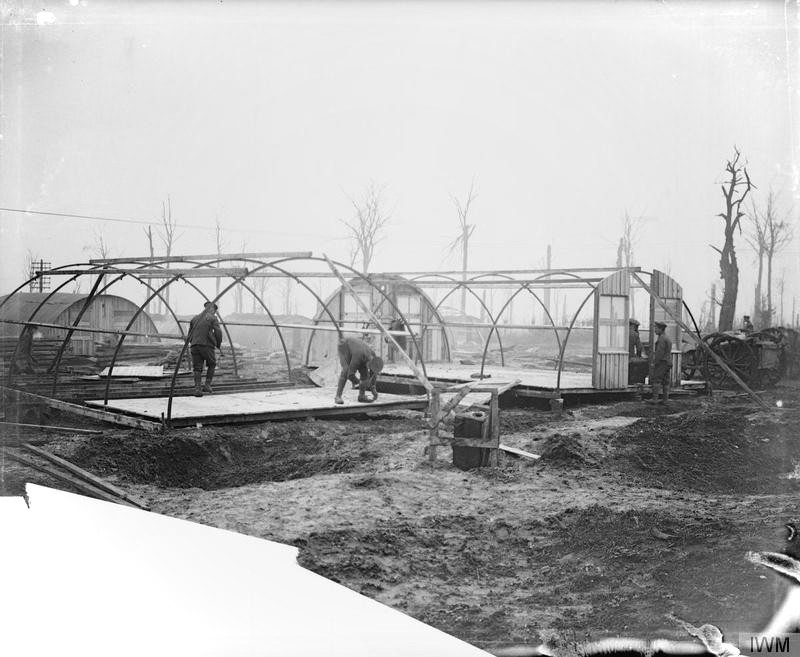
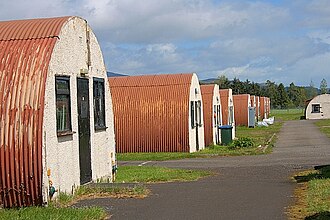
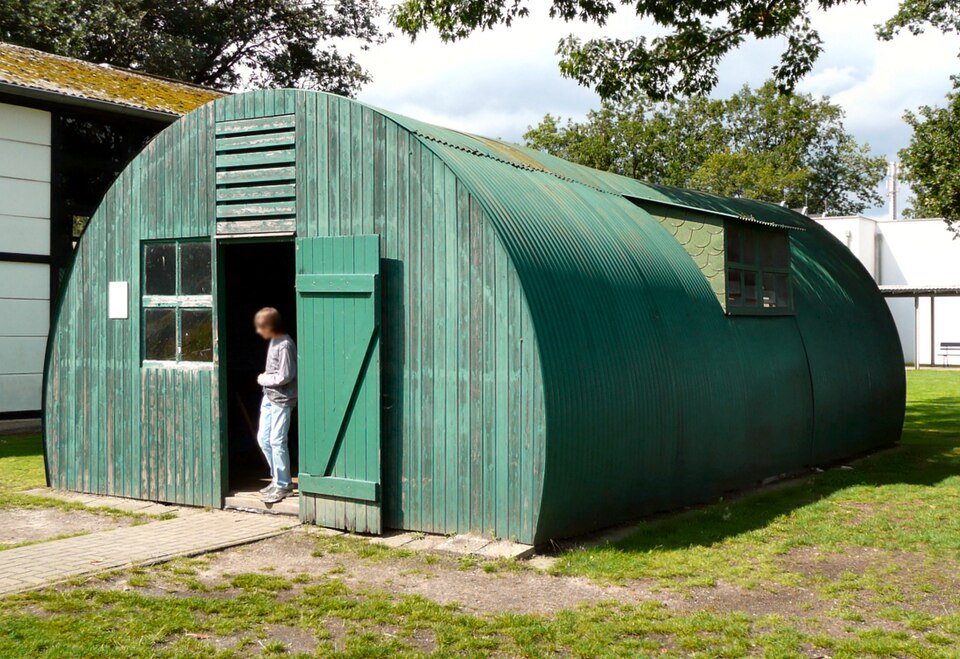
A Nissen hut is a prefabricated steel structure originally for military use, especially as barracks, made from a 210° portion of a cylindrical skin of corrugated iron placed over a steel and wood frame. It was designed during the First World War by Major Peter Norman Nissen. It was also used extensively during the Second World War and was adapted as the similar Quonset hut in the United States.
A Nissen hut is made from a sheet of metal bent into half a cylinder and planted in the ground with its axis horizontal. The cross-section is slightly more than a semi-circle so that the bottom of the hut curves inwards slightly. The exterior is formed from curved corrugated steel sheets 10 feet 6 inches (320 cm) by 2 feet 2 inches (66 cm), laid with a two-corrugation lap at the side and a 6-inch (15 cm) overlap at the ends. Three sheets cover the arc of the hut. They are attached to five 3-by-2-inch (76 mm × 51 mm) wooden purlins and 3-by-2-inch (76 mm × 51 mm) wooden spiking plates at the ends of the floor joists.
The purlins are attached to eight T-shaped ribs (1+3⁄4 by 1+3⁄4 by 1⁄8 inch [44.5 mm × 44.5 mm × 3.2 mm]) set at 6-foot (1.8 m) centres. Each rib consists of three sections bolted together using splice plates, and each end is bolted to the floor at the bearers. With each rib are two straining wires, one on each side, and a straining ratchet (or in some cases a simple fencing-wire strainer). The wires are strained during construction. The straining wires do not appear in the original Nissen patent.
The purlins are attached to the ribs using a "hook" bolt, which hooks through a pre-drilled hole in the rib and is secured into the purlin. The hook bolt is a unique feature of the Nissen design.
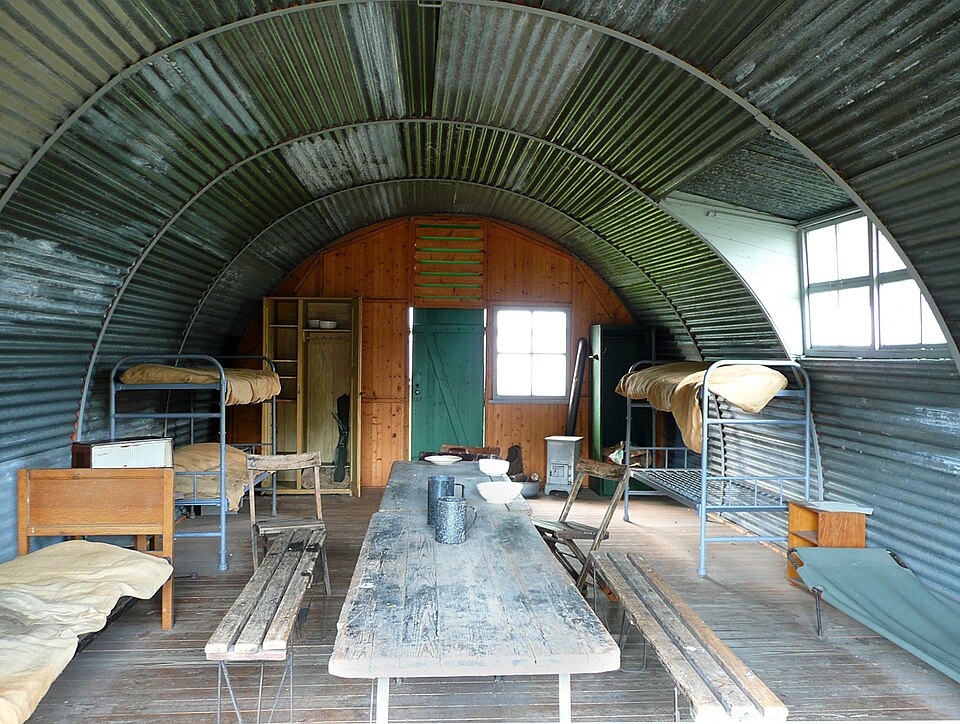
Interior lining could be horizontal corrugated iron or material like hardboard attached to the ribs. Sometimes corrugated asbestos cement sheeting was used.[1] If required, the space between the lining and the exterior may be used for insulation and services.
The walls and floors rest on foundations consisting of 4-by-4-inch (10 by 10 cm) stumps with 15-by-9-inch (38 by 23 cm) sole plates. On these are 4-by-3-inch (10.2 by 7.6 cm) bearers and 4-by-2-inch (10.2 by 5.1 cm) joists at 34-inch (86 cm) centres. The floor is made from tongue-and-groove floorboards.
At each end the walls are made from a wooden frame with weatherboards nailed to the outside.
Windows and doors may be added to the sides by creating a dormer form by adding a frame to take the upper piece of corrugated iron and replacing the lower piece with a suitable frame for a door or window.
Nissen huts come in three internal spans (diameters)—16 ft (4.9 m), 24 ft (7.3 m), and 30 ft (9.1 m). The longitudinal bays come in multiples of 6 ft (1.8 m), allowing the length of the cylinder to be any multiple of that.[2]
The corrugated steel half-circles used to build Nissen huts can be stored efficiently because the curved sheets can be cupped one inside another. However, there is no standard model of Nissen hut, because the design was never static and changed according to demand.[1] ...
https://powerbiltbuildings.com/quonset-huts/nissen-huts
Nissen Huts
Nissen huts have a unique history that connects them to a renewed sense of freedom. Initially developed by the British during World War I, these huts served as an affordable and efficient option for housing equipment, operations, and soldiers. Today, they continue to be used by the military as barracks. The affordability and versatility of Nissen huts have helped them to remain relevant even in the modern era, where they’re used for sheltering valuable possessions and providing extra space for activities