rexresearch
Timo SIUKKOLA
Sand Battery
Sand Battery
https://www.thestorage.fi/post/hot-sand-for-a-cooler-climate
Hot sand for a cooler climate: scalable sand-based heat storage cuts industrial emissions by up to 90%
Sand as the industry’s green energy bank
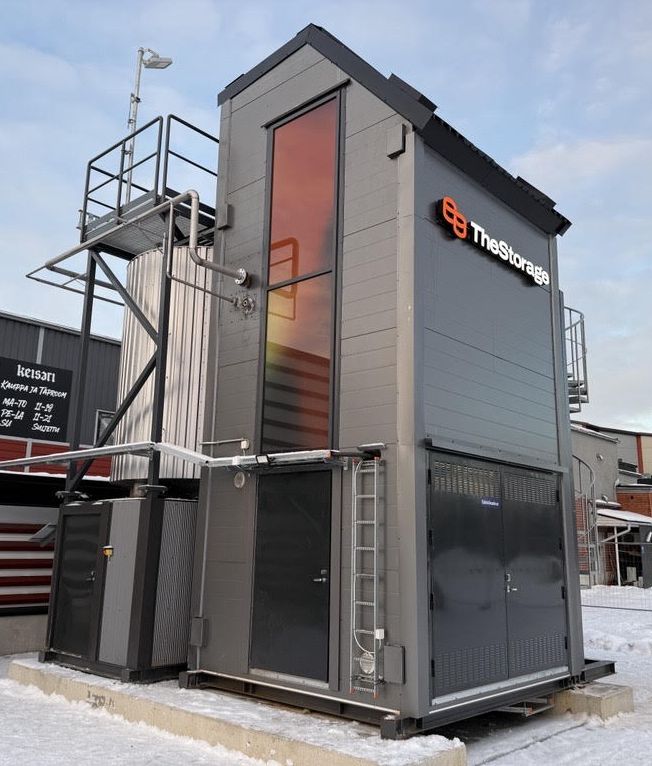
TheStorage’s technology captures electricity when it is abundant and cheap, converts it intohigh-temperature heat, and stores it in sand. This stored heat can be used in industrial processes independently of real-time electricity availability. “Companies have wanted to decarbonize for years, but viable solutions simply weren't available. Finally, renewable energy generation can meet industrial heat demand in a way that's both ecologically sound and economically practical,” says Timo Siukkola, CEO of TheStorage.
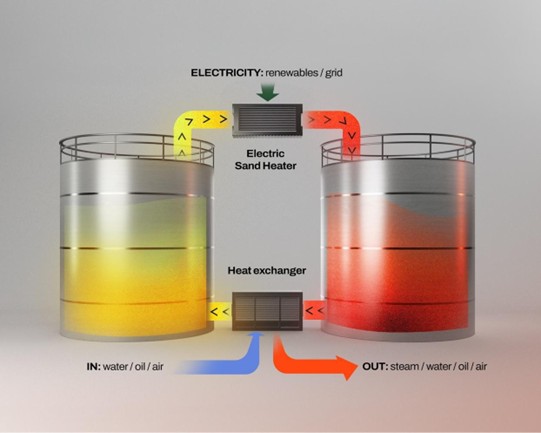
The principle of the sand-based heat storage is simple. The proprietary technology stores heat in ordinary sand using two insulated silos, an electric heater, and a heat exchanger.
Cool sand moves from a cold silo to an electric heater, reaching temperatures up to 800°C. The heated sand is then stored in a hot silo, where energy is efficiently retained in stationary sand. By circulating the sand through an external heat exchanger, the system delivers steam with up to tenfold higher heat transfer efficiency compared to conventional static storage systems.
Thestored heat can be released on-demand as steam or thermal oil, providing stable power that can be quickly adjusted to match demand. The solution is scalable from 20 to 500 MWh with charging power from 1 to 20 MW, depending on industrial needs. The technology allows fully flexible operations in both charging and discharging.
Fossil-free industrial heat is central to achieving EU climate goals, which target a 90% emissions reduction by 2040 and full carbon neutrality by 2050. For companies, these targets are no longer long-term aspirations - they are increasingly concrete obligations: the Corporate Sustainability Reporting Directive (CSRD) requires large and medium-sized companies to report on energy use and emissions, while the EU Emissions Trading System (ETS) makes fossil fuel use increasingly expensive.
"Heat emissions now appear simultaneously in sustainability reports, energy costs, and customer requirements," Siukkola explains. Pressure comes not only from regulation, but also from international corporations, which increasingly require suppliers to demonstrate measurable emission reductions under the Science Based Targets initiative (SBTi)."This forces industrial companies to reconsider how they produce heat to remain competitive in global supply chains," Siukkola concludes.
PATENTS
Inventor: SIUKKOLA TIMO
Applicant: BUFFER SOLUTIONS
A DISCHARGING DEVICE AND A METHOD FOR AN ENERGY STORAGE SYSTEM
FI20245073 // WO2025153774
A discharging device utilizes solid particles (5), for example sand particles, which are heated by the electric power from the renewable energy power plant. The solid particles (5) are fluidized by gas from a static solid-like state to a dynamic fluid-like state. The discharging device has multiple adjacent heat transfer modules (11 - 18), which are each partially separated by a module wall (21 - 27). The module wall (21 - 27) between adjacent heat transfer modules has an opening (31 - 34) in the module wall (21 - 27) to allow the fluidized solid particles (5) to travel to adjacent heat transfer module (11 - 18). The fluidized solid particles (5) travel horizontally from the particle inlet via adjacent heat transfer modules (11 - 18) and through said opening (31 - 34) to the particle outlet (59) of the last heat transfer module (14, 15, 18).
A METHOD FOR STORING HEATED PARTICLES AND A PARTICLE CONTAINER FOR AN ENERGY STORAGE SYSTEM
WO2025153775
An energy storage system utilizes solid particles that are heated by the electric power from the renewable energy power plant. A particle container comprises a cylindrical particle chamber (10) for storing particles (5), that are heated for example at a heat exchanger of the energy storage system. The particle chamber walls (11) are made of a refractory material. Between the particle chamber walls (11) and the support wall (13) is a space (12) that is filled with solid particles (6). These solid particles (6) are purposed to stay in said space (12), and act as an insulation for the particle chamber (10) and to provide flexibility to accommodate the thermal expansion of the particle chamber (10).
A HEAT EXCHANGER AND A METHOD FOR AN ENERGY STORAGE SYSTEM
FI131819
A heat exchanger utilizes solid particles (5), for example sand particles, that are heated by the electric power from the renewable energy power plant. The solid particles (5) are fluidized by gas from a static solid-like state to a dynamic fluid-like state. The heat exchanger has multiple adjacent heat transfer modules (11 - 18), that are each partially separated by a module wall (111, 121, 131, 141). The module wall (111, 121, 131, 141) between adjacent heat transfer modules has an opening in the module wall to allow the fluidized solid particles (5) to travel to adjacent heat transfer module (11 - 18). The fluidized solid particles (5) travel horizontally from the particle inlet (41) via adjacent heat transfer (11 - 18) modules and through said opening to the particle outlet (42) of the last heat transfer module