Maria SHVEDOVA, et al.
ABT-263 Wound Healing
ABT-263 Wound Healing
https://www.sciencedaily.com/releases/2026/09/260922223008.htm
Breakthrough drug reverses skin aging and dramatically speeds healing
A drug that clears away aging, damaged cells may help older skin heal wounds faster.
A drug designed to remove aging, damaged cells may help older skin recover from wounds more quickly, according to research published in Aging (Aging-US).
The study, titled "Topical ABT-263 treatment reduces aged skin senescence and improves subsequent wound healing," examined a drug called ABT-263 and its effects on wound repair in older mice.
Researchers Maria Shvedova, Rex Jeya Rajkumar Samdavid Thanapaul, Joy Ha, Jannat Dhillon, Grace H. Shin, Jack Crouch, Adam C. Gower, Sami Gritli, and Daniel S. Roh from the Boston University Aram V. Chobanian and Edward Avedisian School of Medicine found that applying ABT-263 directly to aging skin reduced the number of damaged cells associated with aging and significantly improved subsequent healing...
The researchers applied ABT-263 to the skin of aged mice for five days. After treatment, the skin showed fewer signs of cellular senescence.
The scientists then created small wounds and monitored how quickly they healed.
The difference became substantial. By day 24, 80% of the mice treated with ABT-263 had completely healed wounds. Among untreated aged mice, only 56% had fully healed by the same point.
The results suggest that removing senescent cells before an injury may leave aging skin better prepared to launch an effective repair response.
One of the more surprising findings involved inflammation.
Treatment with ABT-263 temporarily increased inflammatory activity in the skin. Although prolonged inflammation can interfere with healing, a controlled inflammatory response is also a normal and important early stage of wound repair.
In this case, the brief increase appeared to help activate the skin's repair machinery, allowing it to respond more rapidly once a wound occurred.
ABT-263 also increased the activity of genes involved in rebuilding damaged tissue. These included genes associated with collagen production and the formation of new blood vessels...
Another potential advantage was the way the treatment was delivered. Rather than giving ABT-263 orally, researchers applied it directly to the skin. Local treatment could potentially reduce exposure elsewhere in the body and avoid some of the side effects associated with oral senolytic drugs.
https://www.aging-us.com/news-room/abt-263-treatment-rejuvenates-aged-skin-and-enhances-wound-healing
https://www.sciencedaily.com/releases/2026/05/260519003215.htm
Breakthrough drug reverses aging in skin and dramatically speeds healing
An anti-aging skin treatment helped older mice heal wounds dramatically faster by clearing out damaged “zombie” cells.
Scientists have discovered that a topical anti-aging drug called ABT-263 can dramatically improve wound healing in older skin. The treatment works by removing damaged “senescent” cells that accumulate with age and slow the body’s repair process. In aged mice, wounds healed much faster after treatment, while the drug also activated genes tied to collagen production and tissue regeneration.
https://pmc.ncbi.nlm.nih.gov/articles/PMC11810067/pdf/aging-17-206165.pdf
Aging, 2024; 17 (1): 16
DOI: 10.18632/aging.206165
Topical ABT-263 treatment reduces aged skin senescence and improves subsequent wound healing.
Maria Shvedova, et al.
[ PDF ]
ABSTRACT -- Senescent cells accumulate in aging tissues, impairing their ability to undergo repair and regeneration following injury. Previous research has demonstrated that targeting tissue senescence with senolytics can enhance tissue regeneration and repair by selectively eliminating SnCs in specific aged tissues. In this study, we focused on eliminating senescent skin cells in aged mice to assess the effects on subsequent wound healing. We applied ABT-263 directly to the skin of 24-month-old mice over a 5-day period. Following topical ABT-263, aged skin demonstrated decreased gene expression of senescence markers p16 and p21, accompanied by reductions in SA-β-gal- and p21-positive cells compared to DMSO controls. However, ABT-263 also triggered a temporary inflammatory response and macrophage infiltration in the skin. Bulk RNA sequencing of ABT-263-treated skin revealed prompt upregulation of genes associated with wound healing pathways, including hemostasis, inflammation, cell proliferation, angiogenesis, collagen synthesis, and extracellular matrix organization. Aged mice skin pre-treated with topical ABT-263 exhibited accelerated wound closure. In conclusion, topical ABT-263 effectively reduced several senescence markers in aged skin, thereby priming the skin for improved subsequent wound healing. This enhancement may be attributed to ABT-263-induced senolysis which in turn stimulates the expression of genes involved in extracellular matrix remodeling and wound repair pathways.
https://pmc.ncbi.nlm.nih.gov/articles/PMC12813340/
Mater Today Bio. 2025 Dec 24;36:102741.
doi: 10.1016/j.mtbio.2025.102741
Senolytic-loaded asymmetric wound dressing for targeted senescent cell clearance in diabetic wound healing
Ming Zhang, et al.
[ PDF ]
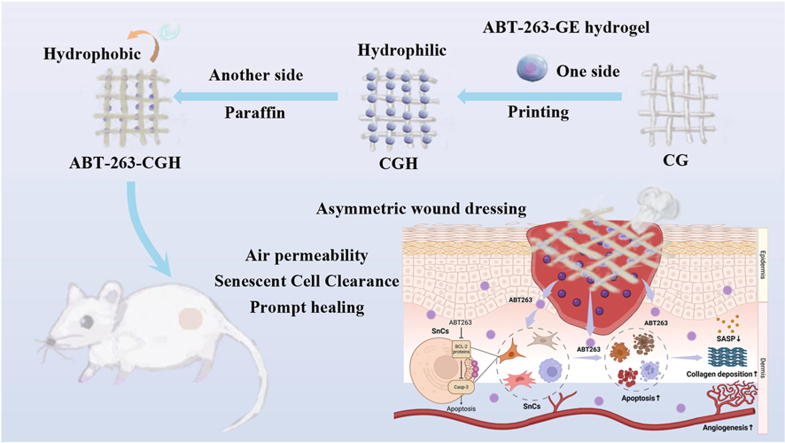
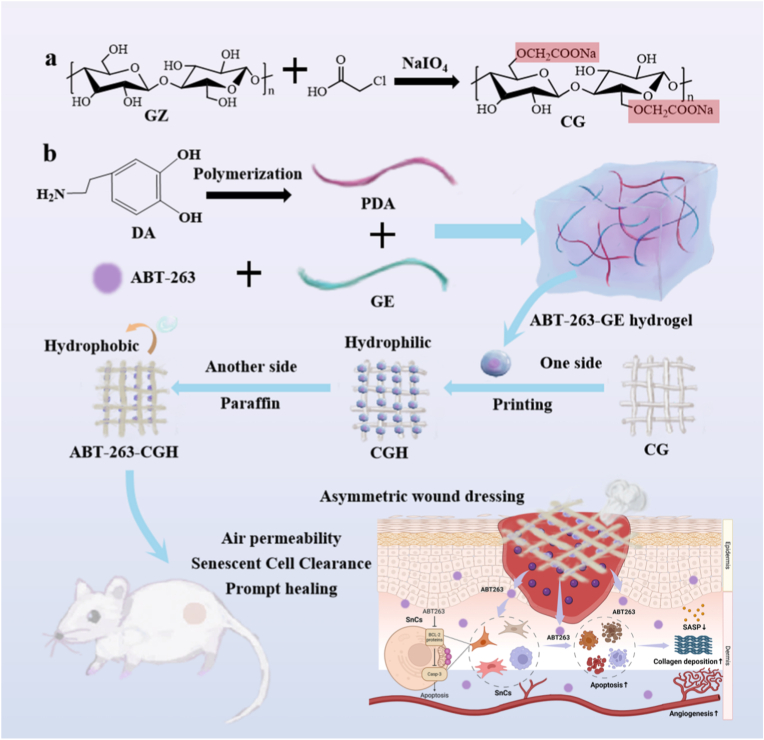
Abstract -- Chronic wounds, especially diabetic foot ulcers, pose a major clinical challenge due to persistent inflammation, impaired angiogenesis, and cellular senescence. Senolytic therapies, which selectively eliminate senescent cells, have shown promise in promoting healing, but systemic toxicity limits their application. To address this, we developed an asymmetric fabric-based composite platform for localized senolytic delivery. Using single-cell RNA sequencing, we characterized senescence-associated alterations in human diabetic foot ulcer tissues and screened several senolytic candidates in skin fibroblasts and endothelial cells. Among these, navitoclax (ABT-263) emerged as the most effective senolytic. Incorporating ABT-263 into the fabric-based platform to prepare ABT-263-CGH, we confirmed its ability to reduce senescent cell burden while maintaining biocompatibility. In a diabetic mouse model, the ABT-263-CGH significantly enhanced wound healing, reduced senescence markers, and exhibited no detectable systemic toxicity. These findings highlight the potential of localized senolytic therapy using an asymmetric fabric-based wound dressing as a novel strategy for enhancing chronic wound healing, offering a promising therapeutic avenue for diabetic wound management, and paving the way for future clinical applications.
...Senolytic agents, a class of drugs designed to induce apoptosis in SnCs selectively, have emerged as a promising therapeutic approach for improving chronic wound healing [6]. Among them, ABT-263, a Bcl-2 family inhibitor, has demonstrated potent senolytic activity by effectively clearing SnCs and attenuating SASP-related inflammatory responses [7]. However, the systemic administration of ABT-263 has been associated with dose-limiting toxicities, particularly thrombocytopenia, which significantly constrains its clinical application [8]. Consequently, localized delivery systems represent a more advantageous alternative, enabling targeted therapeutic action while effectively minimizing systemic adverse effects [9]...
This study investigates the potential of an asymmetric fabric-based platform as a localized delivery system for the senolytic agent ABT-263 in chronic wound healing. To characterize cellular senescence in diabetic wounds, we examined skin tissues from patients with DFU and healthy individuals using single-cell transcriptomic analysis, senescence-associated β-galactosidase (SA-β-Gal) staining, as well as immunochemical detection of key senescence markers. To identify an optimal senolytic candidate, we evaluated the cytotoxicity and senescence-clearing effects of ABT-263, Dasatinib, Fisetin, Quercetin, and A1155463 in skin fibroblast and endothelial cell lines. The selected senolytic candidate was used to prepare an asymmetric wound dressing, and the wound healing performance was evaluated through a streptozotocin (STZ)-induced diabetic mouse model. This study highlights the promise of integrating senolytic therapy with biomaterial-based delivery platforms as a novel approach for accelerating wound repair in diabetic patients and lays the groundwork for future clinical applications (see Scheme 1)...
5. Conclusion
In conclusion, our study explores the potential of fabric-based asymmetric wound dressing loaded with senolytic agents, specifically ABT-263, to enhance chronic wound healing. By integrating materials science, cell biology, and animal science, we evaluated the efficacy and safety of this novel therapeutic approach in both in vitro and in vivo models. Our findings demonstrate the feasibility of this strategy in promoting wound healing by targeting the burden of SnCs in chronic diabetic wounds. By targeting cellular senescence, this dressing can enhance tissue regeneration and promote faster, more efficient wound closure. However, successful clinical translation will require further preclinical and clinical studies to determine optimal dosage, safety profiles, and long-term efficacy. Future research should also focus on optimizing the hydrogel formulation, characterizing the release kinetics of senolytic agents, and validating their effectiveness in various settings, such as by enhancing responsiveness to environmental stimuli like pH, light, and heat through the combination with other biomolecules or upgrading to a smart gel system. This innovative approach has the potential to revolutionize chronic wound management by addressing the cellular mechanisms underlying impaired healing, ultimately improving patient outcomes and reducing the healthcare burden associated with chronic wound care.
ABT-263 Patents
1. ABT-263 and ICG entrapped pH/light dual-response cancer specific targeting nano-drug delivery system -- CN122516129 2026-08-07
2. Application of Bcl-xL, Bcl-2 and Bcl-w inhibitors in preparation of drugs for treating eyelid sebaceous gland cancer --CN122140723 2026-06-05
3. Bionic hybrid lipidosome co-loaded with senlytic drug and antibiotic as well as preparation method and application of bionic hybrid lipidosome -- CN122123978 2026-06-02
4. Phase-change controlled-release multi-stage implantable brain drug delivery device and preparation method thereof -- CN122005422 2026-05-12
5. ABT-263-loaded drug delivery system as well as preparation method and application thereof -- CN120732784 2025-10-03
6. Application of ABT-263 in preparation of medicine for treating inflammation, tissue damage and fibrosis caused by virus infection -- CN120713910 2025-09-30
7. Preparation method of engineered multipotent macrophage for pulmonary fibrosis treatment -- CN120022294 2025-05-23
8. COMBINATIONS OF ARTEMISININS, BCL-2 INHIBITORS, AND KINASE INHIBITORS FOR CANCER TREATMENT -- WO2024238821 (A2) 2024-11-21
9. Model for predicting prognosis risk of colon cancer based on anoikis-related genes and construction method thereof --CN118841092 2024-10-25
10. Nanoparticle with core-shell structure, drug-loaded bionic coating, intravascular stent and preparation method -- CN117815464 2024-04-05
11. Pharmaceutical composition containing Bcl-2 inhibitor and STAT inhibitor -- CN117257959 2023-12-22
12. Pharmaceutical composition for synergistically treating acute myelogenous leukemia -- CN115737822 2023-03-07
13. Beta-galactosidase activated ABT-263 prodrug as well as preparation method and application thereof -- CN115505016 2022-12-23
14. Bcl-2 Composition containing B-cell lymphoma 2 inhibitor for anti-aging and whitening -- KR20220068031 2022-05-25
15. APPLICATION OF ABT-263 IN PREPARATION OF DRUG FOR INHIBITING CORNEAL TRANSPLANT IMMUNE REJECTION -- WO2023024664 2023-03-02
16. COMBINATIONS COMPRISING BH3-MIMETIC COMPOUNDS AND INHIBITORS OF EARLY STAGES OF AUTOPHAGY FOR USE IN THE TREATMENT OF NON-HODGKIN'S B-CELL LYMPHOMAS AND LYMPHOID AND/OR MYELOID LEUKEMIAvS -- WO2021152467 2021-08-05
17. USE OF BCL-2 INHIBITOR AND PHARMACEUTICAL COMPOSITION FOR TREATING AGING-RELATED SKIN DISEASE -- WO2022105511 2022-05-27
18. Application of ABT-263 combined angiotensin converting enzyme inhibitor and product of ABT-263 combined angiotensin converting enzyme inhibitor -- CN112826822 2021-05-25
19. METHODS AND COMPOSITIONS FOR TREATING UVEAL MELANOMA -- US20240122938 2024-04-18
20. TREATMENT OF SPINAL CORD INJURY -- WO2021052962 2021-03-25
21. Application of combination of chidamide and BCL2 inhibitor in double-expression B-cell lymphoma -- CN112274509 2021-01-29
22. AGENT FOR TREATING OR PREVENTING GRAFT-VERSUS-HOST DISEASE -- JP2020111548 2020-07-27
23. Combinations of artemisinins, BCL-2 inhibitors, and kinase inhibitors for cancer treatment -- US2020129470 2020-04-30
24. Chemotherapeutic drug composition -- US2020061075 2020-02-27
25. Doxorubicin and ABT-263 double drug nano carrier and preparation method thereof -- CN108159022 2018-06-15
26. Mdm2 inhibitors and combinations thereof -- AU2019204938 2019-07-25
27. TREATMENT OF LEUKEMIA WITH ARTEMISININ DERIVATIVES AND COMBINATIONS WITH OTHER ANTINEOPLASTIC AGENT -- US2016175331 2016-06-23
28. METHODS OF TREATING CANCER WITH A COMBINATION OF GLUCOSE MODULATORS AND BCL-2 INHIBITORS -- US2016113925 2016-04-28
29. COMBINATION THERAPY COMPRISING NANOPARTICLES OF A TAXANE AND ALBUMIN WITH ABT-263 IN METHODS FOR TREATING CANCER -- US2017202782 2017-07-20
30. Panel of micrornas that silence the MCL-1 gene and sensitize cancer cells to ABT-263 - US8742083 2014-06-03
31. INHIBITION OF MCL-1 AND/OR BFL-1/A1 -- US2015051249 2015-02-19
32. Combined medicament for treating cancers -- CN102836160 2012-12-26
33. Pharmaceutical composition for treating prostate cancer comprising resveratrol analogue HS-1793 or pharmaceutically acceptable salts thereof -- KR20120099540 2012-09-11
34. Synthesis method of 4-(4-((2-(4-chlorophenyl)-5,5-dimethyl cyclohexyl-1-polyprolene) methyl) diethylenediamine-1-radical) benzoic acid -- CN102584744 2012-07-18
35. Isoxazoline derivatives as antiparasitic agents -- NZ606194 2013-12-20
36. A PROCESS FOR THE PREPARATION OF THE APOPTOSIS PROMOTER ABT-263 -- ZA201008890 2011-09-28
37. ABT-263 CAPSULE -- US2011159085 2011-06-30
38. ABT-263 CRYSTALLINE FORMS -- US2011071151 2011-03-24
39. STABLE NANOPARTICULATE DRUG SUSPENSION -- US2010323020 2010-12-23
40. SOLID DISPERSIONS CONTAINING AN APOPTOSIS-PROMOTING AGENT -- US2010311751 2010-12-09
41. Pharmaceutical dosage form comprising a solid dispersion product of abt-263v IL216494 2016-03-31
42. SOLID ORAL FORMULATION OF ABT-263 -- US2010278921 2010-11-04
43. SALT OF ABT-263 AND SOLID-STATE FORMS THEREOF -- US2010305125 2010-12-02
44. LIPID FORMULATION OF APOPTOSIS PROMOTER -- US2010280031 2010-11-04
45. STABILIZED LIPID FORMULATION OF APOPTOSIS PROMOTER -. US2010278905 2010-11-04
46. FORMULATION FOR ORAL ADMINISTRATION OF APOPTOSIS PROMOTER -- US2010297194 2010-11-25
47. Method for preparing novel Bc1-2 protein inhibitor derived from ABT-263 -- CN101798292 2010-08-11
48. A PROCESS FOR THE PREPARATION OF THE APOPTOSIS PROMOTER ABT-263 -- EP2307393 2011-04-13
49. ORAL COMPOSITIONS OF ABT-263 FOR TREATING CANCER -- EP2219651 2010-08-25
50. METHOD OF TREATING ARTHRITIS -- RU2012143212 2014-04-20
51. Synthesis of compound ABT-263 -- CN101220008 2008-07-16
The invention discloses a synthetic method for a compound ABT-263, which essentially comprises the following steps: a compound 5 reacts with a compound 9 under a basic condition to derive a compound 13; the compound 13 and a compound 12 are dissolved in dichloromethane to react by adding EDCI and DMAP for 24 hours at a room temperature; the compound ABT-263 is derived via spin drying, watering, acetic ether extraction, drying, condensing, and column chromatographic separation. The invention adopts different starting materials, different synthetic courses, easier available raw materials and methods, and improves the oxidation method of 2-fluoro sulfide phenyl trifluoromethyl; thereby avoiding the pollution of large amount of heavy metal to the environment, as catalytic amount of chromic anhydride is adopted, the yield is improved from 17 percent to 90 percent; in additional, as the adoption of Mannich reaction shortens the reaction steps, the yield is improved.
CN102584744 -- Synthesis method of 4-(4-((2-(4-chlorophenyl)-5,5-dimethyl cyclohexyl-1-polyprolene) methyl) diethylenediamine-1-radical) benzoic acid
The invention relates to an improved synthesis method of the intermediate carboxylic acid segment [4-(4-((2-(4-chlorophenyl)-5,5-dimethyl cyclohexyl-1-polyprolene) methyl) diethylenediamine-1-radical) benzoic acid] of an anticancer compound molecule ABT-263. The synthesis method mainly solves the problems of complicated operation, low yield and high synthesis cost of the existing synthesis method. The synthesis of the intermediate carboxylic acid segment of ABT-263 comprises the following steps: step 1, the reaction takes 4,4-dimethyl cyclohexanone as a raw material to react with phosphorus tribromide, dichloromethane and N,N-dimethylformamide mixed solution, so 2-bromine-5,5-dimethyl cyclohexyl-1-yl-formaldehyde 2 is generated; step 2, reduction reaction: a compound 2 undergoes the reduction reaction under the action of sodium borohydride to generate the corresponding alcoholate; step 3, bromination reaction: the alcoholate undergoes the bromination reaction under the action of phosphorus tribromide to generate the corresponding bromide; and step 4, the reaction is that: the bromide and 4-(diethylenediamine-1-radical) benzoic acid t-butyl ester are subjected to the substitution reaction to generate the intermediate 4-(4-((2-bromine-5,5-dimethyl cyclohexyl-1-alkenyl) diethylenediamine-1-radical) benzoic acid t-butyl ester, and after the Suzuki reaction of a step 5 and the hydrolysis reaction of a step 6, the corresponding carboxylic acid intermediate is generated.