Yifat BARUCH, et al.
3,3--DiIndolylMethane (DIM) vs Streptococcus
3,3--DiIndolylMethane (DIM) vs Streptococcus
https://pubmed.ncbi.nlm.nih.gov/37370336/
Antibiotics (Basel). 2023 Jun 6;12(6):1017.
doi: 10.3390/antibiotics12061017.
3,3'-Diindolylmethane (DIM): A Potential Therapeutic Agent against Cariogenic Streptococcus mutans Biofilm
Yifat Baruch, et al.
[ PDF ]
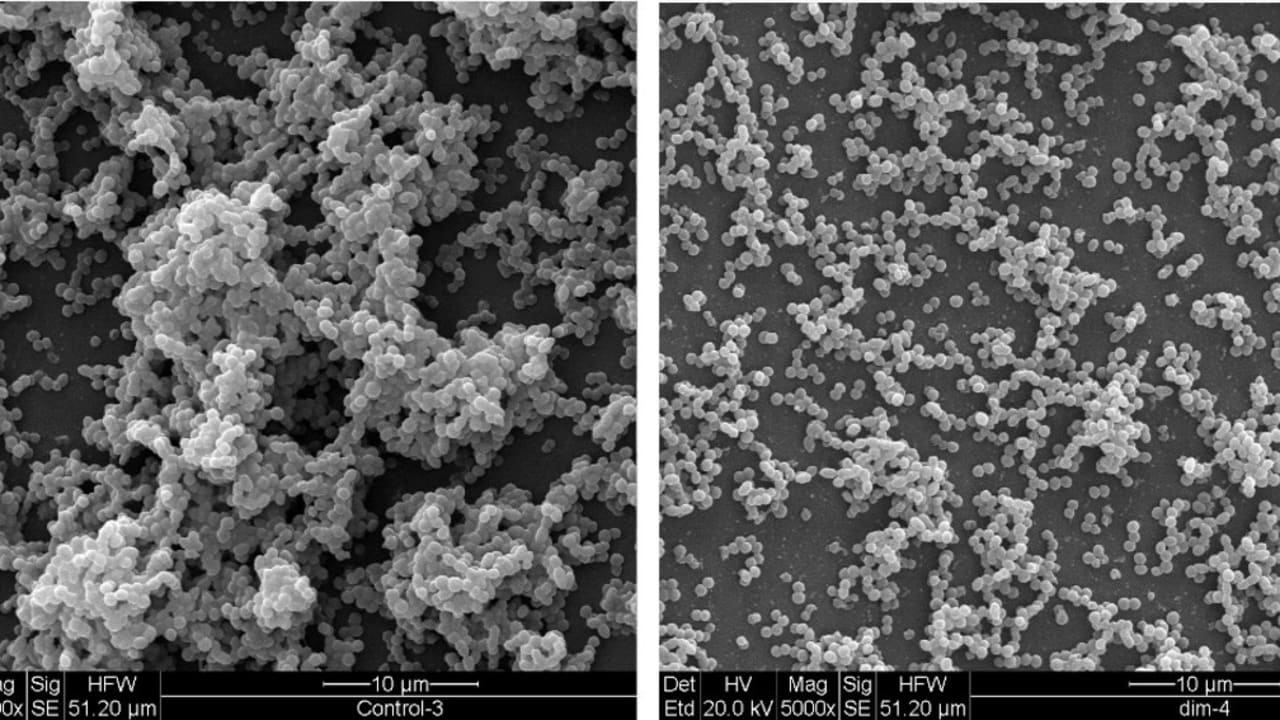
Abstract -- Indole, a metabolite of the amino acid tryptophan, has been proven to act as a signal molecule in bacteria, acting in different aspects of biofilm formation. The oral biofilm is a type of biofilm that has consequences for human health. It is a complex, three-dimensional structure that develops on the surface of teeth via the attachment of primary microbial colonizers. Many oral infections are caused by an imbalance occurring in the microorganisms naturally found in oral biofilms and are considered major public health concerns. In this study, we test the effect of a natural bis-indole, 3,3'-Diindolylmethane (DIM), in mitigating the pathogenicity of the oral biofilm inhabiting bacterium Streptococcus mutans, a bacterium that is considered to be a principal etiological agent in dental caries. Our study found that DIM was able to attenuate S. mutans biofilm formation by 92%. Additionally, treatment with DIM lowered extracellular polymeric substance (EPS) production and decreased its durability significantly under acidic conditions. Therefore, the anti-biofilm and anti-virulence properties of DIM against S. mutans bacteria in an "oral setting" provides evidence for its usefulness in reducing biofilm formation and potentially for caries attenuation.

https://en.wikipedia.org/wiki/3%2C3'-Diindolylmethane
3,3′-Diindolylmethane (DIM)
3,3′-Diindolylmethane (DIM) is a compound derived from the digestion of indole-3-carbinol, found in cruciferous vegetables, such as broccoli, Brussels sprouts, cabbage and kale.[1] It and its parent compound – indole-3-carbinol – are under laboratory research to determine their possible biological properties, particularly in anti-cancer mechanisms.[1][2] DIM is sold as a dietary supplement.[1]
Properties
In vitro, DIM has action as a histone deacetylase inhibitor,[1] specifically against HDAC1, HDAC2, and HDAC3.[3] DIM is a metabolite of indole-3-carbinol. [4]
DIM was found to be a mild cannabinoid agonist with low binding affinity for both CB1 and CB2.[5][6]
A study conducted in 2023 by researchers from Ben-Gurion University of the Negev, in collaboration with teams from Sichuan University and the National University of Singapore, found that DIM can reduce biofilms responsible for dental plaque and cavities by 90%.[7] As of 2025, no clinical trials have been conducted that confirm the effectiveness of DIM in reducing plaque.
https://www.jpost.com/health-and-wellness/article-748213
A natural molecule in toothpastes and mouthwash could help prevent plaque and cavities
The molecule 3,3'-Diindolylmethane (DIM) developed in Beersheba and in Singapore, reduced Streptococcus mutans biofilm by 90%.
...Scientists at Ben-Gurion University of the Negev (BGU) in Beersheba and their colleagues at Sichuan University and the National University of Singapore have discovered that 3,3'-Diindolylmethane (DIM), a naturally occurring molecule – also known as bisindole – reduces the biofilms that produce plaque and cavities by 90%. The molecule is also found to have anti-carcinogenic properties...
INDOLE DERIVATIVES FOR BIOFILM DISRUPTION AND INHIBITION -- US2021338637
Inventor: GOLBERG KARINA, KUSHMARO ARIEL
Abstract -- A method for inhibiting biofilm formation by bacteria on a surface or disrupting existing biofilm on a surface, comprising contacting said surface or existing biofilm with at least one compound selected from the group consisting of 2-(indolin-2-yl)-1H-ind, di(1H-indol-3-yl)methane and 1,1′-biindole, is provided.
Composition for inhibiting biofilm formation and antibacterial against Gram-positive bacteria and fungi comprising indole derivatives -- KR20230106223
Abstract -- The present invention relates to a composition containing indole derivatives as active ingredients for suppressing biofilm formation and inhibiting bacteria against at least one species selected from a group consisting of gram-positive bacteria and fungi. More specifically, indole-3-carbinol has an effect of suppressing biofilm formation without causing cell death of gram-positive acne (C. ances), Staphylococcus aureus (S. aureus) and Candida albicans (C. albicans) that cause skin inflammation and troubles, and 3,3'-diindolylmethane (DIM) exhibits strong antibacterial and antibiofilm activity against the bacteria and enhances the antibacterial activity of antibiotics through co-use with the antibiotics. Accordingly, the composition containing indole-3-carbinol or 3,3'-diindolylmethane as active ingredients may be provided as antimicrobial agents, antibiotic adjuvants or antibiofilm compositions, and may be provided as cosmetic compositions for improving skin inflammatory diseases.
https://nathanandsons.com/blogs/news/how-dim-works-with-minerals-and-oral-care?srsltid=AfmBOoqhx9aBOPW5stSPdfOOHXzWkqQG2LePR4iK3zsx33QDi3fkbyod
How Does DIM Work? What the Research Says About Diindolylmethane
...DIM does not exist preformed in cruciferous vegetables. It is created during digestion. When you chew cruciferous vegetables — broccoli, kale, cauliflower, cabbage, Brussels sprouts — the enzyme myrosinase comes into contact with glucobrassicin stored in the plant cells.
This converts glucobrassicin into indole-3-carbinol. Indole-3-carbinol then undergoes condensation reactions in the acidic environment of the stomach — with approximately 60 percent converting into DIM.
A 2024 review published in Annual Reviews confirmed that DIM is formed by the condensation of two molecules of indole-3-carbinol — and that both compounds alter multiple signaling pathways controlling diverse cellular events including oxidation, inflammation, and immunity.
This formation process matters because it explains both DIM's bioavailability challenges and why supplemental DIM differs from dietary DIM obtained through whole food consumption....
https://www.sciencedirect.com/science/article/pii/S2213453022000556
Antibiofilm activity of 3,3'-diindolylmethane on Staphylococcus aureus and its disinfection on common food-contact surfaces
Hui Zhang, et al.
[ PDF ]
Abstract -- This study explored the antibiofilm efficacy of 3,3’-diindolylmethane (DIM) on Staphylococcus aureus andits disinfection on common food-contact surfaces. The minimum biofilm inhibitory concentration (MBIC) of DIM on S. aureus was 62.5 μmol/L, while it did not impede the bacterial growth evaluated by growth curve and XTT reduction assay. DIM in the concentration range of 31.2−62.5 μmol/L demonstrated a dose-dependent antibiofilm activity to S. aureus, as confirmed by light microscopic (LM), confocal laser scanning microscopic (CLSM), and scanning electron microscopic (SEM) analyses. At DIM of 62.5 μmol/L, the biomass of S. aureus biofilm was significantly reduced by 97% and its average thickness by 58% (P < 0.05). DIM of 62.5 μmol/L inhibited the bacterial initial adhesion and proliferation, as well as cell motility; the release of extracellular DNA (eDNA) and extracellular polysaccharide (EPS) were reduced by 75% and 69%, respectively. DIM exhibited a strong inhibition to S. aureus biofi lm formation on common food-contact surfaces, including 304 stainless steel, glass, and polyvinyl chloride (PVC) but not disperse the mature biofi lm. Overall, our investigation identified DIM as a promising antibiofilm agent and its suitability to prevent the biofilm formation of S. aureus on common food-contact surfaces utilized during food processing.
Synthetic method of 3, 3 '-diindolylmethane -- CN115784964
Abstract -- The invention discloses a synthesis method of 3, 3 '-diindolylmethane, and relates to the technical field of organic synthesis. Indole and formaldehyde are used as raw materials, and water is used as a reaction solvent to synthesize the target product 3, 3 '-diindolylmethane under the action of a phase transfer catalyst and a catalyst 4-dimethylaminopyridine. The reaction route provided by the invention is high in reaction rate, the use of an organic solvent is avoided, relatively harsh reaction conditions such as ultrasonic waves are not needed, and the method is a green organic synthesis technology; the yield and purity of the finally obtained product are high, and industrialization is facilitated.
Green preparation process of 3, 3-diindolylmethane -- CN113880748
Abstract -- The invention provides a green preparation process of 3, 3-diindolylmethane, which comprises the following steps of: S1, by taking indole and formaldehyde as raw materials and cyanuric acid as a catalyst, adding the raw materials into acetone for reaction to prepare crude 3, 3-diindolylmethane; and S2, carrying out recrystallization on the crude 3, 3-diindolylmethane prepared in the step S1 by using ethanol, so as to obtain purified 3, 3-diindolylmethane. Compared with a method using a traditional catalyst, the method provided by the invention has the advantages of mild reaction conditions, very small catalyst dosage and reusability of the solvent.
Evaporation device for extracting 3, 3-diindolylmethane -- CN213853119
Abstract -- The utility model relates to the technical field of evaporation equipment, in particular to an evaporation device for extracting 3, 3-diindolylmethane, which comprises an evaporation device main body, an evaporation plate arranged in the evaporation device main body, a stirring device arranged at the bottom of the evaporation device main body and a heating device arranged on the evaporation plate, the evaporation plates comprise a plurality of right evaporation plates and a plurality of left evaporation plates, the left evaporation plates and the right evaporation plates are arranged in a staggered mode, and the stirring device comprises a stirring shaft arranged at the bottom of the evaporation device body, stirring paddles arranged on the stirring shaft and a driving motor arranged at the bottom of the stirring shaft. The stirring paddle is arranged above the bottom surface of the evaporation device main body, the heating device comprises a heating pipe, one end of the heating pipe is arranged inside the evaporation plate, and the other end of the heating pipe is arranged outside the evaporation device main body. The device can effectively increase the contact area and contact time of materials and the evaporation plate, can effectively improve the heating evaporation efficiency of the materials, and improves the production efficiency of equipment.
Method for simultaneously extracting indole-3-methanol and 3,3'-diindole methane -- CN110541015
Abstract -- The invention provides a method for simultaneously extracting indole-3-methanol and 3,3'-diindolylmethane, and belongs to the field of plant extraction. The method comprises the following steps of: subjecting the obtained fresh sample of edible organs of cruciferous vegetables to vacuum freeze drying, performing crushing to obtain a dried sample, respectively mixing the fresh sample or the dried sample with a citric acid-phosphate buffer solution, performing enzymolysis reaction to obtain enzymolysis solution, performing extraction with ethyl acetate, drying the obtained supernatant by evaporating, mixing the obtained extract with potassium dihydrogen phosphate-dipotassium phosphate buffer solution, adding ethanol to saturate indole-3-methanol, performing standing to obtain a 3,3'-diindolmethane solution and an indole-3-methanol extract, and respectively performing evaporating to obtain the 3,3'-diindolmethane and the indole-3-methanol. The method takes edible organs of cruciferous vegetables as raw materials to realize simultaneous extraction of the indole-3-methanol and the 3,3'-diindole methane.