David HAMEL
Gravitomagnetic Drive
Gravitomagnetic Drive
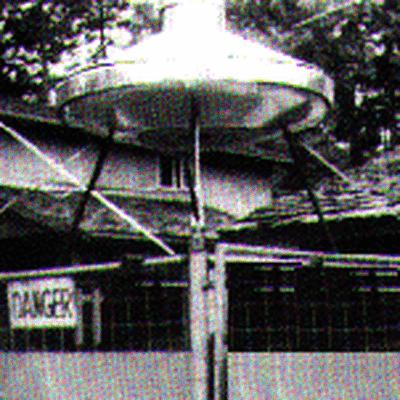
The Original Hamel Spaceship
Stuff Stories: A Flying Saucer
by Matthew Hayes
Growing up, I heard stories from my mom about a friend-of-a-friend-of-a-friend, a reclusive and eccentric man who had had a strange encounter years before. This man carried a mixed reputation in his community of Gilmour, Ontario, halfway between Toronto and Ottawa. His thick French Canadian accent made him hard to understand. Weird stuff happened around him and he had a huge workshop that sometimes caused electrical blackouts. Who was he and what was he doing?
His name was David Hamel and he was building a flying saucer.
In 1975, Hamel lived in Maple Ridge, BC. One day, he was watching TV–his favorite show, Bonanza–in his living room with his wife, Nora. Suddenly, the screen went fuzzy and extraterrestrial beings emerged and took him up and away in their spacecraft to see their distant planet. Hamel returned to Earth a changed man. He was driven. He immediately began construction on his own spacecraft, a task that would occupy him for the next 30 years.
In 2019, I made a 15-minute documentary film about Hamel. He claimed that the TV aliens had given him special knowledge that would allow him to obtain a source of clean energy to save the world from its environmental crises–that is, to save humanity from itself, which is a common theme in UFO history. As early as the 1950s, UFO “contactees” were preaching about the need for nuclear disarmament and world peace, making the connection between runaway technology and the harms it caused to the planet.1 These claims were always built on environmental concerns about the potential annihilation of Earth, the (inexplicable) use of natural elements and forces in UFO propulsion, and even the strange interactions UFOs had with flora and fauna. For Hamel, building his flying saucer was just the first step in harnessing the awesome power of the cosmos. Hamel died in 2012. Until his death, he claimed that he had succeeded, but the flying saucer had flown off into the sky of its own accord. Was Hamel a visionary or a crank?
The best way for me to answer these questions about Hamel is to try to sit on the fence and look around.2 What do we see when we look at the boundary between real and unreal, visionary and crank? How can it help us teach a more nuanced story about an otherwise unconventional subject?3 How do we make this story relevant to today’s environmental concerns? One thing that intrigued me about Hamel’s story is the “stuff” of it. Some of Hamel’s stuff is obvious in the short film: the remnants of a flying saucer prototype, Hamel’s colourful blueprints, and a mysterious gelatinous cone.
But the stuff of UFOs and aliens is usually intangible, ephemeral, and beyond our ability to see or experience, such as the “special knowledge” Hamel was given by the TV aliens. I’ve come to consider this as its own kind of stuff because the theme of specialized knowledge from faraway planets appears often in UFO accounts. There are other types of non-stuff too, such as the forces of electromagnetism and gravity (and its corollary, anti-gravity), long-favored candidates in the UFO community to explain the motive force behind flying saucers.4 This intangibility of UFO stuff is what fascinates and continues to inspire wonder. But it can also cause confusion and conflict for believers as they try to convince others.5 Famously, scientists have ignored, debunked, and lampooned UFOs for just this reason: there’s no stuff to study.6
So then, what continues to motivate some believers in UFOs and aliens? Like members of certain religious groups, some UFO believers have faith that salvation is coming. They wait for benevolent aliens to arrive from distant planets to bestow us with their advanced, planet-and-society-saving technology. When Hamel started working on his flying saucer in the mid-1970s, that salvation was often framed in environmental terms. In the early 1950s, the environmental concern was about Cold War nuclear destruction, but by 1975 the world was in the grip of an energy crisis and the environmentalism movement was growing. We can track the development of ufology rhetoric over time, seeing how it is adapted to meet the needs of each new generation, to provide hope and alleviate concern about what we now might call “existential crises.”
David Hamel was convinced the aliens had chosen him to save the world from its woes, but he wasn’t the only UFO enthusiast who thought this way. UFO enthusiasts had long before articulated an environmental consciousness. For example, radiation and its effects on bodies and the planet has always been part of UFO lore, because a number of witnesses have described symptoms akin to radiation poisoning in the days after their UFO encounter and because radiation, while invisible, is nevertheless something scientists can measure and might take seriously as evidence of contact.7 UFO enthusiasts have also been convinced that the atomic bomb tests upset the balance of our world (politically and/or magnetically) and the wider intergalactic ecosystem, populated by any number of extraterrestrial species.
Stuff has also been a part of this lore, so long as we conceive it a bit more broadly than scrap parts from a flying saucer. UFOs and the fate of our planet have always been intertwined, because UFOs seem to show up when we’re dealing with intractable global problems. They tantalize us with the prospect of technology that might save us, the same way people might look to tech moguls in Silicon Valley.8 It’s just that the stuff of UFOs, like radiation from the atomic bomb, is usually invisible.9 Nevertheless, UFO stories like David Hamel’s help us see that aliens have always been a way for Earthlings to articulate fears and hopes that seem impossible to overcome or achieve otherwise. To solve huge problems on Earth, we look to the stars. Environmental problems are exactly this – too big for humans, but more than manageable for technologically advanced aliens.
https://open.spotify.com/episode/40nyV56qklmnZpZUN1GAh1
David Hamel's granite Saucer
According to him, the story starts in the 1970s when two extraterrestrials entered his home through his television set and took him aboard their spacecraft. While on board, he claims to have been taught engineering concepts unknown to mankind.
From that point on, David Hamel would dedicate nearly every cent and every moment he had trying to build a flying saucer with hopes of one day travelling to their planet.
In tonight's episode we will be joined by Dr. Matthew Hayes who directed a film about this story 'the Granite Man of Gilmour'
https://maisonneuve.org/article/welcome-future
Welcome to the Future
Eric Shinn
Twenty-nine years ago, during the global energy crisis of 1975, David Hamel was watching The Waltons on his home television in Maple Ridge, British Columbia, when two grey static pixels emerged from the screen and enlarged into alien beings on either side of him. They appeared to him as a humanoid male-female couple, although he admits that’s an arbitrary visualization his brain concocted when engaged telepathically by beings from another dimension.
They introduced themselves as “A” and Arkan, from the planet Kladen. They brought Hamel aboard their flying saucer—“They sent me through the roof!” is how he describes the paranormal out-of-body experience—where their androgynous android companion, On, illustrated how they travelled from their distant galaxy to Earth: their ship floated in an anti-gravity bubble powered by electrically charged vortical airflow between magnetic rings. It was, the aliens said, the same method they had used when they visited the ancient Egyptians prior to the construction of the great pyramids at Giza, when they turned up as three wise men in Bethlehem for the birth of Jesus and when they appeared to Third Reich scientists before World War II in an attempt to avert global military conquest.
On explained that the ship’s motor needed no fuel except the inherent magnetic forces that attracted and repelled its components. By varying the relative position of the magnetic rings, a vortex of charged air could be created intense enough to suck the ship through a surrounding electromagnetic disturbance, escaping gravity, radar and common sense. Hamel received a breathtaking fifteen-minute demo ride at hypersonic speed over the Canadian landscape, pausing only to hover over a man carrying a yoke laden with two buckets, who collapsed when he saw the ship overhead. Hamel was then instructed to do two things: develop the aliens’ technology on earth in order to save the human race from “the Grid” (the world’s asphalt-electrical network) and use it to build a survival ship like Noah’s Ark. At last, “A,” Arkan and On dropped Hamel back home into his body, and he emerged in the immersive flicker of his TV’s cathode static.
Though he says, “They’re in my body, my mind, I can’t get away from them,” Hamel’s next and final direct encounter with the aliens came just three months later, when they returned in a black car with red diplomatic licence plates. He admits to feeling a little hurt by that visit, because they ignored him and instead communicated for three hours with his wife Nora, whom they had in fact visited once before, six years earlier.
Back then, in 1969, David Hamel was training baton-twirling girls at the local Legion hall in Maple Ridge. Nora, who is unable to walk and has limited motor skills due to the cerebral palsy with which she was born in 1944, would sit in her wheelchair, enjoying the manoeuvres. The two struck up an understanding, with David’s horrific World War II trauma balanced by the pain Nora had suffered because of fourteen botched operations to mend her misshapen legs.
It was after one such surgery that the aliens came to Nora, comforting her during her recovery and, curiously, leaving angelica leaves on her hospital bed, in her hair and on the floor of her room.
Moved by her situation, David asked for Nora’s hand in marriage after several years of twirling courtship—to the disbelief of Nora’s family. “I thought for four days about it,” says Hamel, who still has three children from an ill-fated first marriage he embarked upon while on leave in Scotland after the war. “They were going to send Nora for more operations. She showed me what they’d done to her, those goddamn doctors. I said, No rotten bastards are going to cut her up again. So I decided to marry her.”
Still very much in love, David and Nora now live together in rural Gilmour, Ontario, a God-fearing, Twin Peaksesque hamlet in the Precambrian Shield forests south of Algonquin Park. Their modest two-storey home at the end of a dirt road is close enough to town that Hamel can drive in daily to get food, but far enough away that he can build and test flying saucers on his sprawling lightning-prone property without causing too much of a ruckus. NASA once came to visit him here after hearing of the six forty-five-gallon oil drums Hamel rocket-launched using motor prototypes developed immediately after his abduction, and of the power outages he continues to cause in the vicinity of his ongoing testing.
“I would work for NASA if they would listen to me, but they don’t!” he rants. Hamel is outspoken, independent, egomaniacal. He’s also a practical, hands-on guy, having received only an elementary-school education during his schoolboy days in 1930s Montreal. During the Cold War, he operated radios along the DEW (Distant Early Warning) Line in the Arctic and worked as a rock-cutter for a marble company that designed bank lobbies. “I’ll put the lights out for miles, then they’d listen, they’d know what I’ve got. The scientists come here, but they can’t accept the magnetic. They’d rather play around with nuclear rods, but they’re poison. There’s too much lying, too much greed. Everyone wants the truth, but they won’t find it, they won’t plant the seed, people are dying, the end is coming!”
Not all of Hamel’s neighbours approve of his ufological eschatology, but he doesn’t bother them at the local parish—televangelical Sunday service suits him just fine. Many know him as “the UFO guy,” who earlier this year escaped from a head-on collision with an oncoming truck while attempting to turn his car off the highway into the parking lot of a local restaurant. “I don’t know how he survived that,” says the restaurant owner incredulously. “He sure is stubborn.”
But wouldn’t you be stubborn if the signs were everywhere? After David and Nora moved here from British Columbia in 1980, they found—left behind in the attic by the previous occupant—a yoke matching the one carried by the man Hamel saw from the saucer. And patterns of angelica leaves identical to those left behind for Nora were discovered beneath their wallpaper during renovations.
Nowadays the Hamel home is a treasure trove of occult ephemera. Lining the living room wall (opposite the wood carvings of scenes from the Book of the Dead depicting what some believe are ancient Egyptians receiving radiation therapy from primitive electrode effigies) are blueprints for Hamel’s Ark of the Covenant—the Noah-inspired spaceship he hopes will carry survivors of the coming apocalypse. Hamel plans to launch the craft from a giant slab of granite rock near James Bay. Also hanging on the wall is a framed black-and-white airbrush illustration of a domed saucer hovering within a glowing aura, taken from a 1970s pulp sci-fi illustration. Hamel claims the illustration, in the form of undeveloped microfilm, was subcutaneously embedded in his palm following his original abduction. A stigma remains on his hand from the emergency surgery required to remove it.
David Hamel is an inventor. Not only of stories that just might be true, but also of machines that just might work. He is as much an artist as an engineer, weaving alternate realities from historical and scientific anomalies, sculpting metal according to intuited designs. He works alone or with friends in the backyard shed he built himself. He supports his wife on a meagre military disability pension, which he began receiving in the mid-1960s as compensation for crippling bullet wounds suffered during the Second World War.
As if the bureaucratic ineptitude of a twenty-year pension delay doesn’t irk him enough, Hamel knows he would now be rich if his magnet-related patent applications hadn’t been misfiled years ago. He can’t remember when, but he is sure he attempted to patent the process of magnetically aligning individual atoms within a lattice (an idea that is now a profitable emerging procedure in nanotechnology). So upset was he upon arriving at the Canadian Patent Office in Gatineau, Quebec, to find that his entire file had gone “missing” that he slammed cross-shaped vibrating magnets on the counter and had to be removed by police for causing a scene.
Life in Gilmour is not easy for the Hamels. At the start of every day, sixty-year-old Nora is hoisted out of bed by David, twenty years her senior, using a chain-link pulley system he’s rigged into the bedroom and bathroom ceilings. Then he purées her meals so she can feed herself through a large red straw while listening to the radio. An intimate and warm sense of humour helps keep their spirits up. “Oh, Nora, you’ve gone and made a mess again,” Hamel chides with mock seriousness while wiping food from her bib. Nora squeals with delightful denial, her face scrunching into a chagrinning “who, me?”
Both are serious when it comes to saucers. They see their situation as part of a ten-thousand-year legacy of alien contact all over the earth. They also know that David could get more work done on his Ark of the Covenant if Nora were put in a government home, but they tried that for a year a decade ago, and both lost their will to go on without the other’s compassionate support. Poor and crippled, but rich with ideas and love, the Hamels get by with a little help from their friends, and from God.
The Hamels attract all kinds of devotees. For many, a visit to David’s shed is a spiritual pilgrimage, a conspiracy confirmation and an environmentally friendly energy workshop all rolled into one. Many of these trips have been turned into fan fiction or film documentaries. The four-title Eyewitness series (available on VHS from www.world-famous.com) captures the true Hamel low-budget ethos, using a handheld camera to capture the man himself ranting and line drawings to explain the aliens’ technology.
The definitive text, though, is Jeanne Manning and Pierre Sinclaire’s The Granite Man and the Butterfly, an engaging retelling of Hamel’s abduction, philosophy and inventions. It forms the basis for Granite Starship, written by Paul Coulbeck. “He’s the bastard who copied my book,” says Hamel. Coulbeck stayed with Hamel for a week, then published the abductee’s life story—with all the relevant characters renamed and no credit given to Hamel. Bob Thomas of Arlington, Texas, hopes to set the record straight later this year in The Word Made Manifest Through Sacred Geometry: The Work of David Hamel, a book he co-authored with Hamel himself (Hamel ranted, Thomas wrote) following a two-month stay with the inventor.
On the Internet, the Hameltech Yahoo Internet group is ground zero for the inventor’s worldwide support network. Established in 2000, the forum is now home to over six hundred members, who pool their resources to realize Hamel’s vision. Core member Dan LaRochelle began networking with other Hamel fans online after reading about the enigmatic0engineer on the KeelyNet alternative energy website in 1997. A family man from Wethersfield, California, LaRochelle first visited Hamel seven years ago, while his wife was pregnant with their first child. Like Hamel, LaRochelle is a Christian, and he says he was “flabbergasted” when Hamel told him that the ship “A,” On and Arkan rode in was the Star of Bethlehem. “I’m not saying that’s exactly what happened,” he says, “but there’s something religious to it. The main message is that the world will be completely destroyed very soon, so you’ve got to build this survival ship otherwise humanity could be wiped out.”
“There are very powerful controlling factors in this world,” LaRochelle adds, “and they don’t want people to know this stuff.” Continuing, he muses about a potential conspiracy surrounding the recent mysterious murder of Gene Mallove, the editor of Infinite Energy magazine. “He was on the verge of a big discovery. We’re still forced to put gasoline in our cars and send the utility bill every month.”
LaRochelle has spread the Hamel gospel via his self-produced booklet “The Gods Have Returned,” which he has distributed at the Tesla Conference in Colorado Springs, Colorado, and at the Exotic Research Conference in Phoenix, Arizona. These events attract hundreds of participants annually from the diverse environmentalist “free energy” community. He admits to getting a lot of his facts wrong in the booklet.
Even the schematics LaRochelle correctly reproduced don’t yield working machines. He knows as many as forty people who have tried to build a forty-five-gallon oil drum device based on Hamel’s design—all unsuccessfully. “I had a friend spend $10,000. He stayed a month with Hamel. He’s a bullheaded guy, spent his life savings, his wife divorced him.”
Steve Hiscock, a forty-four-year-old magnet aficionado from Belleville, Ontario, has so far spent between $4,000 and $5,000 on an eight-inch model, which remains incomplete despite twelve years of active collaboration with Hamel. He says he’d need to spend another $5,000 to $7,000 to build a model two feet wide, the minimum size at which the motor can function. His lack of concrete, reproducible results notwithstanding, Hiscock feels the decade-long process of discovery has been an enriching experience. “I would consider myself a very spiritual person—in a metaphysical sense, not in a conventional orthodox religious way,” he says. “The concept of the technology is rooted in a very fundamental understanding of the nature of reality, which is spirituality.”
Hiscock is wary of the delusional ego Hamel is developing with age and fame, and understands that magnetic free-energy is considered fringe even among wind, solar, geothermal and cold-fusion advocates. Still, he believes that Hamel is onto something that, with proper development, could revolutionize power supply for the coming age. He notes that earlier this year inventor Mike Brady of Johannesburg claimed to have developed the first fully functional fuel-less magnetic motor after three decades of research and testing. Brady’s company, Perendev Power, has licensed a twenty-kilowatt generator model to German and Australian distributors. (A four-megawatt model exists in blueprint form.) According to Perendev, each twenty-kilowatt unit is capable of producing enough energy to power an average home; the cost of purchase would quickly be recuperated as the owner uploads excess power to the local network. Sounds great, but without publicly available information published in peer-reviewed scientific journals, this technology will remain relegated to the lunatic fringe, even if the products are commercially viable.
“What has to happen,” says Hiscock, “is that we need a mathematical model based on a working device, so people can understand and reproduce the idea.”
David Hamel’s story sets off every skeptic’s alarm bells. As it should: he advocates an alternate chronology of human evolution that traces our origins to pre-Sumerian alien ancestry. But with the vast quantity of data available these days drowning historical and scientific knowledge in a sea of disinformation, what—and who—do we believe? The revolutionary theosophical and historical revisionism advocated on mega-sites like www.bibleufo.com and www.violations.org.uk? Or their opposite, sites like www.badastronomy.com and www.skeptic.com, which pool the world’s hoax-debunking resources with equal force?
Hamel represents the ultimate consolidation of every cliché conspiracy into one major anti-establishment theory. He has become an official mascot for shifting, subjective, spiritually situated knowledge and action, as opposed to “objective” truth imposed by the orthodox establishment. In a way, he is a true contemporary of Linus Torvalds and Michael Moore. Like Linux vs. Microsoft, the battle Hamel is fighting pits open-source communal energy-sharing against top-down infrastructure. And like Moore vs. Bush, Hameltech vs. Big Oil is calculated satire. “Art is a lie that reveals the truth,” as Picasso said.
The Biblical David had only to throw a rock to kill Goliath. Hamel’s task in our world of spiralling chaos is far more daunting: how do you effectively throw the Book at today’s energy crisis? The technocrats keep the faith, Hamel argues, and we pay the price for their power—in our homes, our vehicles, all over our polluted planet. With the “oiligarchy” (on both Christian and Islamic sides of the fundamentalist fence) hell-bent on harnessing dwindling fossil fuel resources, Hamel—and the full spectrum of more moderate free-energy supporters inspired by his passion—are taking aim.
So if you feel you must treat Hamel’s messianic message as a crackpot UFO odyssey, fine. You won’t be alone. But Hamel would remind you that the Battle for Oil is a crackpot odyssey pursued with far more damaging messianic zeal. Hamel has been living on the brink of Armageddon for as long as he can remember, and he’s not about to wait for you to come around before trying to build a magnetic free-energy device that he believes can save the world from the tyranny of the Grid. If you feel you don’t need saving, that’s fine too. He hopes not to see you in hell.
EPILOGUE: DRESDEN
It was no ordinary blaze that engulfed Dresden, Germany, on February 13, 1945. Three waves of Allied bombers unleashed a precision-engineered firestorm on the city from above, killing between 25,000 and 135,000 people in a heat of such intensity that many died of suffocation before burning, as air was sucked from the ground as if by the bellows of a furnace.
Among the million-plus people then crowded into the city were thousands of Allied POWs, made famous by fellow prisoner Kurt Vonnegut, who science-fictionalized his fiery escape from Dresden in his novel Slaughterhouse Five. One of the POWs was Montrealer David Hamel, the firstborn of fifteen children, who in 1939, at the age of fifteen, joined the Canadian army because it was the only work he could find during the Depression. He landed at Dieppe and survived a bullet to his spine before eventually being captured and detained at Dresden in 1944.
When all hell broke loose that February night, Hamel says he fled his prison through a window and, using a horse blanket and metal wire taken from a barn, rigged himself a makeshift bed hung from the underside of a train headed for the drilling fields of Ukraine. After ten days of living off of stolen food, he smelled gasoline and noticed he was rumbling through a Nazi-held oil well zone, so he signalled with a flare to notify the Russians of this crucial bombing target. For this heroic feat, Hamel was awarded the Order of the White Eagle by the Russian military. Unfortunately, the medal was stolen from his burnt hands as he lay on a stretcher in Belgium, en route to Buckingham Palace.
A photomontage from his subsequent audience with King George VI now hangs on Hamel’s wall, ensuring he cannot escape the memory of Dresden. He won’t discuss his time as a prisoner, but he’s emphatic about what he saw while running from his prison to the train. “I looked up, and saw the ships join together in formation—one, two, three, four … the corners of a pyramid. And above them, I didn’t know what it was at the time, at the apex, I know now, was a flying saucer.”
http://jnaudin.free.fr/html/dhfsv1.htm
http://jnaudin.free.fr/html/dhpicts.htm
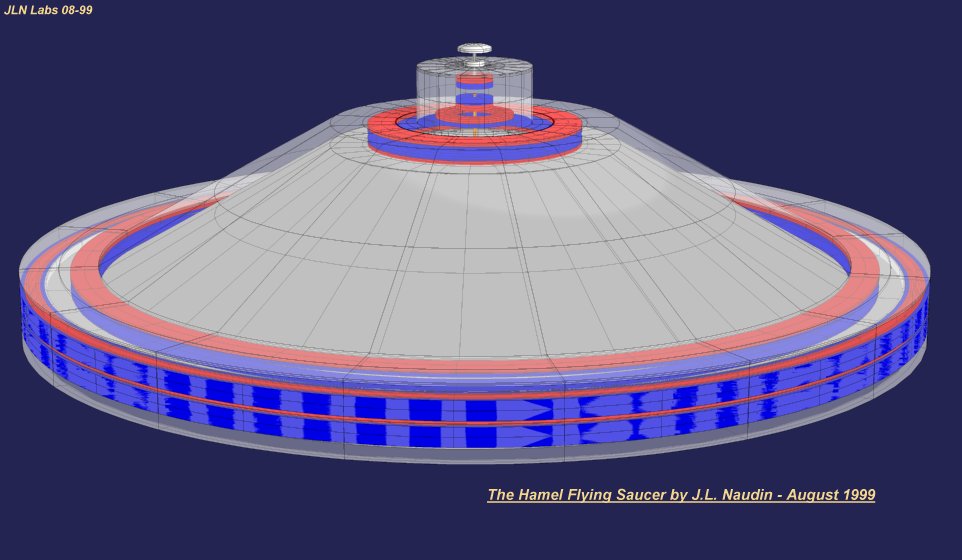
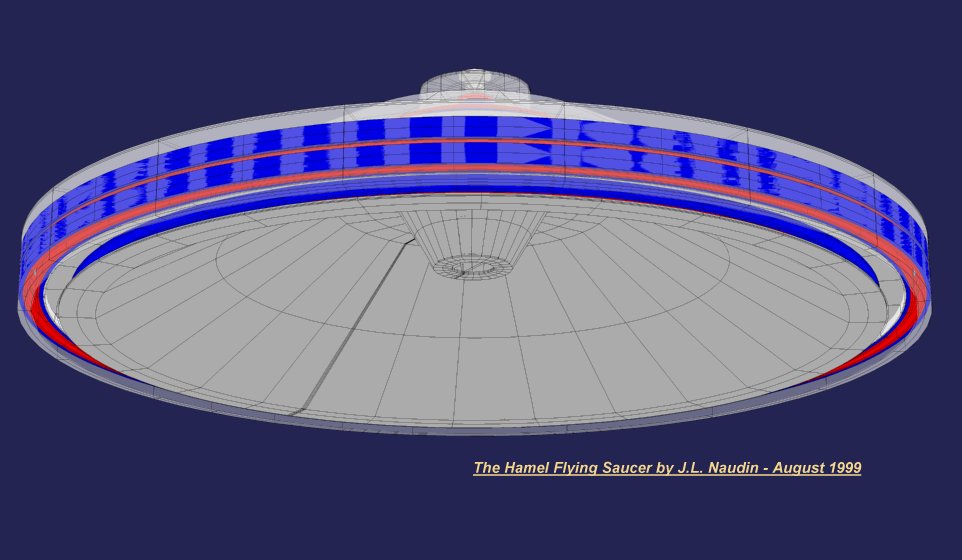
The Hamel Flying Saucer
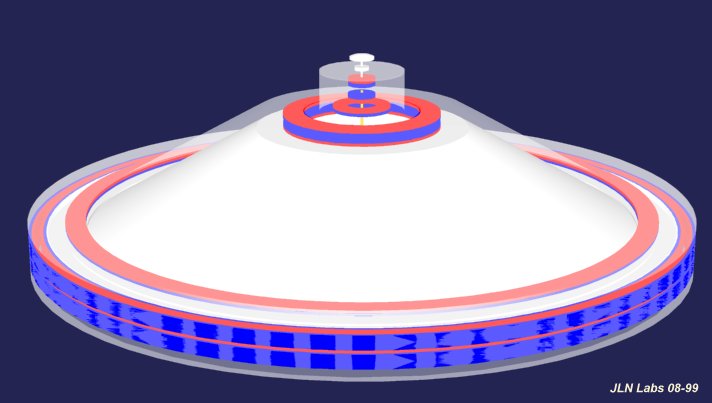
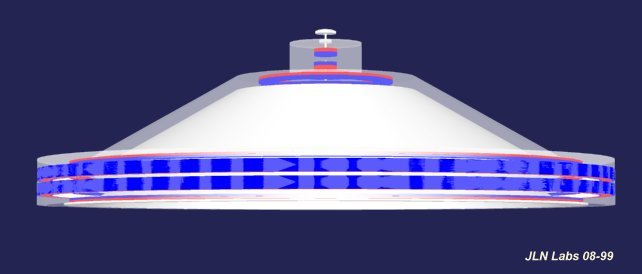
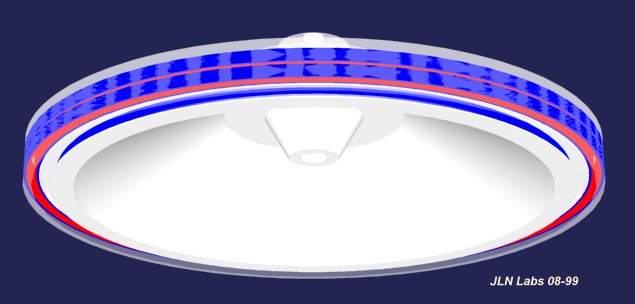
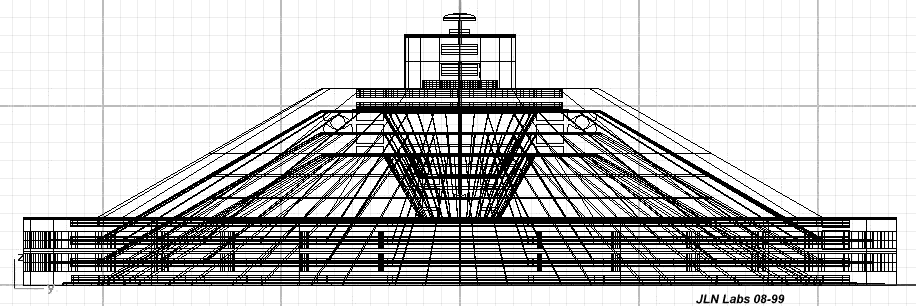
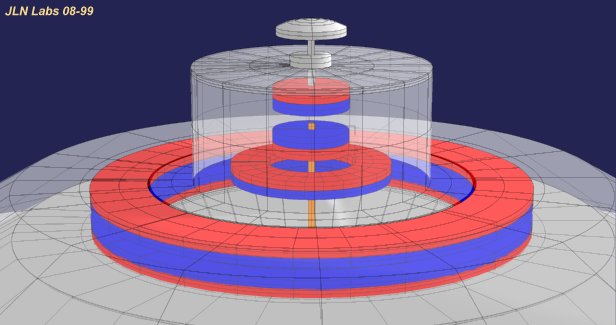
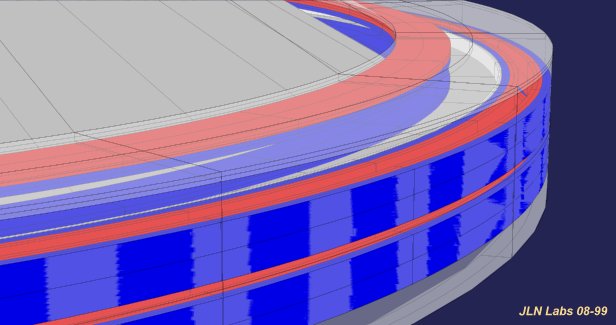
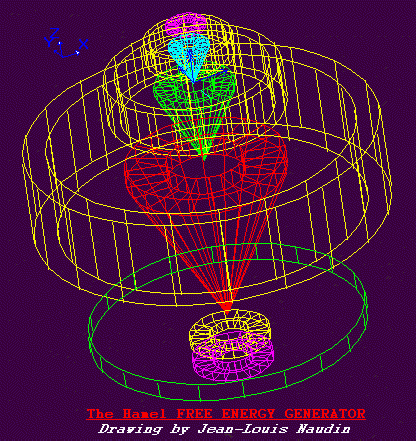
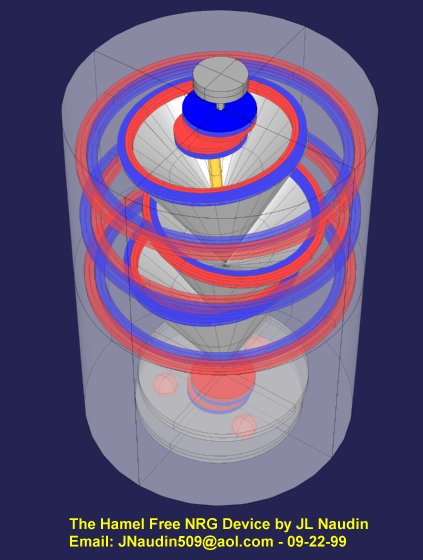
The Gravitomagnetic drive is the David Hamel Flying Saucer, these 3D designs are based on the original 2D diagrams courtesy of Dan La Rochelle.
http://jnaudin.free.fr/html/dhpicts.htm
Photo Gallery
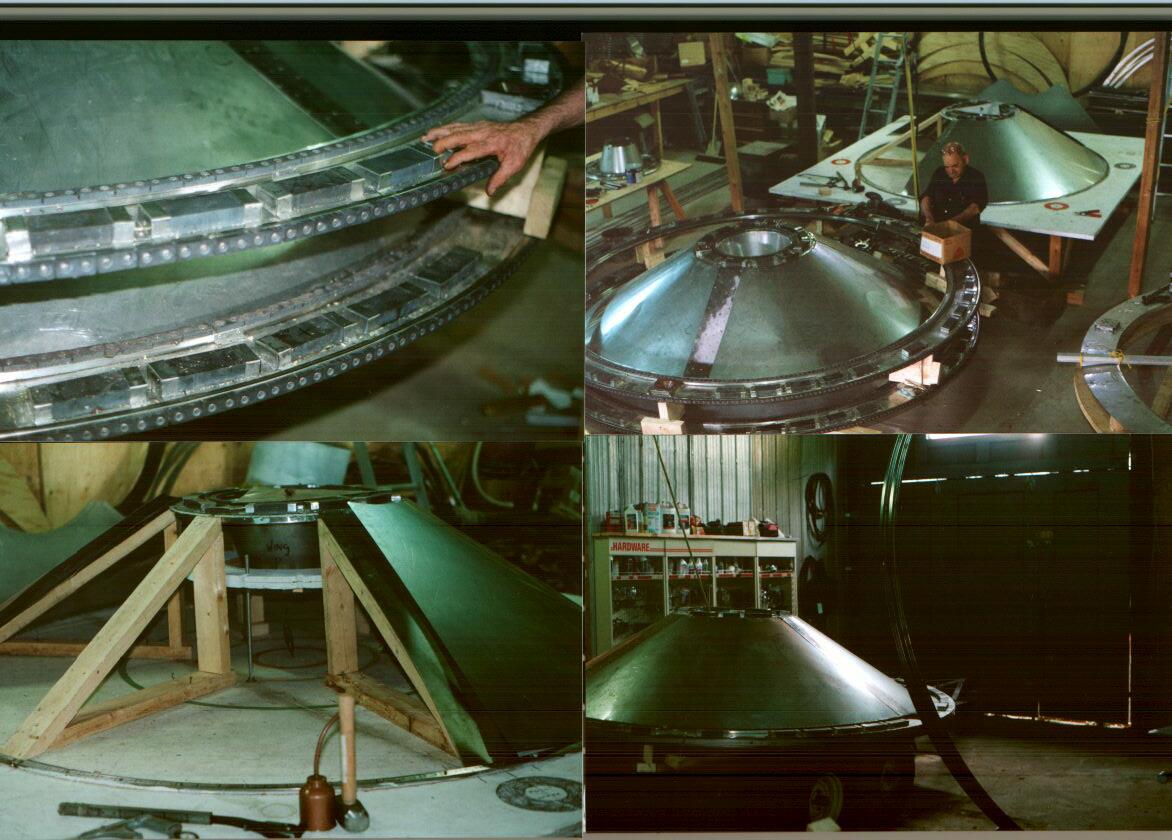
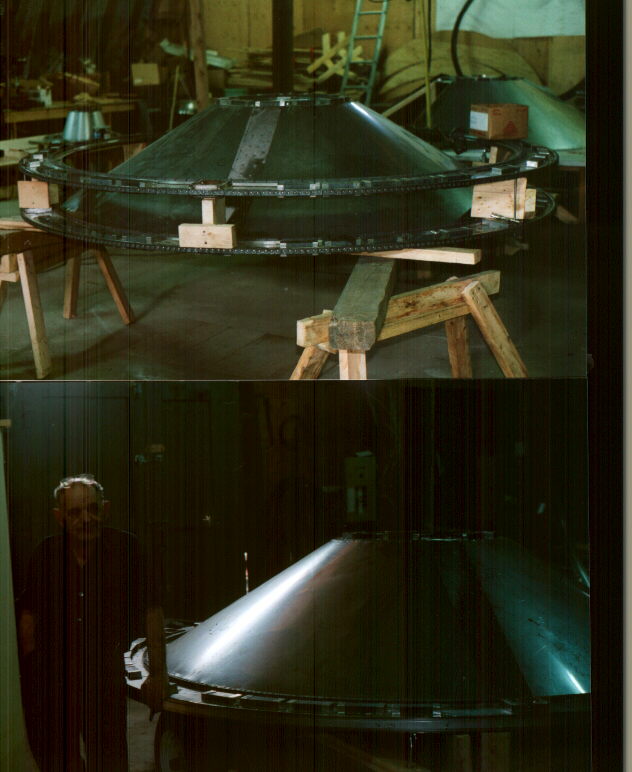
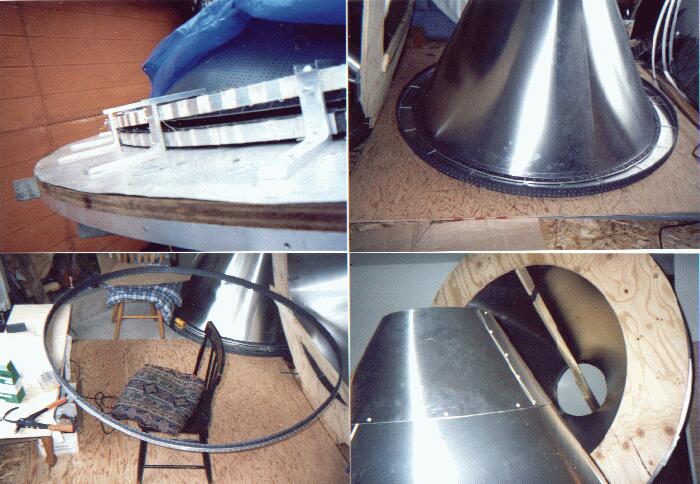
" The cone is all one piece. The horizontal wing surface is also one piece. Except for the top skin where I ran out of material I had to use two pieces attached to a piece of 3/4 inch plywood. There is also 3/4 inch plywood at the bottom with a three inch hole in the center and air holes around the bottom. There are no sections. The ribs on the horizontal wing portion are two 1/2 inch pieces of aluminum striping joined together with a brass screw and then glued with the 3m glue. They act as stiffeners. The cone stiffener is a round piece of 1/2 inch plywood half way down the cone and 1/2 inch aluminum strips from there to the horizontal portion of the wing. It's very light construction weighing only 34 pounds without the magnets, but sturdy and strong enough to hold the wings in place. It is my own design. " Tracy.
...
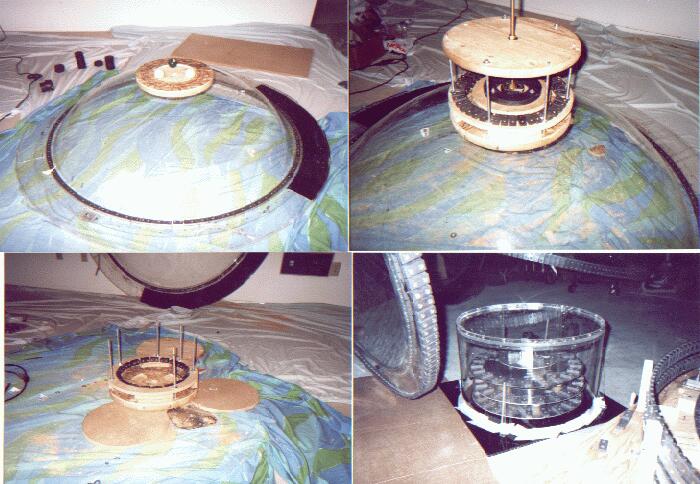
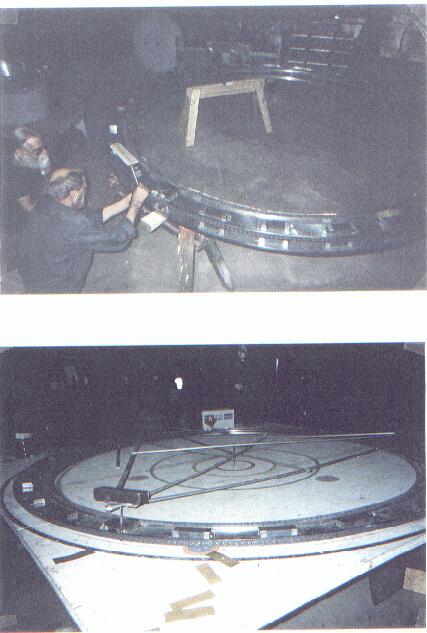
" The top pic shows the 2 x 4 x 6 inch magnets David had me install to give the wings more lift. There are 18 on one side of the wing and 18 on the underside each in rejection to each other held in place by the brackets. David had marked then all with a large N so I wouldn't get them mixed up. I was too busy trying to keep the damn things together and in place to notice what method he used to mark the magnets. The center part with the rod sticking up is to hold the wings in place. I welded a small bracket to each wing so the rod could slide all the way through when the wings were stacked. You can see the bottom part of the structure of which the bottom wing rests on. Stainless Steel channel was used to hold the magnets in place and all are the standard rectangle magnets from AZ Industries with the indentations facing towards the opposing magnets face to face. On the wing which you can't see is another row of magnets directly underneath the row that you can see. All of these are also indented side facing indented side in rejection.
The bottom pic shows the wing on the table before we moved it. " Tracy.
.....
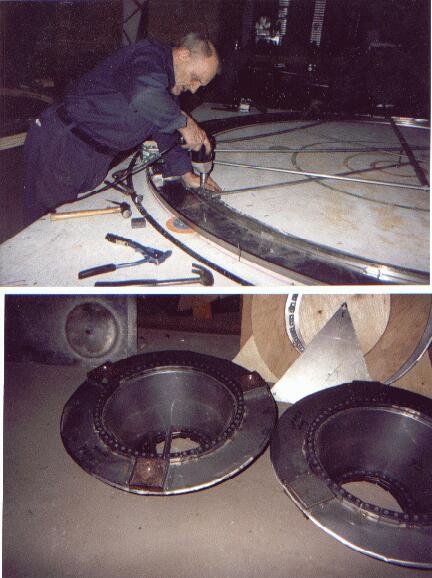
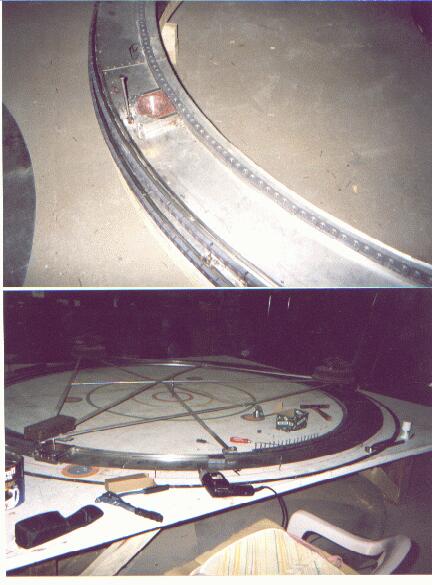
" Top photo shows where I welded the piece of pipe to hold the long spike that keeps the wings lined up so they don't move when assembling the rest of the machine. This is a very important item and must be done exactly or else the wings magnets will not be in rejection when the top wing is resting above the bottom wing. If the wings go to far from one side to the other the magnets will come into attraction and lock up. The length of this movement is restricted by the pinions. There are spikes in front of all three cups as pictured in the photo.
Bottom photo shows the rectangle magnets being placed on the bottom plate of the machine. You will notice there are no perimeter magnets at the very bottom or the very top leaving the two wings in between which has the perimeter magnets. The heavy looking rectangle piece on top of the cups is to hold the measuring triangle in place so that all magnets are placed exactly where they are suppose to go. All magnets are pop rivet with stainless steel pop rivets and you want to be sure to measure 3 or 4 times before you pop rivet that little puppy into place because they are very hard to grind off should you make a mistake." Tracy.
The Hamel's Drum under construction
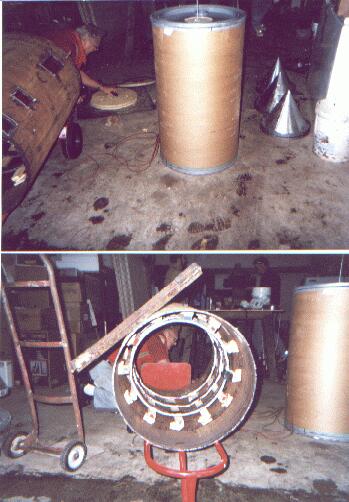
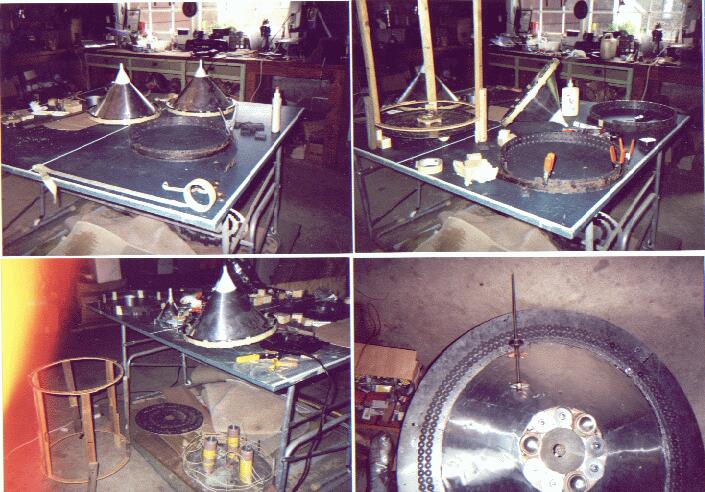
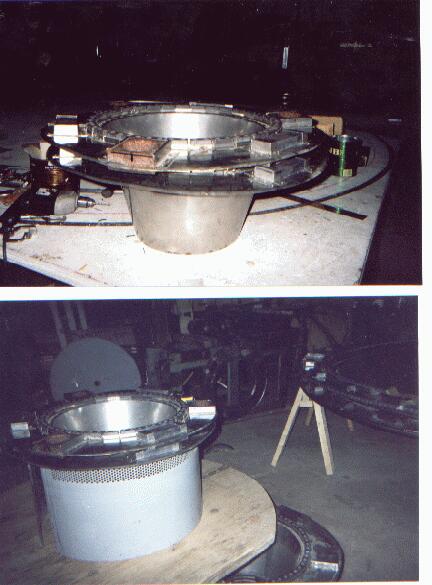
" The top pic shows Bob Thomas's drum on the left and my insert on the right which I later used to go inside a 55 gallon drum. The insert fits into the steel drum after you cut off 1/2 inch off the top so you and reqlue it back on. Bob cut some peek holes in the side of his drum so he could watch it oscillate. I had done the same only at the top.
The bottom pic shows the inside of Bob's steel drum. " Tracy.
" The upper left is the driver for Dan Dial's eight foot Modified Telsa Coil. The upper right shows Dan pointing a neon tube towards the top and watching it light up as it gets close to the coil. The bottom shows Dan's patent device which he describes in the visit message a few days ago." Tracy.
http://jnaudin.free.fr/html/dhpicts3.htm
The Hamel's devices build Tracy Jones -- The Plexiglass models
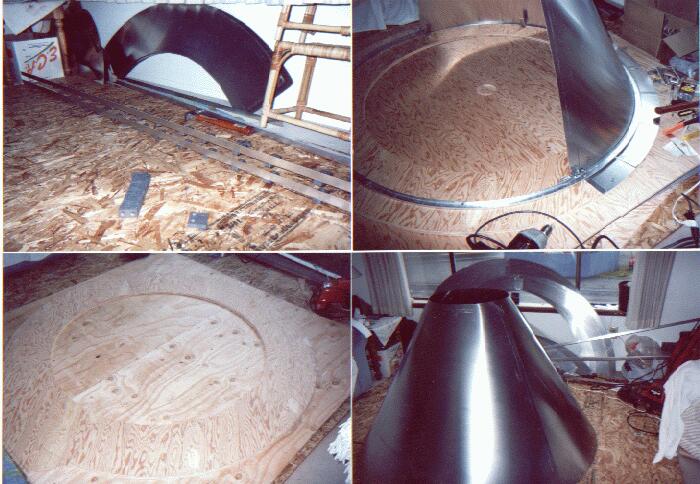
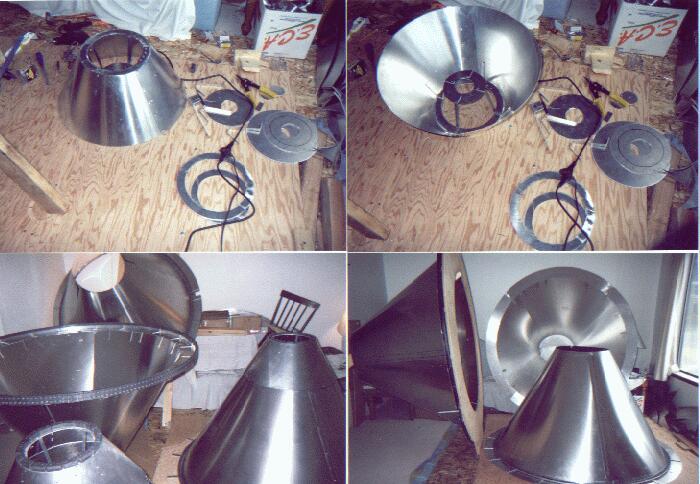
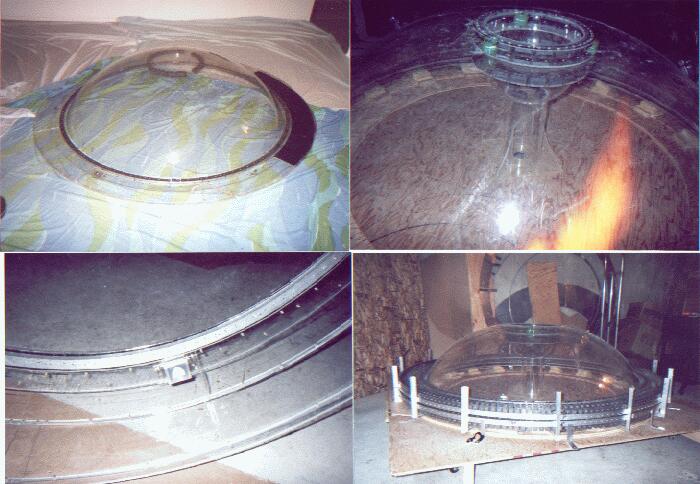
" I had figured out how to solve the problem of the droopy wings by paying a very nice guy in a plastic shop to form me 4 domes with the horizontal wings at only a cost of 215.00 per. He later did my inner cones for another 30.00 per. The only advantage of doing this was not only did I not have any more problems with the wings, but you could see what was going on inside which was pretty much nada. It's kind of fun trying to get smoke to go downward into the inner cones after you have forced it up to the top to see how the air is suppose to flow using a lighted cigarette and blowing the smoke between the wings. Of course I was fortunate to find a hacker to do this for me. " Tracy.
" The bottom right shows my cup for my diamond shape pinions scaled down to fit the domes. I was very fortunate in that my friendly Canadian machine shop foreman only charged me 465 dollars for all nine pinions in US currency. I couldn't find an American machine shop to do the work even if it was done in aluminum. I used my cue balls for the shoulder pinions. " Tracy.
" The bottom right was the cover I used for the top. I finished the device only to find some more nada. During this period of time I had the good fortune to meet Dan Dial. I had decided to spend the winter in San Diego bugging Dan LaRochelle for any information he might have on the subject and try my hand at using the Enhancer to help people help themselves. This was done with high expectations of huge donations from those getting better all the time. However, most of my prospective clients didn't have any money, but they used the machines anyway and I was able to sell a few I put together myself from kits I purchased from Dan. I along with Bob Thomas left our machines at his place for him to study and maybe get the damn things to work. I returned the following summer with great expectations on making yet a third hfs after working with David in Ontario. Dan decided it was too much out of kilter to do anything with and he also informed me that plastic wouldn't work anyway. Dan now has the plastic domes and I have some of the magnets in my third hfs. This one you already have seen some of the photos of which I have about 150 to date. Don't worry, I won't be sending you these enmasse, but will accommodate anyone on an individual basis. " Tracy.
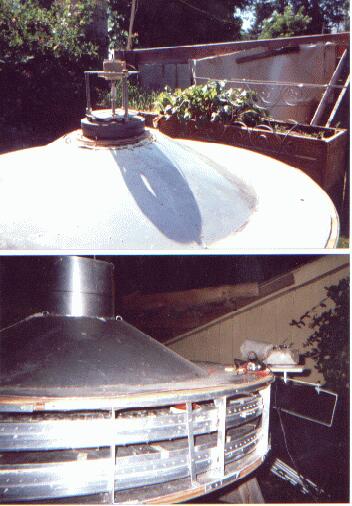
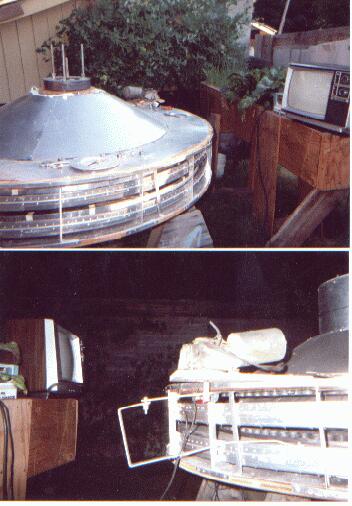
" The top photo shows the fan motor that finally burned up that I used to turn the floating magnet. The bottom shows the wiper motor in action. None of the photos showed any sparking. However, the largest sparks came at the bottom of the shaft at the motor where it was attached and the arm just before it turns down at a ninety degree turn. These two joints are loose so the arm could move when the motor rotated. " Tracy.
" The top photo shows the wiper motor being hooked up. The bottom photo shows another night shot and the arm extended to the bottom wing which was also loosely attached and showed sparks, but not in the photo. " Tracy.
http://jnaudin.free.fr/s
David Hamel's Spaceship
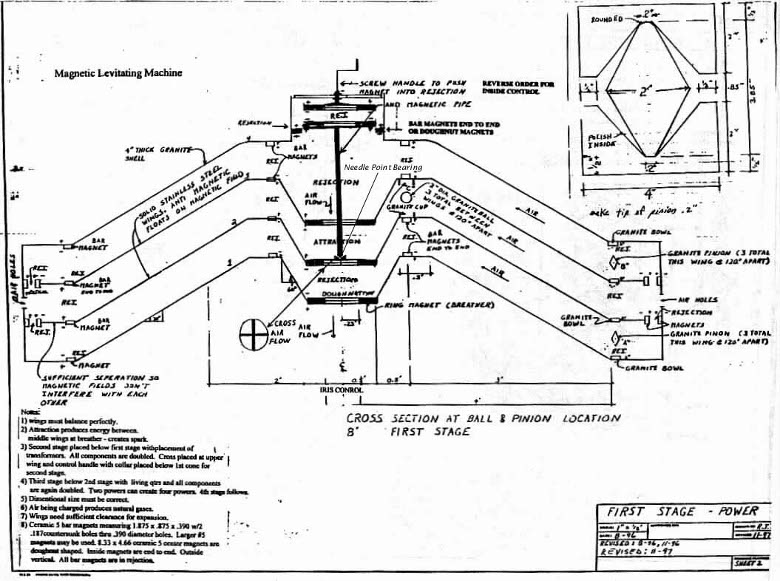
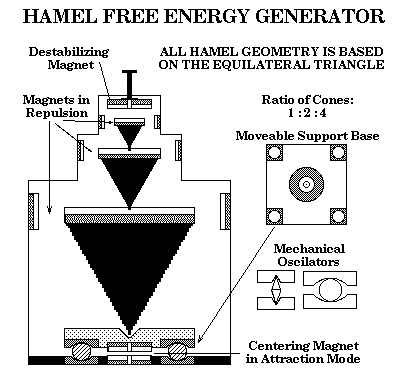
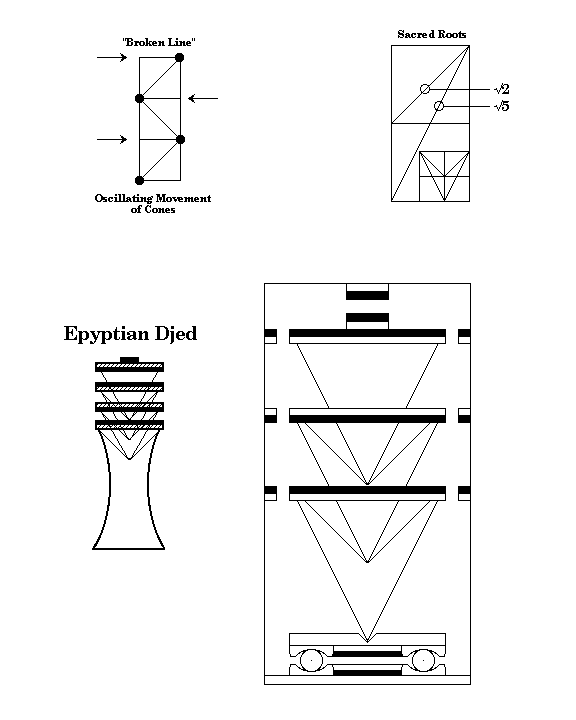
The complete ship is actually built as three stages. The first stage is usually referred to as the motor and is what most of this page details. At the bottom are a few pictures dealing with the second stage. All magnets are ceramic magnets.
Before my first contact with David Hamel I tried to build my own smaller and cheaper version of the motor component (first stage) by roughly following Pierre Sinclaire's blueprints.
Everything that I write here will have been told to me by David Hamel. I will try very hard to make sure that nothing is invented by me.
First Stage
The first stage is analagous to the ionoshere as it is in that stage that the ions are produced. The second stage is analagous to the stratosphere since the air within this stage is thin and it is hard to breath. The third stage is analagous to sea level and that is where the passengers will live. The previous motor that David had built that flew away was equivalent to the first stage (or motor).
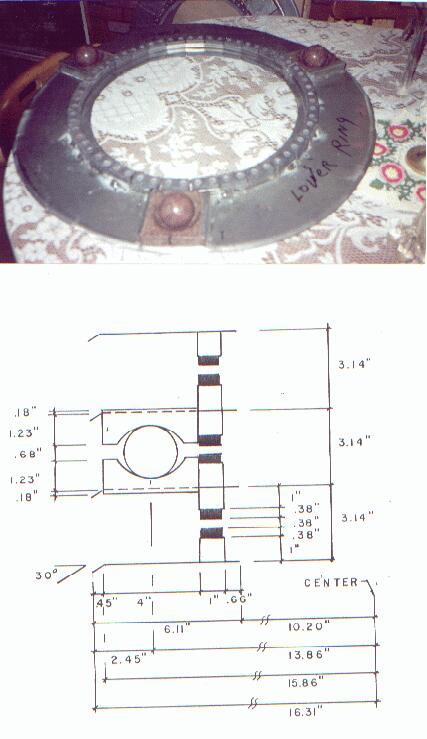
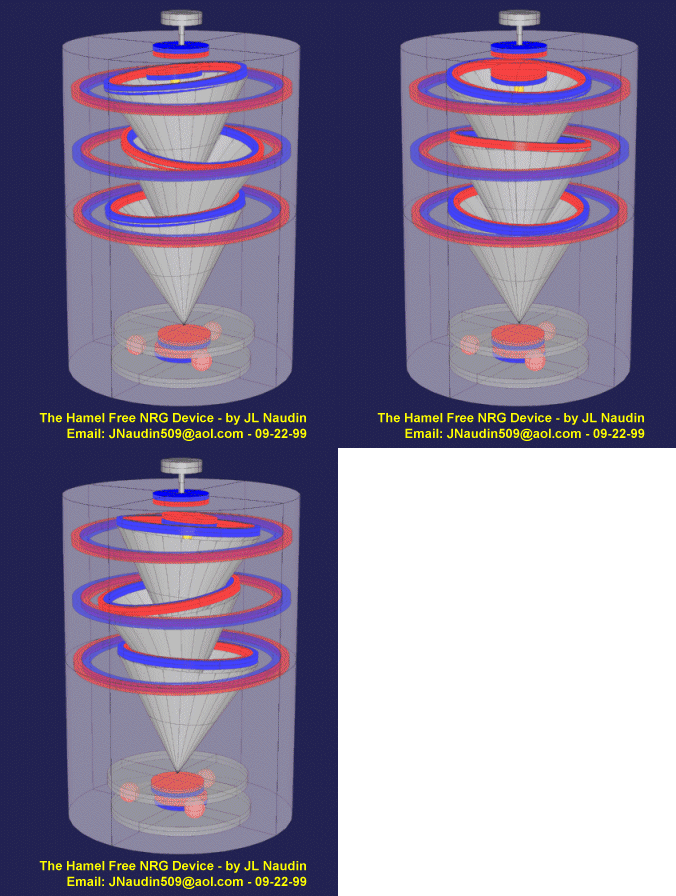
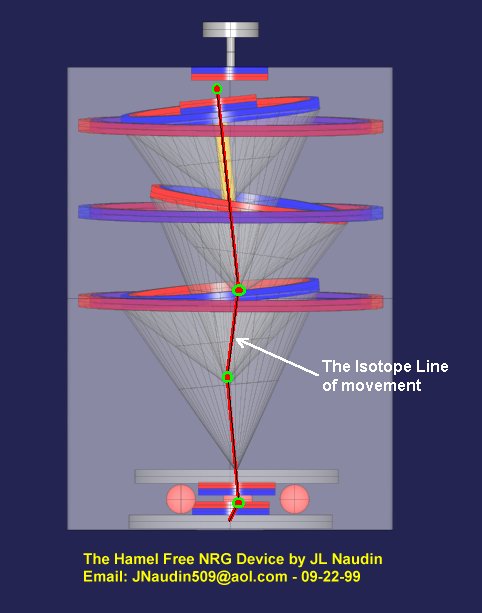
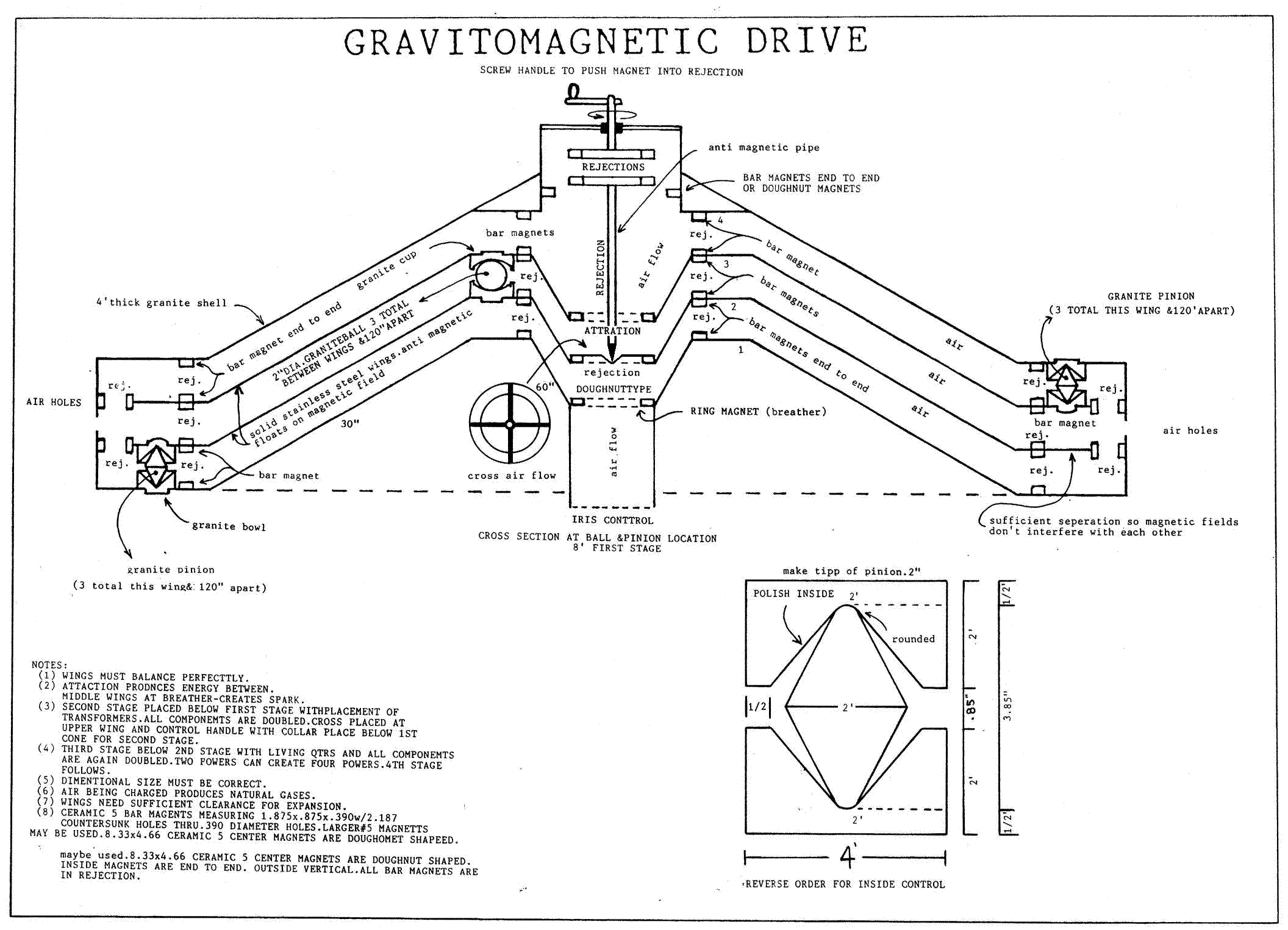
The motor consists of a top, two semi-free floating wings and a base. The top and the base are fixed in place. The wings are floating on and are somewhat restricted by ceramic magnets but are also restricted in how far they can move through the use of balls and pinions. As you can see by the diagram there are three granite balls spaced 120 degrees apart between the two wings. A picture of one of the balls can also be found below. There are six granite pinions altogether spaced 120 degrees apart. There are three pinions between the top and the top wing and there are three pinions between the base and the bottom wing. See the diagram and pictures below for more on the pinions.
Drawing of motor/first stage. Click on the drawing for a larger version. Click here for a cleaned up version of this drawing (copied from Dan LaRochelle's website which no longer exists). David Hamel Gravito Magnetic Device (spaceship) schematic.
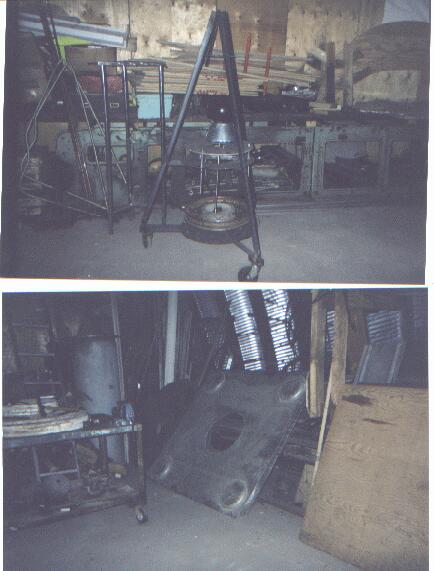
Photo of David Hamel's original spaceship. This is the one that actually flew. Unfortunately its takeoff was unexpected and it flew off, never to be seen again. It was a first stage only. Original David Hamel spaceship
Section view of all three stages. You can see the first stage as the relatively tiny part at the top. Click for a larger photo.
Some additional drawings, photos of David's construction and photo's of Tracy Jone's efforts can be found here. (look for links labeled HFS or Hamel Flying Saucer).
Click on the small images to see larger versions.
Blueprint drawn by Bob Thomas of the first stage and part of the second
stage. The granite is the areas that are dotted.
Rejection magnets
David is holding the ceramic magnet and rod that are at the top of the motor. There are actually two magnets in this picture, the first is the one that is attached to the rod and the second one is the one that will be lowered down to repel the first one.
Top of motor
Closeup looking down of the cone that will be a part of the top.
Side view of the cone that will be a part of the top.
Top wing (i.e. first wing from the top)
This is a view looking down into the cone of the top wing. The raised square piece houses the cup for the ball that will be between the two wings. The ball can be seen sitting in the cup belonging to the bottom wing in a picture below.
A view of a pinion sitting in its cup in the rim of the top wing.
Bottom wing (i.e. second wing from the top)
This is looking up underneath the bottom wing. The cross can be seen at the bottom of the cone. This is what the rod in the picture above will be sitting in and moving.
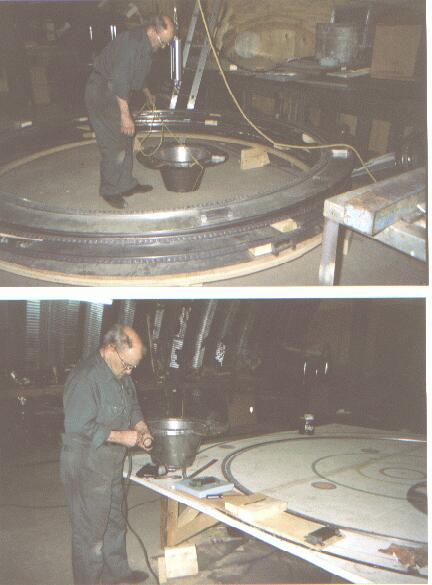
This shows a ball sitting in its cup. This ball will restrict the movement of the wings with respeect to each other. In the background David can be seen explaining something to Ole.
A view of the housing for the cup for a pinion. The next picture shows the same thing from underneath. The pieces of wood are temporary and are for when the top wing is lowered on this one for testing.
The cup for a pinion.
Base
Note that on this day the base was sitting upside down outside so keep that in mind as you look through these pictures.
The base sitting upside down outside.
The underside of the base. It is through the center hole that you see that the air returns. Dan LaRochelle refers to this is as the "1st Stage Vortex Return".
If you look closely in the circular hole you can see another crescent shaped hole. It looks like the winglike shapes channel the air into this central column. I could speculate more but I said I wouldn't add things that David didn't tell me.
Just below David's right hand you can see a horizontal slit in the circumference of the rim of the base. There are three of these around the circumference and David said they are air intakes. Yet more pictures below...
A shot of a hole with a bolt in it. If you look back at the pictures of the bottom wing pinions you will also see holes in the same places. When the wings are being placed on top of each other, a bolt will be put through these holes to hold them lined up over each other.
This is the same hole that is in the previous picture. Note the cup for the pinion. Remember, the base is upside down in these pictures and this shot is looking upwards. The pinion in question is the one that will be restricting of the bottom wing which will be floating above the base.
Looking more directly down the central hole of the base. Or more precisely, looking up the cenral hole (since the base is sitting upside down in these pictures). Note the crescent shaped hole in the side for admitting air.
I should have turned my camera upside down. This is a picture of the top of the base.
Sitting on the floor is the rim that still needs to be attached to the base as well as a ring of ceramic magnets for repelling one of the two wings' rim-magnets.
Second Stage
Once the motor is complete, work begins on the second stage. The entire ship is being built from the top down, the motor being at the top. So the motor will sit at the top of these three poles while the second stage is built down from there.
This is one of the pinions for the second stage. Note that following the rules of the dimensions as David refers to it or the master pyramid matrix as many others refer to it, this pinion is larger than the ones in the first stage.
Test reports
Sujet : hfs report 9/22/99
Date : 23/09/99 03:28:13
From: tracy@plix.com (Tracy)
Good evening everyone,
This afternoon, I designed a bracket to hold my old time Buick windshield wiper motor I purchased and attached a 1/2 inch strip of aluminum to serve as the arm. This I attached to the bottom wing and began to oscillate the wing using my battery charger as a power source. The bottom wing oscillates about 1/4 inch and the top wing slightly less. The center floating magnet oscillates about 1/8 to 1/4 inch, and does not spin. Da fatlady was witness to this and I asked her to go home, a short distance away, and give me a phone check. I have a power transformer located approximately 60 feet from the device and it's estimated to be about 20 to 25 feet above the ground. The phone lines run from this pole to the house and the closest distance to the hfs is approximately 30 feet. Most of the phone interference was towards the direction of these lines and pole. My portable phone was disconnected 6 times with the furthest being about 5 feet and lying in a line towards the pole transformer. This line of sight and closer to the hfs also produced the loudest noise interference and when the noise increased, it continued to do so until the phone disconnected. The only other area of interference noted was below the device towards the edge between the phone lines and the hfs, above the edge of the wing itself which is where the magnets are and the opposite side of the hfs from a direct line towards the power pole. I then hooked up my TV along side the hfs on a level just above the wings and about 4 feet distance. Without my cable hookup, I can only receive one station and the reception is very poor, but the sound is fine. I noticed considerable interference with the tv, but not the sound. The strongest build up before the phone had disconnected was when I oscillated the top wing by hand while the bottom wing was being oscillated by the motor. When I turned the motor off, all the interference on the phone ceased. The windshield motor has been running for 75 minutes and I intend to leave it running all night.
Far as I can determine, it will continue to operate barring any breakdown in the attached arm. The last disconnect was when I had the phone close to the skin of the hfs and between the horizontal portion of the wing and floating magnet. The distance at its strongest detected interference was when the phone was within 2 inches of the skin and it was like this completely encircling the hfs. This is most interesting because it makes no difference concerning the location of the overhead phone wires or the pole transformer. It remains a constant all the way around the hfs. If it is still here by morning and the motor is still operating, then I will devise another design to hooked up the arm to the top wing and try that. I've also taken 5 photos of the arrangement. Will keep you posted. Tracy.
Sujet : report 2 hfs 9/22/99 @ 95 minutes
Date : 23/09/99 03:42:28
From: tracy@plix.com (Tracy)
An interesting development just began. While still oscillating as before with only the motor, the TV is now resonating with the movement of the wings with both the sound and picture turning itself off and on. I've asked DA fatlady to come over and witness this development. Tracy.
Sujet : report hfs 9/22/99 @ 215 minutes
Date : 23/09/99 06:17:23
From: tracy@plix.com (Tracy)
The windshield wiper motor is still working and ever time its arms to the wing touch or move within the connected joints it sparks and sometimes very much. This also happens when aluminum touches each other. It does not have to be steel. The TV appears to just about had it with only large flashes showing every time it sparks. No program at all now. I was speaking to Louis on the portable phone earlier and it disconnected on him also when I placed it close to the wings. I've taken two more pictures with flash. It's now 9:02PM PST and will remain up for a while longer. I will also leave the motor running. Tracy.
Sujet : report hfs 9/22/99 325 minutes
Date : 23/09/99 07:48:16é)
From: tracy@plix.com (Tracy)
The tests began at 4:50PM and it's now 10:15PM, that's 5 hours and 25 minutes or 325 minutes and the damn thing is still looking like that pink bunny rabbit with the ever ready battery attached to it, It just keeps running and running, but no lift off. I did make another test thinking that it must be grounded somehow to be sparking like it is. I detached the motor from the top of the structure where I have it bolted and isolated it from the hfs while it was still running. The sparking continued when ever the aluminum arm touched the frame as it leads to the bottom wing or when the arm moved while loosely attached to the bottom wing. I rebolted it and then ran an alligator clip from the bottom wing and struck the top wing. No spark. When I struck the clip to the frame from the top wing, still no spark. I then attached the clip to the frame on the opposite side and struck the bottom wing, lots of spark, but none from the top wing when I struck it. Each time it sparks no matter where the spark comes from, the TV goes bonkers with lots of large flashing from the screen. This flashing is so intense,it's like looking down into the tube itself and seeing the rear end of the tube. Getting sleepy so will retire and check on it later. It's still running now. Tracy.
Sujet : PartslistTracyswheels
Date : 30/09/99 09:27:39
From: tracy@plix.com (Tracy)
My shopping spree in Seattle netted me enough material to begin my "Tracy's wheels" within the next couple of days. Tomorrow I will pick up from the machine shop my wheels and assembly will begin ASAP. In the meantime I will give you a list of material I will be working with that I purchased in Seattle. This does not include a complete list because I will be using material left over from my previous assembly and that which I will take off the current one.
The purpose of sharing this information with you is to let you know what I will be using and at what cost so you can compare your costs in the event it works and you wish to assemble one yourself. I repeat, this is a modification of the HFS and is my own interpretation of how it might work. When I begin assembly, I will make a report of what I've done and how I did it and I will try to do this on a daily basis. I usually make my health report in the early morning hours and will do this report at the same time. I will also be taking photos as I proceed and will try to make drawings when ever possible. Currently, my brother is making a drawing from a sketch I left him while I was in Seattle. Soon as it is presentable, I will forward it to you. I trust that if you will compare it to the HFS, you will understand it better. The object is to provide more surface area for what I consider the cones to be a capacitor without making it bigger and at the same time easier to assemble. I've done away with the outer rings and replaced them with a simple method of centering the rings (wheels) so the magnets remain in balance, but at the same time move across one another. I've also designed it so the outer skin is insulated from the machine itself and provides a means of air flow that will be vortex if in fact that is what is required. The center floating magnet is replaced with two fixed magnets in the center of the hub in rejection to each other. I will be using soda pop cans for my cups filled with concrete and miniature snooker balls (hard plastic of 1 and ½ inch in size) for the pinions. I can also utilize the floating magnet I have now at the top and have considered the magnetic motor Dan La has introduced to keep it spinning. Rather or not this is necessary is yet to be seen. I have also designed a simple method to keep the entire device moving so that the two middle wheels will be in constant movement until the device energizes itself if that's what it will do. If at any time when I am presenting this information to you and you don't understand the procedure or have a suggestion for what you consider an easier method, then by all means speak up and I will either explain why it can't be incorporated or will incorporate it at that time. The following is a list of material I purchased for this assembly with a brief reason for its use in the machine. Most of the material was purchased at the Boeing Surplus facility in Kent, Washington. Keep in mind concerning the quantity purchased is because of the purchasing rules as follows: 1) What you see is what you get and no refunds. 2) If you can find another customer to share your purchase, then you don't have to buy the entire selection (piece) on display. 3) All purchases are paid for by check or in cash. 4) Pickup is usually made at time of purchase. 5) All material is new and is leftovers or obsolete from previous jobs. 6) Tools, equipment, and furniture are usually all used. 7) Most material is sold by the pound as well as some tools (pliers, specialized bits, etc.).
Material Description Use Cost
1. 2 - 4 x 12 ft. .010 aluminum sheets. Capacitors and inner cones 22.00
2. 1 - 5 x 12 ft. .032 aluminum sheet. Capacitors and skin 56.00
3. 80 feet x 3 feet wide thin rubber Possible insulator 20.00
4. 2' x 8' x 1" acrylic plastic Framing and spacers 50.00
5. 3 - 2" x 2" x 8' solid nylon possible framing alternative 13.00
6. 2 - ¼" x 24" x 16" aluminum plate hub rings. 44.80
7. 12' x ¼ " rubber mat possible insulator 30.00
8. 28" x 28" x 1/8" copper plate and remnants general use 16.50
9. 2 large pieces of plywood w/1/16"alum coating possible structure 10.00
10. 4 - 20' x ½ " rubber belt insulator for skin 4.00
11. 4' x 8' x 1" honeycomb aluminum sheet possible capacitor 16.50
Other items of small import such as 1" shrink tubing at .10 cents a foot to put magnets in to hold in place for other experiments, 500 plastic ties of different sizes, 7.10, 10 drill bits .40 cents total, two small wire cutters 1.00, etc.
Tacoma Screw Products:
1. 500 aluminum 1/8 x ½ rivets 12.30
2. 500 aluminum 1/8 x 3/8 rivets 11.48
3. 400 aluminum 1/8 x ¼ rivets 7.10
4. 10 1/8 drill extra hard drill bits 14.00
5. 100 6-32 brass machine nuts 3.15
6. 100 1" 18-8 # 8 screws phil head 11.49
American Games:
12 miniature snooker balls (1 x ½ inch) 24.00
https://www.youtube.com/watch?v=LPd619LWbuQ
David Hamel's Granite Saucer
According to him, the story starts in the 1970s when two extraterrestrials entered his home through his television set and took him aboard their spacecraft. While on board, he claims to have been taught engineering concepts unknown to mankind.
From that point on, David Hamel would dedicate nearly every cent and every moment he had trying to build a flying saucer with hopes of one day travelling to their planet.
https://www.youtube.com/shorts/0438MPkqJd8
Magnetic Vortex Levitation Hamel Flying Disc #science ... - YouTube
Jun 2, 2025 ... This experiment explores the secrets behind the Hamel Flying Disc, one of the most incredible and lesser-known discoveries related to UFO ...

https://www.scribd.com/document/230843435/The-David-Hamel-Scalar-Generator
The document describes David Hamel's scalar generator device. It contains nested spinning rings that can generate scalar currents and effects. When tested, photos of the device appeared fogged, indicating scalar effects. The device uses principles of unbalanced magnetic fields and spinning discs to generate energy and alter the effects of gravity.
https://www.scribd.com/document/5504468/hyperdimensional-physics-the-david-hamel-flying-saucer-hfs-anti-gravity-zero-point-field-disc-construction
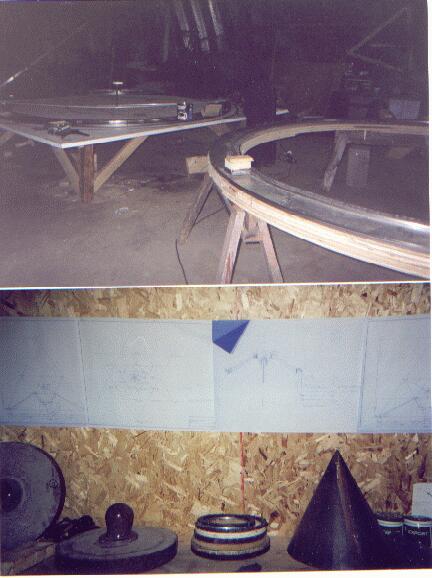
This document contains 15 pictures and captions documenting the construction of David Hamel's flying saucer. It shows various stages of construction including the inner cones, magnet placement, and wing assembly. Tracy Jones provides commentary explaining details of the design and construction process. The photos also include shots of Hamel and others working in his workshop and comparisons to other experimental craft projects.