Yasushiro IWAMURA, et al.,
Quantum Hydrogen Energy ( QHe )
Quantum Hydrogen Energy ( QHe )
https://www.cleanplanet.co.jp/
Clean Planet
https://www.cleanplanet.co.jp/technology/
What is the heat generation phenomenon of QHe?
QHe is a heat-generating technology with hydrogen quantum diffusion. The diffusion is induced by heating a small amount of hydrogen saturated in nano-sized nickel-based composite material.
QHe’s energy density is more than 10,000 times higher than natural gas
QHe’s heat density per gram of fuel is much higher than that of chemical reactions such as methane (natural gas) and hydrogen combustion. With QHe, less than 10 grams of hydrogen are needed to power the monthly electricity and heat needs of a household.
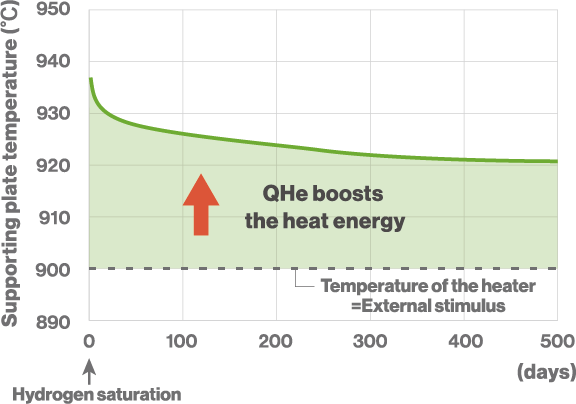
QHe can run continuously following initial absorption of hydrogen
In one of our experiments, excess heat was observed for 589 days from May 7, 2021, to Dec. 18, 2022, with hydrogen saturation only at the beginning of the experiment.
Potential of QHe
QHe can provide industrial-scale heat up to 1,000°C. The technology operates with nano-sized nickel- based composite material and a small amount of hydrogen. The technology has been developed with Tohoku University, the top runner in this field. QHe is a breakthrough technology for the world to go net-zero.
Clean Planet is currently engineering QHe-powered heat modules that can provide energy to the industrial, commercial, transportation, and residential sectors. Clean Planet is developing a pilot industrial boiler with Miura Co., Ltd., the Japanese leading industrial boiler company, using QHe-powered heat modules as the heat source to market boilers in a near future.
QHe-powered heat modules are applicable to power generation, manufacturing factories, steel and chemical industries, agriculture, direct air capture, and water desalination.
Our Patents
Clean Planet has been strategically building its patent portfolio since 2013, including principal patents in heat generation using Quantum Hydrogen Energy, and related technologies such as reaction control, nano-sized reactant material production, and heat-utilizing applications.
Research History and Papers
Y. Iwamura, T. Itoh, S. Yamauchi, and T. Takahashi, Anomalous heat generation that cannot be explained by known chemical reactions produced by nano-structured multilayer metal composites and hydrogen gas, Japanese Journal of Applied Physics. 63, 037001 (2024).
J. Kasagi, T. Itoh, Y. Shibasaki, T. Takahashi, S. Yamauchi, Y. Iwamura, Photon radiation calorimetry for anomalous heat generation in NiCu multilayer thin film during hydrogen gas desorption, Proceedings of the 25th Meeting of International Conference of Cold Fusion, ICCF25, August 27-31, 2023.
Y. Iwamura, J. Kasagi, T. Itoh, T. Takahashi, M. Saito, Y. Shibasaki, S. Murakami, Progress in Energy Generation Research Using Nano-Metal With Hydrogen/Deuterium Gas, Journal of Condensed Matter Nuclear Science. 36 (2022) 285-301.
Y. Iwamura, T. Itoh, J. Kasagi, S. Murakami, M. Saito, Excess Energy Generation using a Nano-sized Multilayer Metal Composite and Hydrogen Gas, Journal of Condensed Matter Nuclear Science. 33 (2020) 1-13.
Y. Iwamura, Heat generation experiments using nano-sized metal composite and hydrogen gas, Cold Fusion: Advances in Condensed Matter Nuclear Science, Ed. Jean-Paul Biberian, Elsevier, Amsterdam, (2020) 157-165.
J. Kasagi, Y. Honda, K. Fang, Screening energy for low energy nuclear reactions in condensed matter, Cold Fusion: Advances in Condensed Matter Nuclear Science, Ed. Jean-Paul Biberian, Elsevier, Amsterdam, (2020) 167-187.
Y. Iwamura, Review of permeation-induced nuclear transmutation reactions, Cold Fusion: Advances in Condensed Matter Nuclear Science, Ed. Jean-Paul Biberian, Elsevier, Amsterdam, (2020) 191-204.
Y. Iwamura, T. Itoh, T. Takahashi, S. Yamauchi, M. Saito, S. Murakami, J. Kasagi, Energy Generation using Nano-sized Multilayer Metal Composites with Hydrogen Gas; Intentional Induction of Heat Burst Phenomenon, Proceedings of the 22nd Meeting of Japan CF Research Society, JCF22, March 5, 2022, p.27-39.
Y. Iwamura, T. Itoh, M. Saito, S. Murakami, J. Kasagi, Evidence for Surface Heat Release Reaction over Nano-sized Multilayer Metal Composite with Hydrogen Gas, Proceedings of the 21st Meeting of Japan CF Research Society, JCF21, December 11-12, 2020, p.1-14.
T. Itoh, Y. Shibasaki, J. Kasagi, S. Murakami, M. Saito, Y. Iwamura, Optical Observation on Anomalous Heat Generation from Nano-sized Metal Composite, Proceedings of the 21st Meeting of Japan CF Research Society, JCF21, December 11-12, 2020, p.15-25.
PATENTS
BOILER -- US11371695
Provided is a boiler for heating fluid by a heat generation unit including heat generation bodies in a container, the boiler being able to moderately heat fluid according to various situations while heat generated by the heat generation bodies can be efficiently utilized. A boiler for heating fluid by using heat generated by heat generation bodies includes the heat generation bodies and a container having the heat generation bodies inside and configured such that the inside of the container is filled with gas with higher specific heat than that of air. The boiler includes a controller configured to control a heat generation amount of the heat generation body under a situation where the gas has been supplied into the container.
HEATING DEVICE -- US2023152009 // JP7810453
A heat generating device includes a container, a heat generating element disposed inside the container, a heater for heating the heat generating element, a conductive wire part connecting a wall portion of the container and the heater, a hydrogen supply unit for supplying a hydrogen-containing hydrogen-based gas to the heat generating element, and a vacuum evacuation unit for evacuating the container. Formula (1) is satisfied:AHC?eq(TH-TW)+Aseeqs(TS4-TW4)+Pm<Hex (1),where TH is heater temperature, TW is external environmental temperature, AHC is equivalent heat conduction area, keq is equivalent thermal conductivity, Leq is equivalent thermal conduction length, AS is sample radiation surface area, TS is sample surface temperature, eeq is equivalent emissivity, s is Stefan-Boltzmann constant, Pm is energy required for maintaining operation, Hex is thermal energy generated by the heat generating element, and ?eq is (keq/Leq).
To provide a heating device excellent in energy efficiency.SOLUTION: A heating device 10 includes a container 11, a heating element 14, a heater 12 for heating the heating element, a conductor part 13 for connecting a wall part of the container and the heater, a hydrogen supply part 15 for supplying hydrogen-system gas to the heating element, and an evacuation part 16. A formula (1) is satisfied when a heater temperature is represented as TH, an ambient temperature as TW, an equivalent heat conduction area as AHC, an equivalent heat-transfer coefficient as keq, an equivalent heat conduction distance as Leq, a sample radiation surface area as AS, a sample surface temperature as TS, an equivalent radiation rate as eeq, Stefan-Boltzmann's constant as s, energy required for maintaining an operation as Pm, and heat energy generated by the heating element as Hex. In the formula (1), ?eq is a value (keq/Leq) obtained by dividing the equivalent heat-transfer coefficient by the equivalent heat conduction distance...
HEAT GENERATION CELL, HEAT GENERATION DEVICE, AND HEAT UTILIZATION SYSTEM -- US2024240836
A heat generating cell includes: a support having tubular shape; and a multilayer film formed on an inner peripheral surface of the support for generating heat by occlusion and discharge of hydrogen. A heat generating device includes: a plurality of the heat generating cells; a sealed container; a plurality of separators dividing an inside of the sealed container into a first space, a second space, and a third space in an axial direction of the sealed container, the first space and the second space being locating at both ends in the axial direction in the sealed container; and a heater for heating each of the plurality of heat generating cells. The plurality of heat generating cells penetrate through the plurality of separators, and both ends of each of the plurality of heat generating cells in an axial direction are respectively opened to the first space and the second space.
BOILER -- US12209747
Provided is a boiler including a heat generation body, a container including the heat generation body, and a water pipe to be heated by heat generated by the heat generation body under environment where the inside of the container is filled with gas with higher specific heat than that of air.
HEAT GENERATING SYSTEM -- US2023160609
A heat generating system includes a heat-generating element cell and a circulation device. The heat-generating element cell includes a container having a recovery port and a discharge port, and a reactant that is provided in the container, is made from a hydrogen storage metal or a hydrogen storage alloy, has metal nanoparticles on a surface of the reactant. The heat-generating element cell generates excess heat when hydrogen-based gas contributing to heat generation is supplied into the container and hydrogen atoms are occluded in the metal nanoparticles. The circulation device circulates the hydrogen-based gas in the heat-generating element cell. The circulation device includes a circulating passage that is provided outside the container and connects the recovery port to the discharge port, a pump circulates the hydrogen-based gas in the container via the circulating passage, and a filter on the circulating passage adsorbs and removes the impurities in the hydrogen-based gas.
HEAT GENERATION DEVICE, HEAT UTILIZATION SYSTEM AND FILM-LIKE HEAT GENERATION ELEMENT -- US12618592
A heat generating device includes: a sealed container; a tubular body provided in a hollow portion of the sealed container; a heat generating element provided on an outer surface of the tubular body and configured to generate heat by occluding and discharging hydrogen supplied to the hollow portion; and a flow path formed by an inner surface of the tubular body and through which configured to allow a fluid that exchanges heat with the heat generating element to flow. The heat generating element includes a base made of a hydrogen storage metal, and a multilayer film provided on the base. The multilayer film has a first layer made of a hydrogen storage metal and having a thickness of less than 1000 nm, and a second layer made of a hydrogen storage metal, which is different from that of the first layer, and having a thickness of less than 1000 nm.
BOILER -- US11326772
Provided is a boiler configured to perform heating by a heat generation section provided with heat generation bodies in a container and capable of properly charging a circulation path including, as part thereof, the inside of the container with required gas.A boiler includes: heat generation bodies; a container configured such that the heat generation bodies are provided inside and configured chargeable with gas with higher specific heat than that of air; and a circulation path including, as part thereof, the inside of the container, the circulation path being a path in which gas circulates. When the charging process of charging the circulation path with the gas is performed, a circulation amount and a gas concentration in the circulation path are monitored.
HEAT UTILIZATION SYSTEM AND HEAT GENERATING DEVICE -- US12287126
A heat generating device according to the invention includes: a sealed container into which a hydrogen-based gas is supplied; and a heat generating structure accommodated in the sealed container and in which a plurality of heat generating elements that are configured to generate heat by occluding and discharging hydrogen contained in the hydrogen-based gas are radially arranged. Each of the heat generating elements includes a base made of a hydrogen storage metal, a hydrogen storage alloy, or a proton conductor, and a multilayer film provided on the base. The multilayer film has a first layer made of a hydrogen storage metal or a hydrogen storage alloy and having a thickness of less than 1000 nm and a second layer made of a hydrogen storage metal or a hydrogen storage alloy, which is different from that of the first layer, or ceramics and having a thickness of less than 1000 nm.
HEAT UTILIZATION SYSTEM AND HEAT GENERATING DEVICE -- US2025146715
A heat utilization system includes: a heat generating device of one aspect of the invention, includes: a heat generating device including a heat-generating element configured of a multilayer film for generating heat by occlusion and discharge of hydrogen, a heating unit for heating the heat-generating element, and a sealed container for containing the heat-generating element and the heating unit; and a heat utilization device for utilizing a heat medium heated by the heat generating device as a heat source. The heat generating device is configured to be attachable and detachable with respect to the heat utilization device.
HEAT GENERATION DEVICE AND HEAT GENERATION ELEMENT COOLING METHOD -- US2025123029
A heat generating device includes: a heat generating element that is capable of occluding hydrogen and generating heat using a heat generating reaction by quantum diffusion of the hydrogen; a heater that heats the heat generating element to cause quantum diffusion of the hydrogen in the heat generating element; a container that accommodates the heat generating element and the heater; a heat removal medium circulation unit that circulates a heat removal medium through a circulation path provided on an outer periphery of the container; an inert gas supply unit that supplies an inert gas for cooling the heat generating element into the container; a coolant supply unit that supplies a coolant for cooling the heat generating element into the container; and a container opening unit that opens the container.
HEAT-GENERATING DEVICE AND BOILER -- US2025116423
A heat generating device includes: a heat generating container configured to allow a hydrogen-based gas containing hydrogen to be introduced; a heat generating element provided inside the heat generating container and configured to generate heat by occluding and discharging the hydrogen; a first heat removal path configured to allow a first heat removal fluid heated by the heat generating element to flow therethrough; and a second heat removal path configured to allow a second heat removal fluid to flow therethrough in a direction opposite to a direction in which the first heat removal fluid flows.
HEAT GENERATION DEVICE -- US2024426522
A heat generating device includes a pair of heaters provided with an interval therebetween; and a plurality of heat generating elements that are capable of occluding hydrogen and generating heat using a heat generating reaction by quantum diffusion of the hydrogen caused by heat of the pair of heaters, in which the plurality of heat generating elements are arranged with an interval between each other and are arranged between the pair of heaters.
HYDROGEN HEATING DEVICE AND HYDROGEN HEATING METHOD -- US2024381494
A hydrogen heating device includes: a sealed container configured to allow a hydrogen-based gas to be led in; a heat generating element provided inside the sealed container and configured to generate heat by occluding and discharging hydrogen; and a temperature adjustment unit configured to adjust a temperature of the heat generating element. The heat generating element includes a plurality of stacked bodies each including a support made of at least one of a porous body, a hydrogen permeable film, and a proton conductor, and a multilayer film supported by the support. The multilayer film has a first layer made of a hydrogen storage metal or a hydrogen storage alloy and having a thickness of less than 1000 nm, and a second layer made of a hydrogen storage metal or a hydrogen storage alloy different from the first layer, or ceramics and having a thickness of less than 1000 nm.
HEAT GENERATING DEVICE AND METHOD FOR GENERATING HEAT -- US2024255192
A heat generating device includes a container, a heat generating element, and a heater. A hydrogen-based gas contributing to heat generation is introduced into the container. The heat generating element is provided inside the container. The heater is configured to heat the heat generating element. The heat generating element includes a base made of a hydrogen storage metal, a hydrogen storage alloy, or a proton conductor, and a multilayer film provided on a surface of the base. The multilayer film having a stacking configuration of: a first layer that is made of a hydrogen storage metal or a hydrogen storage alloy, and a second layer that is made of a hydrogen storage metal, a hydrogen storage alloy, or ceramics different from that of the first layer. The first layer and the second layer have a layer shape with a thickness of less than 1000 nm.
HEAT GENERATING SYSTEM -- US2023160609
A heat generating system includes a heat-generating element cell and a circulation device. The heat-generating element cell includes a container having a recovery port and a discharge port, and a reactant that is provided in the container, is made from a hydrogen storage metal or a hydrogen storage alloy, has metal nanoparticles on a surface of the reactant. The heat-generating element cell generates excess heat when hydrogen-based gas contributing to heat generation is supplied into the container and hydrogen atoms are occluded in the metal nanoparticles. The circulation device circulates the hydrogen-based gas in the heat-generating element cell. The circulation device includes a circulating passage that is provided outside the container and connects the recovery port to the discharge port, a pump circulates the hydrogen-based gas in the container via the circulating passage, and a filter on the circulating passage adsorbs and removes the impurities in the hydrogen-based gas.
HEAT GENERATION DEVICE, HEAT UTILIZATION SYSTEM AND FILM-LIKE HEAT GENERATION ELEMENT -- US12618592
A heat generating device includes: a sealed container; a tubular body provided in a hollow portion of the sealed container; a heat generating element provided on an outer surface of the tubular body and configured to generate heat by occluding and discharging hydrogen supplied to the hollow portion; and a flow path formed by an inner surface of the tubular body and through which configured to allow a fluid that exchanges heat with the heat generating element to flow. The heat generating element includes a base made of a hydrogen storage metal, and a multilayer film provided on the base. The multilayer film has a first layer made of a hydrogen storage metal and having a thickness of less than 1000 nm, and a second layer made of a hydrogen storage metal, which is different from that of the first layer, and having a thickness of less than 1000 nm.
HEAT GENERATION CELL, HEAT GENERATION DEVICE, AND HEAT UTILIZATION SYSTEM -- US2024240836
A heat generating cell includes: a support having tubular shape; and a multilayer film formed on an inner peripheral surface of the support for generating heat by occlusion and discharge of hydrogen. A heat generating device includes: a plurality of the heat generating cells; a sealed container; a plurality of separators dividing an inside of the sealed container into a first space, a second space, and a third space in an axial direction of the sealed container, the first space and the second space being locating at both ends in the axial direction in the sealed container; and a heater for heating each of the plurality of heat generating cells. The plurality of heat generating cells penetrate through the plurality of separators, and both ends of each of the plurality of heat generating cells in an axial direction are respectively opened to the first space and the second space.
Heat generating device and heat utilization system -- TW202334592
HEAT GENERATION METHOD -- KR20230136018
Heating device -- TW202317923
Heat utilization system, and heat generating device -- AU2023203567
Heat generating device -- TW202300853
Heat generation cell, heat generation module, and heat generation device -- TW202300854
BOILER -- KR102953877
HEATING DEVICE, AND HEATING METHOD -- BR112016000822
HEAT UTILIZATION SYSTEM, AND HEAT GENERATING DEVICE -- KR102746846
HEAT GENERATING STRUCTURE AND HEAT GENERATING DEVICE -- AU2024292643
HEATING MODULE, HEATING DEVICE, AND GAS INTRODUCTION DEVICE -- WO2025263389
POTENTIAL DIFFERENCE GENERATION DEVICE -- CA3252234
HEAT GENERATING SYSTEM -- EP4678999
HEATING DEVICE -- JP7810453
Heat generating device and heat utilization system -- TW202334592
HEAT GENERATION METHOD -- KR20230136018
Heating device -- TW202317923
Heat utilization system, and heat generating device -- AU2023203567
Heat generating device -- TW202300853
Heat generation cell, heat generation module, and heat generation device -- TW202300854
HEAT UTILIZATION SYSTEM, AND HEAT GENERATING DEVICE -- KR102746846
HEAT GENERATION SYSTEM -- JP2017110899
HEAT GENERATION SYSTEM -- JP6149996
NiCu Preparation Patents
CN121737756 -- Pulse electrodeposition monatomic alloy catalyst and application thereof in air fertilizer preparation
The invention discloses a pulse electrodeposition monatomic alloy catalyst and application thereof in air fertilizer preparation, and belongs to the field of electrochemical catalysis and environmental functional materials. The catalyst is an M-Cu monatomic alloy, M is one of Ni, Co, Fe or Mn, and M exists in a Cu lattice in an atomic dispersion form; the preparation method of the catalyst adopts a three-electrode system pulse electrodeposition method and comprises the following steps: taking a copper sheet as a working electrode, a platinum foil as a counter electrode and Ag/AgCl as a reference electrode; the electrolyte is a mixed electrolyte containing H2SO4 and Ni, Co, Fe or Mn metal sulfate, and the Ni, Co, Fe or Mn metal sulfate is respectively added when the NiCu alloy, the CoCu alloy, the FeCu alloy or the MnCu alloy are prepared; the molar ratio of Cu to M is controlled by adjusting the anode/cathode pulse time ratio ta/tc, the value range of ta/tc is 1/10-10/10s, and the problems of low catalytic activity and selectivity are solved.
CN120099600 -- Method for preparing NiCu alloy with gradient nanostructure and application
The invention belongs to the field of material science, and discloses a method for preparing a NiCu alloy with a gradient nanostructure and application. According to the method, gradient distribution of NiCu alloy components and structures is achieved by accurately controlling the current density and the potential gradient in the electrodeposition process. Compared with a traditional preparation method, the method avoids the problem that physical and chemical properties of metal are possibly changed by adding alloy elements, increasing mechanical deformation and the like. The NiCu alloy prepared through the method has good obdurability, abrasion resistance, damping capacity and high-temperature performance
CN120041867 -- NiCu alloy electrode preparation method based on electrochemical micromachining and electric crystallization coordinated regulation
The invention discloses a NiCu alloy electrode preparation method based on electrochemical micromachining and electro-crystallization coordinated regulation and control, which comprises the following steps: (1) electrochemical micromachining: cutting a nickel net, clamping the longer end of the nickel net by using an electrode clamp with a platinum sheet, ensuring the effective area of an electrode immersed in an electrolyte, electrifying the nickel net in an acid solution, and carrying out electrochemical micromachining on the nickel net; cleaning and drying for later use; and (2) Ni-Cu gradient crystallization is conducted, specifically, nickel crystallization is conducted firstly, then copper crystallization is conducted, a Ni-rich compact bottom layer is formed in the initial stage of crystallization, a Ni-Cu mixed columnar crystal transition layer is formed in the middle stage of crystallization, and a Cu-rich nano dendritic crystal surface layer is formed in the later stage of crystallization. According to the preparation method, a multi-scale micro-nano composite structure is constructed through electrochemical micromachining, a micron framework-nano dendritic crystal composite structure is formed through Ni-Cu gradient crystallization, micron-scale gaps generated by electrochemical micromachining are filled, the NiCu alloy interface characteristics are optimized, the electro-catalytic performance is remarkably improved, and the method is close to a precious metal platinum catalyst.
CN117643888 -- Preparation method and application of doped NiCu-based three-dimensional graded nano-catalyst
The invention discloses a preparation method of a doped NiCu-based three-dimensional graded nano-catalyst, which comprises the following steps: S1, dissolving nickel salt, M metal doped salt and copper salt in an organic solvent to prepare a mixed salt solution A; s2, dissolving a reducing agent sodium borohydride in water, and adjusting the alkalinity with sodium hydroxide to obtain a solution B; s3, the solution B is dropwise added into the mixed salt solution A, the solution B and the mixed salt solution A are not dissolved mutually, metal ions and a strong reducing agent sodium borohydride exist at the two-phase interface at the same time, the concentration of the metal ions and the concentration of the sodium borohydride at the phase interface can be reduced along with the proceeding of the reaction, and the metal ions and the sodium borohydride are separated; concentration diffusion causes metal ions and sodium borohydride in a solution body to be continuously diffused to an interface and have a reduction reaction, and the doped NiCu-based three-dimensional graded nano-catalyst is formed. The doped NiCu-based three-dimensional graded nano-catalyst prepared by the invention has the advantages of high activity, high stability and low cost.
CN115888718 -- Preparation and application of chestnut-shaped hollow NiCu composite material
The invention discloses a preparation method and application of a chestnut-shaped hollow NiCu composite material, and belongs to the technical field of preparation of nano materials. According to the preparation method, nickel chloride hexahydrate and copper chloride dihydrate are taken as raw materials, urea is taken as a precipitator, deionized water is taken as a solvent, and the hollow NiCu nano composite material with the chestnut-shaped morphology is prepared by utilizing a hydrothermal method. The preparation process is simple, the period is short, the cost is low, large-scale industrial production can be achieved, the obtained chestnut-shaped hollow NiCu composite material is composed of Ni2 (OH) 2CO3. 4H2O and Cu (OH) 2, charge conversion on an interface is enhanced through the interaction between heterojunction arrays, and therefore carbon dioxide can be highly selectively photo-reduced into carbon monoxide, and the carbon dioxide can be efficiently converted into carbon monoxide. The method has good economic benefits and environmental benefits.
CN115261881 -- Preparation method of nickel-copper bimetallic array type nanosheet electrode for electrolyzing urea
The invention provides a preparation method of a nickel-copper bimetal array type nanosheet electrode for electrolyzing urea, which comprises the following steps: S1, placing foamed nickel in an HCl solution, carrying out ultrasonic treatment for 5-15 minutes, purifying the foamed nickel after the ultrasonic treatment, and then drying in a vacuum drying oven; s2, a diluted hydrochloric acid solution is poured into a polytetrafluoroethylene high-pressure reaction kettle, Cu salt and magnetons are added into the solution to be stirred, after the solution is completely and evenly mixed, stirring is stopped, the magnetons are taken out, the dried foamed nickel is placed into the polytetrafluoroethylene high-pressure reaction kettle, the foamed nickel is completely immersed into the solution, the polytetrafluoroethylene high-pressure reaction kettle is closed, and the reaction kettle is cooled to room temperature; and transferring the polytetrafluoroethylene high-pressure reaction kettle into a blast drying oven, and washing and drying to obtain the NiCu-OH/foamed nickel electrode. The NiCu bimetallic nanosheet grows on the substrate in situ, and the problems of low activity and poor durability of a traditional electrode material for electrolyzing urea are solved by means of excellent electronic regulation and control capability and CO poisoning resistance of Cu element.
CN114622237 -- Preparation method and application of nickel-copper bimetallic nanotube catalyst material
The invention discloses a preparation method of a nickel-copper alloy nanotube catalyst material (NiCu NTs) growing on the surface of foamed nickel and application of the nickel-copper alloy nanotube catalyst material in organic electrocatalysis. According to the method, the nickel-copper alloy nanotube array material directly grows on the conductive substrate in situ in a one-step simple electro-deposition-dealloying mode. The preparation method has the advantages of simple process, short time consumption and low cost, and the prepared material has large specific surface area and provides abundant catalytic reaction active sites. The catalyst can be used for electrocatalytic oxidation of biomass derivatives (such as 5-hydroxymethylfurfural (HMF), benzyl alcohol (BA), furfural (FF) and furfuryl alcohol (FFA)) to prepare corresponding biomass acid products, has extremely high conversion rate and selectivity, and shows excellent catalytic universality. Taking HMF as an example, the conversion rate can reach 98% or above, and the selectivity can reach 99% or above.