Karrick Low-Temperature Carbonization of Coal ( 4 )
JACOBSEN, S. / CARTER, G.: Low-T Carbonization (LTC) ~ B. Sci. Thesis (1933, Univ. of Utah), "Engineering Factors Relating to the Utilization of the Cannel Coals of Southern Utah", describing construction & operation of a Karrick retort.
GENTRY, Frank: The Technology of Low Temperature Carbonization ~ LTC Fundamentals, Coal Gas -Tar - Coke, Processes, Operation, Design, Materials, & Economics (1928).
KARRICK, Lewis: LTC of Coal ( 1 ) ~ Low Temperature Carbonization of coal by this process produces up to 1 barrel of oil per ton of coal -- free! -- plus smokeless char and water-gas.
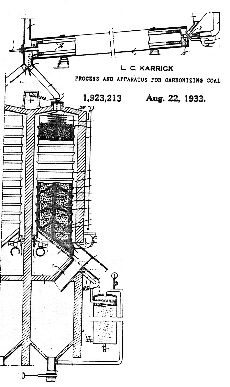
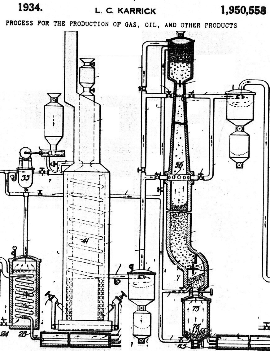
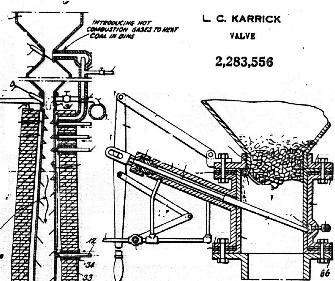
KARRICK, L.: LTC Patents ( 2 ) ~ Karrick's US Patents for LTC of coal.
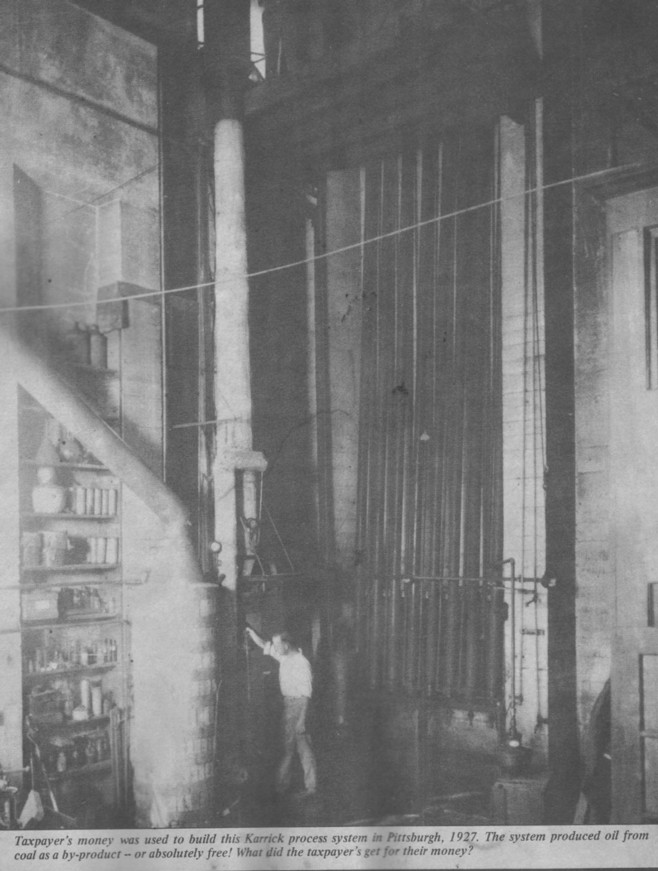
KARRICK, L.: LTC of Coal ( 3 ) ~ Photos of US Bureau of Mines NTU Retorts ( Ind Engg Chem., Jan '51 ), Pittsburgh '27, &c.
KETCHUM, Richard: Karrick LTC Pilot Plant Feasibility Study ~ Construction & operation of a pilot plant for the Karrick Process
KETCHUM, R.: Review of Coal LTC Processes ~ Ketchum, et al., reviewed 101 LTC processes for their applicability to Utah coals; Karrick's best.LARSEN, William / STUTZ, Clifford: Design of Plant for Low Temperature Carbonization of Utah Coal by Karrick Process ~ Complete specifications, parts list, &c for a commercial scale Karrick-LTC pilot plant.
https://en.wikipedia.org/wiki/Karrick_process
The Karrick Process
The Karrick process is a low-temperature carbonization (LTC) and pyrolysis process of carbonaceous materials. Although primarily meant for coal carbonization, it also could be used for processing of oil shale, lignite or any carbonaceous materials. These are heated at 450 °C (800 °F) to 700 °C (1,300 °F) in the absence of air to distill out synthetic fuels–unconventional oil and syngas. It could be used for a coal liquefaction as also for a semi-coke production. The process was the work of oil shale technologist Lewis Cass Karrick at the United States Bureau of Mines in the 1920s.
The Karrick process is a low-temperature carbonization (LTC) and pyrolysis process of carbonaceous materials. Although primarily meant for coal carbonization, it also could be used for processing of oil shale, lignite or any carbonaceous materials. These are heated at 450 °C (800 °F) to 700 °C (1,300 °F) in the absence of air to distill out synthetic fuels–unconventional oil and syngas. It could be used for a coal liquefaction as also for a semi-coke production. The process was the work of oil shale technologist Lewis Cass Karrick at the United States Bureau of Mines in the 1920s...
https://en.wikipedia.org/wiki/Lewis_Karrick
Lewis Karrick
https://www.researchgate.net/publication/375028033_The_Karrick_Process/link/653c3bc8f7d021785f161a26/download?_tp=eyJjb250ZXh0Ijp7ImZpcnN0UGFnZSI6InB1YmxpY2F0aW9uIiwicGFnZSI6InB1YmxpY2F0aW9uIn19
The Karrick Process -- ENCH4PP 2023
Professor Amir H. Mohommedi, et al.
[ PDF ]
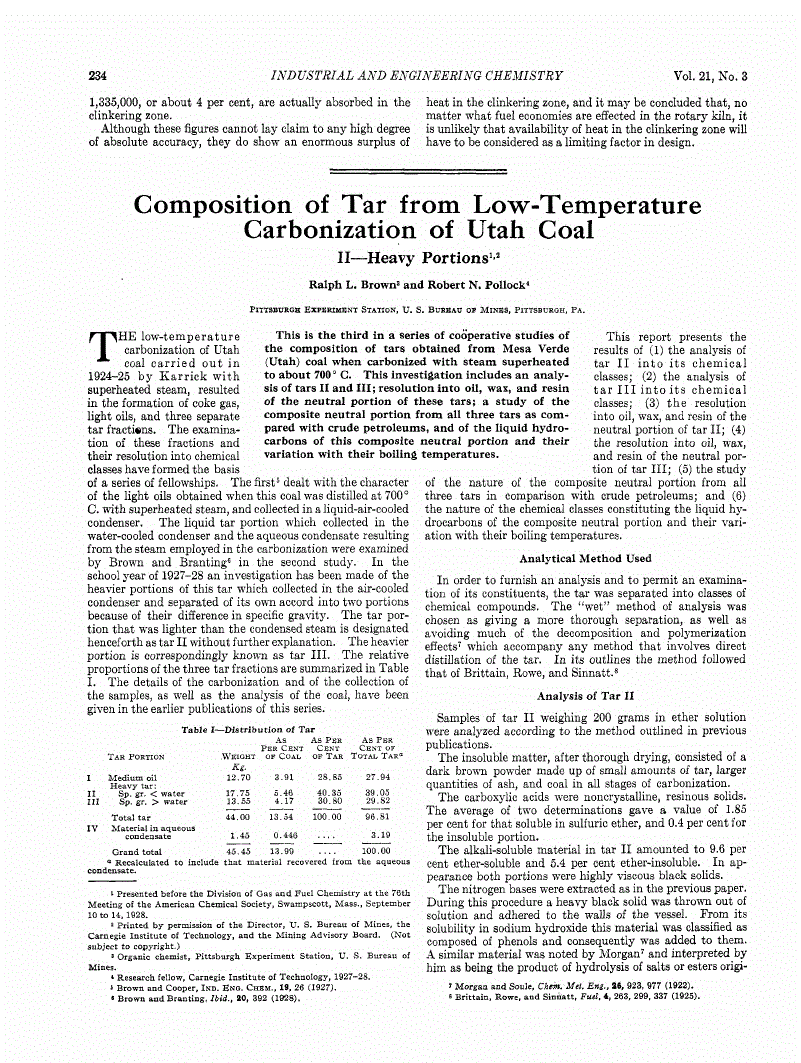
https://pubs.acs.org/iechad/article-abstract/21/3/234/1051540/Composition-of-Tar-from-Low-Temperature?redirectedFrom=PDF
Composition of Tar from Low-Temperature Carbonization of Utah Coal II — Heavy Portions
Ralph L. Brown; Robert N. Pollock
US9926492-- Method and Apparatus for Liquefaction and Distillation of Volatile Matter within Solid Carbonaceous Material
Abstract -- A method for liquefaction of coal or other solid carbonaceous material includes passing the material through a reformer having a temperature gradient therein, the temperature gradient generally increasing as the material flows down through the reformer. The more valuable volatile components of the material exit the material at their respective vaporization temperatures, and pass out of the reformer for processing in condensers. Some of each fraction of the volatile material flow is re-heated and recycled through the reformer to supply heat to maintain the temperature gradient, the recycling injection occurring at a level below that where the fraction exited the reformer so that the recycled fraction will again pass out of the reformer to be condensed. At the bottom of the reformer, the non-volatile portion of the carbonaceous material is removed from the reformer for further processing or sale.
SPEIGHT, James: Synthetic Fuels Handbook -- Properties, Process, and Performance
( p.9 )
Another process to manufacture liquid hydrocarbons from coal is low temperature carbonization (LTC) (Karrick process). Coal is coked at temperatures between 450 and 700°C compared to 800 to 1000°C for metallurgic coke. The lower temperatures optimize the production of coal tar that is richer in lighter hydrocarbons than high-temperature coal tar. The coal tar is then further processed into fuels.
( p.25 )
With respect to coal, there are several processes for the conversion of coal to gas. One in particular, the Karrick process, is a low temperature carbonization process in which coal is heated at 360 to 749°C (680 to 1380°F) in the absence of air to produce oil and gas. For example, Karrick processing of 1 ton (2000 lb) of coal yields up to 1 bbl of coal tar (12 percent by weight, rich in lower molecular weight hydrocarbons suitable for processing into fuels), 3000 ft3 of fuel gas (a mixture of hydrogen, carbon monoxide, methane, and other volatile hydrocarbons), and 1500 lb of solid smokeless char or semicoke. Smokeless char can be used for utility boilers and cooking coal in steel smelters, yields more heat than raw coal, and can be converted to water gas which, in turn, can be converted to hydrocarbon fuel by the Fischer-Tropsch process.
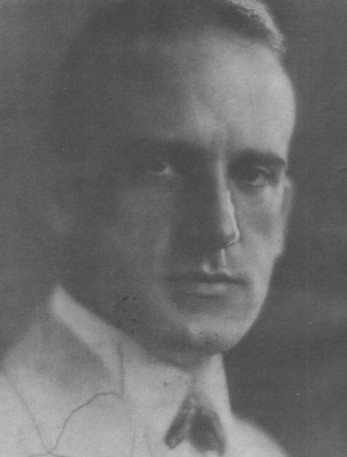
Lewis Cass Karrick