Irving LANGMUIR
Atomic Hydrogen
Atomic Hydrogen
https://en.wikipedia.org/wiki/Atomic_hydrogen_welding
Atomic hydrogen welding
Atomic hydrogen welding (AHW or Athydo[1]) is an arc welding process that uses an arc between two tungsten electrodes in a shielding atmosphere of hydrogen. The process was invented by Irving Langmuir in the course of his studies of atomic hydrogen. The electric arc efficiently breaks up the hydrogen molecules, which later recombine with tremendous release of heat, reaching temperatures from 3400 to 4000 °C. Without the arc, an oxyhydrogen torch can only reach 2800 °C.[2] This is the third-hottest flame after dicyanoacetylene at 4987 °C and cyanogen at 4525 °C. An acetylene torch merely reaches 3300 °C. This device may be called an atomic hydrogen torch, nascent hydrogen torch or Langmuir torch. The process was also known as arc-atom welding.
The heat produced by this torch is sufficient to weld tungsten (3422 °C), the most refractory metal. The presence of hydrogen also acts as a shielding gas, preventing oxidation and contamination by carbon, nitrogen or oxygen, which can severely damage the properties of many metals. It eliminates the need of flux for this purpose.
The arc is maintained independently of the workpiece or parts being welded. The hydrogen gas is normally diatomic (H2), but where the temperatures are over 6,000 °C (10,800 °F) near the arc, the hydrogen breaks down into its atomic form, absorbing a large amount of heat from the arc. When the hydrogen strikes a relatively cold surface (i.e. the weld zone), it recombines into its diatomic form, releasing the energy associated with the formation of that bond. The energy in AHW can be varied easily by changing the distance between the arc stream and the workpiece surface.
In atomic hydrogen welding, filler metal may or may not be used. In this process, the arc is maintained entirely independent of the work or parts being welded. The work is a part of the electrical circuit only to the extent that a portion of the arc comes in contact with the work, at which time a voltage exists between the work and each electrode.
This process is being replaced by gas metal-arc welding, mainly because of the availability of inexpensive inert gases.
https://en.wikipedia.org/wiki/Irving_Langmuir
Irving Langmuir
Irving Langmuir (/ˈlæŋmjʊər/;[2] January 31, 1881 – August 16, 1957) was an American chemist, physicist, and metallurgical engineer. He was awarded the Nobel Prize in Chemistry in 1932 for his work in surface chemistry.

https://www.youtube.com/watch?v=uZwYMyHlWXk
The Inside of Atomic Hydrogen Arc Welding, Part 1 - 1943
https://www.youtube.com/watch?v=Kz-S5wLGHwI
The Inside of Atomic Hydrogen Arc Welding, Part 2 - 1943
https://web.archive.org/web/20080111004745/http://www.lateralscience.co.uk/AtomicH/AHW.html
Atomic - Hydrogen Welding
"A process in which the welding heat is generated by passing a stream of hydrogen through an electric arc between two inclined electrodes, which are usually of tungsten. The high temperature of the arc dissociates molecules of the gas into atoms, a large quantity of heat being absorbed by the hydrogen during dissociation. When the atoms leave the influence of the arc they recombine, forming molecules of hydrogen and liberating heat previously absorbed. The gas then burns in the ordinary way, taking up oxygen from the atmosphere for the purpose.
The average temperature of the flame is approximately 4000 deg. C., which is higher than the maximum temperature of any other flame. The heat is concentrated chiefly at the point of recombination of the atoms, and this recombination is accelerated catalytically by contact with the surface of the metal being welded. Thus an intense flame is obtained at the point of welding. The process is, therefore, used when rapid welding is necessary, as for stainless steels and other special alloys. The hydrogen envelope prevents oxidation both of the metal and the tungsten electrodes, and it also reduces the risk of nitrogen pick-up. The non-oxidizing characteristic is perhaps the most important in practice.
As a rule, the cost of welding by this process is slightly higher than with other processes, but it is sometimes the only practicable method by which a satisfactory weld can be made. An automatic atomic - hydrogen welding process has also been developed in which, instead of using hydrogen from high-pressure cylinders, the hydrogen is obtained by cracking anhydrous ammonia." -- Odhams Practical & Technical Encyclopaedia 1947
https://web.archive.org/web/20080111004750/http://www.lateralscience.co.uk/AtomicH/atomicH.html
Atomic Hydrogen Blowtorch
Invented by Langmuir in 1926 , this device produces a temperature of 3700 degrees centigrade. Tungsten can be melted, diamond vapourised.
A jet of hydrogen gas is dissociated as it passes through an electric arc. H2 > H + H - 422 kJ. An endothermic reaction, with the intensely hot plasma core of the arc providing the dissociation energy. The atomic hydrogen produced soon recombines; and this recombination is the source of such high temperatures (easily outperforming oxy-hydrogen: 2800oC and oxy-acetylene: 3315oC).
The hydrogen can be thought of as simply a transport mechanism to extract energy from the arc plasma and transfer it to a work surface. It produces a true flame, as the heat is liberated by a chemical reaction. H + H > H2 + 422kJ. The molecular hydrogen burns off in the atmosphere, contributing little to the heat output.
From the May 1, 1926 issue of The Science News-Letter -
"...developed by Dr. Irving Langmuir, assistant director of the Schenectady laboratory, and makes use of what he calls flames of atomic hydrogen.... Electric currents of 20 amperes and at voltages ranging from 300 to 800"...
From A Text Book of Inorganic Chemistry, Partington 1946 -
"Atomic hydrogen. - Langmuir (1912) has shown that hydrogen in contact with a tungsten wire heated by an electric current at low pressure, is dissociated into atoms:
H2 <=> 2H. This splitting of the hydrogen molecule is attended by the absorption of a large amount of energy, about 100kcal per gram molecule. The atomic hydrogen so formed is chemically very active. Langmuir also showed that atomic hydrogen is formed when an electric arc between tungsten electrodes is allowed to burn in hydrogen at atmospheric pressure. The atomic hydrogen was blown out of the arc by a jet of molecular hydrogen directed across the arc, and formed an intensely hot flame, which is capable of melting tungsten (m.p. 3400oC). This flame obtains its heat not from combustion but from the recombination of hydrogen atoms into H2. It is suitable for melting and welding many metals. Iron can be melted without contamination with carbon, oxygen or nitrogen. Because of the powerful reducing action of the atomic hydrogen, alloys can be melted without fluxes and without surface oxidation. A feature of the flame is the great rapidity with which heat can be delivered to a surface, which is very important in welding operations."
Atomic hydrogen welding
.
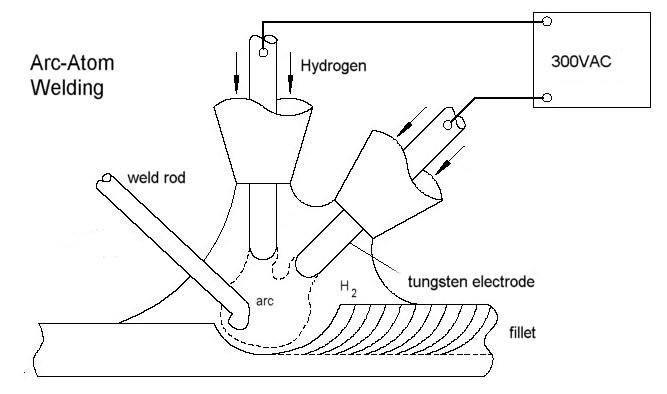
Used extensively before the second world war, particularly in germany. The method was known as Arc-Atom. The welding torch consists of two inclined tungsten electrodes across which an AC arc is struck. Annular nozzles around the electrodes carry hydrogen gas. The gas streams converge forming a fan shaped flame. A transformer with an open circuit voltage of 300V is required to strike and maintain the arc in hydrogen.
Because of the high thermal conductivity of hydrogen, the plasma channel in the arc is constricted, offering very high energy concentration. Arc-Atom welding was of particular use for such jobs as surfacing dies, where the high flame temperature enabled a thin surface layer to be deposited on the thick base metal. Modern sheilding gas methods such as MIG and TIG processes have replaced Arc-Atom, but do not have the extreme temperatures and arc constriction qualities of atomic hydrogen.
https://chavascience.com/en/hydrogen/langmuir-excess-energy-from-hydrogen
Langmuir - excess energy in atomic Hydrogen torch
Nicholas Moller on Langmuir's study on the atomic hydrogen torch
EXCERPTS:
Langmuir - excess energy in atomic Hydrogen torch
... In studying the effect of hydrogen he observed very peculiar phenomena. A limited amount of hydrogen disappeared and became adsorbed on the bulb, where it remained in a chemically active form, which was capable of reacting with oxygen at room temperature even long after the tungsten filament had been allowed to cool. This suggested hydrogen atoms and seemed to confirm some conclusions that Langmuir had already drawn from observations on the heat losses from tungsten filaments in hydrogen at atmospheric pressure. In making squirted tungsten filaments, and sometimes in cleaning the drawn wire, filaments were heated in this manner in hydrogen. Because tungsten filaments melt at a temperature 1500o above the melting point of platinum, it seemed to him that tungsten furnished a tool of particular value for the scientific study of phenomena in gases at high temperatures. From his work on lamps he knew approximately the relation between the electrical resistance of tungsten wire and its temperature, and could thus use a tungsten wire as a kind of resistance thermometer. By connecting a voltmeter and an ammeter to the tungsten filament which was being heated in hydrogen, he could determine the temperature as well as find the heat loss from the filament in watts. He wanted to see if anything abnormal happened when the temperature was raised to the extremes which were only possible with tungsten. The results greatly interested him, for they showed that the energy loss through the gas, was proportional to the square of the temperature up to about 1800oK., and increased at a much higher rate above that, until at the highest temperatures the energy loss was proportional to about the fifth power of the temperature. This result could only be explained if hydrogen at high temperatures were dissociated into atoms. The diffusion of the hydrogen atoms from the filament, and their recombination at a distance from it, would cause an enormous increase in heat conduction. After publishing these preliminary results, he was naturally very interested in getting more information about the properties of these hydrogen atoms. A large number of experiments, extending over several years, were thus made in this study of atomic hydrogen. Nearly all of these experiments would have seemed quite useless, or even foolish, to a man who was making a direct and logical attack on the problem of improving tungsten lamps. When nitrogen at low pressure was introduced into a bulb containing a tungsten filament at extremely high temperatures, such as 2800oK., the nitrogen disappeared at a rate which was independent of its pressure. This suggested that the reaction velocity was limited by the rate at which the tungsten evaporated from the filament. To check this hypothesis the rate of loss of weight of filaments at various temperatures was measured in good vacuum. This rate varied with the temperature in accordance with known thermodynamic laws, and it was concluded that the loss of weight was really due to evaporation and not to chemical action of residual gases or to electric currents that passed from the filament to the surrounding space. A comparison of the rate of disappearance of nitrogen with the loss of weight in the filament showed that one molecule of nitrogen disappeared for every atom of tungsten that evaporated. A brown compound, WN2, was formed which deposited on the bulb and decomposed when water vapor was introduced, forming ammonia gas. From time to time the question kept arising-how good would a lamp be if it had a perfect vacuum? And now, from his studies, he began to have an answer. Hydrogen, oxygen, nitrogen, carbon monoxide, and in fact every gas that he introduced, with the exception of water vapor, did not produce blackening of the lamp bulb. The serious blackening that occurred with only small amounts of water vapor depended upon a cyclic reaction in which atomic hydrogen played an essential part. The water vapor of molecules in contact with the hot filament produced a volatile oxide of tungsten and the hydrogen was liberated in atomic form. The volatile oxide deposited on the bulb where it was reduced to the metallic state by the atomic hydrogen, while the water vapor produced returned to the filament and caused the action to be repeated indefinitely. Thus, a minute quantity of water vapor may cause a relatively enormous amount of tungsten to be carried to the bulb. The question then arose whether the traces of water vapor, which might still exist in a well-exhausted lamp, were responsible for the blackening which limited the life or the efficiency of many of these lamps. They made some tests in which well-made lamps were kept completely immersed in liquid air during their life, so that there could be no possibility of water vapor coming in contact with the filament. The rate of blackening, however, was exactly the same as if no liquid air had been used. Having thus proved that the blackening of a well-made lamp was due solely to evaporation, he could conclude with certainty that the life of the lamp would not be appreciably improved even if they could produce a perfect vacuum.
The heat of Hydrogen disassociation
... The energy loss from heated wires in various gases can be readily calculated by simple equations. For nitrogen and mercury vapor the results calculated in this way agree well with experimental results up to temperatures as high as 3500oK.
With air and carbon dioxide similar agreement was obtained up to the melting point of platinum.
In the case of hydrogen, however, there was agreement only up to about 2100oK. Above that the energy loss increased extremely rapidly such that at 3300oK it was four or five times the calculated value.
This was explained by assuming that hydrogen at very high temperatures is dissociated into atoms.
A theory of the heat conductivity of a dissociating gas was developed.
The heat of reaction and the degree of dissociation at various temperatures was thus calculated. Experiments at low pressures proved that the phenomenon was a true dissociation, and that the volume of the dissociation products was approximately twice the volume of the original hydrogen.
That is, the dissociation took place according to the equation langmur-equation.
There was much evidence that the dissociation was not electrolytic.
Nitrogen, even at 3500oK, was not dissociated at atmospheric pressure. That is, its dissociation did not exceed 5%, at 3500oK.
The following quantitative results were obtained. The heat of reaction at constant volume for 2H H2 was 550,000 joules, or 130,000 calories. At constant pressure it was approximately 575,000 joules, or 136,000 calories at 3000oK.
The degree of dissociation at any temperature, T, was given by the equation
Here p1 is the partial pressure of the hydrogen atoms (in atm), and P is the total pressures (in atm). From this equation the free energy of formation of hydrogen molecules from atoms can be calculated.
Atomic hydrogen flames
Armed with fresh knowledge, Langmuir continued his work exploring the new phenomenon of Atomic Hydrogen and found that the heat carried away from an incandescent wire by a surrounding inert gas at ordinary temperatures increases roughly in proportion to the 1.9th power of the absolute temperature, T of the filament. This relation holds, for example, for such gases as nitrogen, argon, and mercury vapor up to the temperature of melting tungsten, 3660oK.
In the case of hydrogen, however, abnormal results were obtained in experiments made at high temperatures. Up to about 1700oK the normal exponent of 1.9 was observed, but at higher temperatures the exponent increased until at 2600oK and above it was about 5.0. At 3400oK the heat conducted by hydrogen was twenty-three times as high as that carried by nitrogen under similar conditions.
Nernst in 1904 had developed the theory of heat conduction in a dissociating gas and had shown that dissociation results in a great increase in the heat conductivity. The dissociation products diffuse from the hot portions of the gas into the cold portions and there, by recombining, give up the large energy of the reaction. This suggested, as mentioned earlier that the abnormal heat conductivity of hydrogen at high temperatures was due to dissociation of the hydrogen into atoms according to the reaction. By means of theoretical considerations it was possible to determine the degree of dissociation and the heat of the reaction by which atoms combine to form molecules. The results that were published in 1915 gave 90,000 calories as the heat of combination of 2 grams of hydrogen atoms at constant pressure and at 3000oK. The degree of dissociation, x, expressed as the fraction of the molecules which have been dissociated, was found to be, at atmospheric pressure, 0.00165 at 2000oK, 0.0109 at 2400oK, and 0.0421 at 2800oK. Niels Bohr, one of the most prominent theoretical physicist of the time and a close friend of Langmuir, calculated in a valuable and wonderfully suggestive paper on the Constitution of Atoms and Molecules (Phil. Mag. xxvi, p.863, 1913), the heat of formation of hydrogen molecules from the atoms to be 60,000 calories per gram-molecule. He pointed out that this value was considerably less than the value of 130,000 found by Langmuir (J. Amer. Chem. Soc. xxxiv, p. 860, 1912) by measuring the heat-conduction through the gas from an incandescent wire in hydrogen. In order that the results obtained by Langmuir should not bear false evidence against the theory derived by Dr. Bohr, he gave a preliminary account of some more recent measurements carried out by Mr. G.M.J. Mackay and himself, on the dissociation of hydrogen. The method adopted was similar to that previously used, namely, to determine the heat-loss from electrically heated tungsten wires in hydrogen. In these experiments, however, very much greater care was used in determining the temperatures of the wires and in obtaining extremely pure hydrogen. Pressures of hydrogen ranging from 1 mm up to 760 mm of mercury were used. Still further experiments were made at pressures from 0.01 mm up to 20 mm pressure. The measurements at low pressures gave very interesting results: At about one-tenth of an atmospheric pressure in hydrogen, the total heat-loss from filaments heated to very high temperatures (3000oK) was several times as great as in hydrogen at atmospheric pressure. By subtracting the heat-loss due to normal heat-conduction from the total observed heat-loss, the heat carried by diffusion of hydrogen atoms was obtained. By plotting the logarithm of this quantity against the reciprocal of the absolute temperature, straight lines were obtained in each experiment. The slopes of all these lines were practically equal, no matter what pressure of the hydrogen was used (above 10 mmHg). On the assumption that the diffusion coefficient varies with the 3/2 power of the temperature, this lead to the result that the heat of formation of hydrogen is about 76,000 calories per gram-molecule, as against 130,000 previously found. The reason for the high value of the latter figure is that it was based on a calculation of the actual value of the diffusion coefficient of hydrogen atoms through ordinary hydrogen. These results showed that the actual degree of dissociation was much smaller than that previously found, and that even at 3500oK hydrogen was probably not dissociated to a very great extent. Further measurements finally suggested the heat of recombination to be 90.000 calories per gram/molecule. Still a value of extraordinary proportions.
Atomic hydrogen flames
Chemical Properties of Atomic Hydrogen
While the measurements of the heat losses from filaments in hydrogen were being made, other experiments showed that hydrogen which had been in contact with heated filaments acquired entirely new chemical properties, and they were quite in accord with those to be expected of an atomic form of the element. A very remarkable phenomenon occurred when a mixture of oxygen and hydrogen at low pressure was admitted to a bulb containing a filament at 1500oK. The oxygen reacted with the filament rapidly to form W03, which evaporated at this temperature as fast as formed. The oxygen thus cleaned up at a rate proportional to its own pressure and the pressure of oxygen thus fell to half value about every 2 minutes in a bulb of ordinary size. All this occurred exactly as if no hydrogen were present. During this time there was no measurable disappearance of hydrogen. After 10 or 15 minutes the oxygen was nearly all gone and then for 5 or 10 minutes more the gas pressure remained apparently constant and corresponded exactly to that of the hydrogen which was admitted. Then suddenly, when the pressure of oxygen was low enough (10-9 mm), the hydrogen pressure began to drop by dissociation and in a few minutes the pressure fell practically to zero. Water vapor has an effect similar to oxygen in preventing the dissociation of hydrogen. At filament temperatures of 1750oK some of the hydrogen disappeared while the oxygen was cleaning up, but the kink in the curve still occurred when the oxygen was gone. Water vapor and oxygen are thus powerful catalytic poisons for the reaction of the hydrogen dissociation.
Arcs in Hydrogen at Atmospheric Pressures
Several years earlier in the General Electric laboratory studies were made of arcs between tungsten electrodes in various gases. Arcs in hydrogen were remarkable because of the high voltage drop and small cross section. A 10-ampere, direct-current arc between heavy tungsten electrodes about 7 mm apart in a bulb containing pure hydrogen at atmospheric pressure appeared as a sharply defined, brilliant red line about 0.5 mm in diameter along which the potential gradient was 150 volts per centimeter, making a power dissipation of 1500 watts per centimeter of length, this being about fifteen times as great as in nitrogen or argon. This abnormal behavior of hydrogen was then attributed to the dissociation which apparently carried energy so rapidly out of the arc.
Arcs in Hydrogen at Low Pressures
In attempting to obtain the Balmer spectrum of hydrogen without contamination by the secondary spectrum, they built very long vacuum tubes of moderate bore, in which they passed currents as large as 20 amperes through moist hydrogen at about 0.5 mmHg pressure. They observed many remarkable phenomena. Short pieces of tungsten wire projecting into the discharge were heated to incandescence, although a fine thread of glass or a platinum wire in a similar position was apparently not heated by the discharge. On drying the hydrogen with phosphorus pentoxide the secondary spectrum (due to molecular hydrogen) appeared strongly and the Balmer spectrum (due to atomic hydrogen) nearly disappeared. The heating of the tungsten wire was also prevented by drying the hydrogen. In correspondence with Professor Wood, Langmuir pointed out that oxygen and water vapor decrease the rate of dissociation of hydrogen in contact with tungsten and must thus also tend to prevent the recombination of hydrogen atoms an a tungsten surface. He also suggested that moisture poisons the catalytic activity of the dry glass surfaces that otherwise converts atomic into molecular hydrogen. Thus with moist hydrogen the tube becomes filled with nearly pure atomic hydrogen and the diffusion of this to the catalytically active tungsten wire causes the heating of the latter. Calculations based on the measured heat of dissociation proved that a pressure of only 0.16 mmHg of atomic hydrogen at 5000C would suffice to maintain a tungsten filament at 2400oK. These conclusions were confirmed by Wood's observations that the walls of the tube became only slightly heated if the hydrogen was moist, whereas they were strongly heated with dry hydrogen. A tungsten wire was heated red hot even when mounted in a side tube (of 5 mm diameter) at a distance of 4 cm from the discharge tube, showing that the hydrogen atoms could diffuse in relatively large quantities out of the discharge. It occurred to Langmuir that it should be possible to obtain even higher concentrations of atomic hydrogen by passing powerful electric arcs between tungsten electrodes in hydrogen at atmospheric pressure and this atomic hydrogen could be blown out of the arc by a jet of molecular hydrogen directed across the arc.
Preliminary Experiments with Flames of Atomic Hydrogen
To try out the possibility of blowing atomic hydrogen out of an arc, 20-ampere arcs from a constant-current transformer were passed between two tungsten rods 6 mm in diameter mounted transversely in a horizontal alundum tube (10 cm diameter) through which a stream of hydrogen flowed. With voltages from 300 to 800V, arcs could be maintained with electrode separations up to 2 cm. The magnetic field of the arc caused the hydrogen to move transversely so that it became fan-shaped. Iron rods 2 or 3 mm in diameter melted within 1 or 2 seconds when they were held 3 to 5 cm above the arc. By directing a jet of hydrogen from a small tube into the arc, the atomic hydrogen could be blown out of the arc and formed an intensely hot flame. To maintain the arc in a stable condition the electrodes were brought close together (1 to 3 mm), but the arc did not remain entirely between the electrodes, but extended as a fan to a distance of 5 to 8 mm. The flame of atomic hydrogen, however, extended far beyond the arc. At distances of 1 or 2 cm from the arc molybdenum (m.p. 2900oK) melted with ease. Near the end of the arc tungsten rods and even sheet tungsten (m.p. 3660oK) could be melted. The use of hydrogen under these conditions for melting and welding metals proved to have many advantages. Iron can be melted without contamination by carbon, oxygen, or nitrogen. Because of the powerful reducing action of the atomic hydrogen, alloys containing chromium, aluminum, silicon, or manganese can be melted without fluxes and without surface oxidation.
Temperature of Atomic Hydrogen Flame
Compared with Other Flames Let us suppose we could obtain atomic hydrogen in bulk at atmospheric pressure and room temperature and that we could then let this burn to the molecular form in a flame. What would be the temperature of this flame and how would it compare with that of other flames? Taking the heat of reaction (for 2 grams) to be 98,000 calories and taking the specific heat of molecular hydrogen (for 2 grams) to be 6.5 + 0.0009 T, we find that the heat of the reaction would be sufficient to heat the hydrogen to 9200oK. The dissociation of the hydrogen, however, would prevent the temperature from rising to any such high value. If x is the degree of dissociation at the maximum temperature reached, the available heat of recombination is only (1-x) 98,000. Langmuir plotted two curves based on his accumulated data . These two curves intersected at T = 4030oK and x = 0.642. Thus atomic hydrogen at room temperature and atmospheric pressure would heat itself to 40300K and the degree of dissociation would then be 0.642. There is another factor which tends greatly to increase the temperature of the atomic hydrogen flame even above the calculated value of 4030oK. The atomic hydrogen, instead of being originally at room temperature, is already at a high temperature at the moment of its escape from the arc. The conditions are analogous to those in an oxyhydrogen flame in which both gases are preheated. Thus the upper limit of temperature is fixed only by the degree of dissociation of the hydrogen and the rate at which heat is lost by radiation or contact with bodies of lower temperature.
Rate of Surface Heating by Flames
Although the high temperature of the atomic hydrogen flame is of great importance when it is desired to melt substances of very high melting point such as tungsten, a factor of even greater importance in for example ordinary welding operations is the speed with which heat can be delivered to a surface per unit area. If a Bunsen burner flame delivers 51 watts per sq. cm to the whole surface of a black body, it would thus heat it to a maximum temperature of 17300K. If heat is applied by the flame to one side of a plate-shaped body and the heat is radiated from both sides, the maximum temperature reached would be 1450oK. The fact that the Bunsen flame does not heat bodies so hot as this indicates that the rate of surface heating decreases as the temperature of the body increases. The heat reaches the surface from such a flame by conduction through a relatively stationary film of gas. The decrease in the temperature gradient when the body becomes hot would explain the lower rate of surface heating. With 1330 watts per sq. cm delivered by the atomic hydrogen flame, the temperature of a black body would rise to 3900oK. The power radiated from tungsten at its melting point is 395 watts per sq. cm, and 1330 watts per sq. cm should heat tungsten to about 5300oK. At such high temperatures, however, the rate of surface heating by an atomic hydrogen flame must decrease because of the fact that the hydrogen remains partly dissociated so that the recombination is not complete. With surface temperatures below 2000oK, however, this factor would be negligible. It is probable that the rate of surface heating would be dependent not so much on the temperature gradient in the surface film of gas as on the rate of diffusion of atomic hydrogen through this film. Thus we may expect the rate of delivery of energy to a metal surface to remain nearly constant until the surface reaches a temperature of at least 2000oK.
Total Heat Delivered to Surfaces
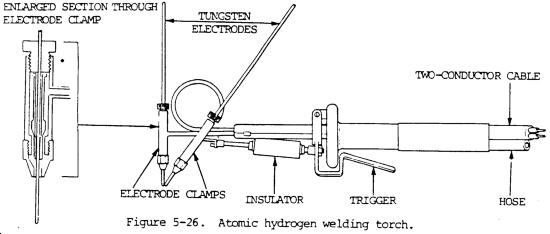
It now became of interest to determine what fraction of the total energy in an arc or a flame could be delivered to a large flat surface against which the flame was directed. For this purpose a cylinder of copper 10.5 cm in diameter and 9.8 cm long was used, which weighed 7950 grams. The flame was directed against one of the flat polished ends, and the rate of temperature rise was measured. An atomic hydrogen flame was produced by a 60-ampere a.c. arc using a torch like that shown here: attomic-hydrogen-torch
The voltage across the electrodes was 70 volts. A wattmeter showed that the power consumption in the arc was 3510 watts, which gives a power factor of 0.84. The electrodes were tungsten rods 3.2 mm in diameter which made an angle of 55 degrees with one another. The rate of flow of hydrogen which bathed the electrodes was 14.2 liters per minute (30 cubic feet per hour). From the temperature rise of the copper block the heat delivered to the surface was found to correspond to 3100 watts when the electrode tips were 3 to 5 mm from the copper surface. This decreased to 2800 watts at 13 mm, 2500W at 25 mm, and 2200W at 35 mm. With the arc turned off but the molecular hydrogen burning in the air, the rate of heating corresponded to 250 watts with the electrodes 6 mm from the surface. Subtracting this energy delivered by the combustion of the hydrogen in the air, we find that the energy carried to the metal by the atomic hydrogen ranged from 2850 to 1950 watts. Thus with the electrodes 3 mm from the metal 82 per cent of the power input into the arc was delivered to the copper surface. This efficiency became 78 per cent at 6 mm, 71 at 13 mm, 65 at 25 mm, and 55 per cent at 35 mm. The power corresponding to the complete combustion of 14.2 liters of hydrogen per minute is 2360 watts. Actually, only 250 watts or 11 per cent of this reaches the copper. The total energy of the arc and the flame of molecular hydrogen is 5870 watts, of which 3100 watts or 53 per cent is delivered to the copper. An oxy-acetylene flame from a standard welding torch consuming 30.6 liters of oxygen per minute (64.8 cubic feet per hour) and 28.6 liters of acetylene per minute (60.6 cubic feet per hour) delivered energy at the rate of 4400 watts to the copper surface. A smaller torch consuming 13.7 liters of oxygen per minute and 13.0 of acetylene (29.0 and 27.5 cubic feet per hour, respectively) gave energy to the copper at the rate of 3900 watts.
Application of Atomic Hydrogen Flames to Welding of Metals
The high temperature of The Atomic Hydrogen flame, together with its powerful chemical reducing action and the avoidance of gases containing oxygen and nitrogen, render it particularly useful for welding, not only for iron and its alloys, but for such metals and alloys as contain aluminum, magnesium, chromium, manganese, etc. The previous figure illustrates one of the later forms of torch used for welding. Two tungsten rods, as electrodes, are held at a definite angle to one another by easily adjustable clamps, and a jet of hydrogen is directed from a small nozzle along each of these rods near its end. The hydrogen thus bathes the heated parts of the electrodes and forms a gentle blast of gas which passes through the arc between the electrode tips, and blows the atomic hydrogen away from the electrodes so that these are not unduly heated. Other torches were also built suitable for automatic welding using machine feed. The electrodes were ordinarily separated 3 or 4 mm and the arc assumed a fan shape extending 6 to 10 mm from the electrodes. Alternating current was generally used. To utilize the atomic hydrogen flame for the welding of metals it became important to have easy and complete control of the flame. Many different forms of welding torches were constructed and tested. The electrodes between which the arc passed were mounted at a convenient angle to one another and were adjustable so that they could be brought into contact at a point which was exposed to a blast of hydrogen from one or more orifices. Thus the atomic hydrogen was blown out of the arc in a definite direction and formed a flame which could be brought into contact with the metal to be welded. The jet of hydrogen also served to bathe all the heated parts of the electrodes and the work, thus preventing oxidation and the introduction of impurities such as nitrogen into the weld. The hydrogen was supplied by a tube which passed through the handle and then by flexible tubes was delivered to each of the electrode holders and escaped through the annular spaces between the electrodes and the lava insulators. Sufficient hydrogen was used not only to surround each of the electrodes to their tips but to form a blast which blew the atomic hydrogen against the work and bathed it in hydrogen.
Electrical Apparatus
Both the striking voltage and the arc voltage were higher for an arc in hydrogen than for the ordinary welding arc since there was no appreciable amount of metallic vapor generated in the arc. The standard arc welding equipment of those days was therefore not suitable as a power source for operating the atomic hydrogen torch. If direct current was used the arc could be stabilized by a series resistance or a specially designed generator of the constant-current type could also be used. With series resistance a line voltage of 250 was found to give good results. Alternating current was more convenient and, since the arc could then be stabilized by reactance instead of resistance, greater efficiency was usually obtained. A line voltage of 350 to 400 gave satisfactory operation. Voltages as high as this were needed solely to give stability and to enable the arc to be started at any time by separating the electrodes even when these were cold. A number of tests were made to determine the voltages required to strike an arc by means of the lever mechanism of the torch. With cold electrodes an open circuit ac voltage of 320 was needed for striking the arc. After the arc had been started and the electrode tips had reached the operating temperature a line voltage of only 150 was sufficient to restart the arc as long as the electrodes remained nearly at the operating temperature. These lower voltages could also be employed to start and maintain the arc if the electrodes were first raised to high temperature by a high current while separating them very slightly so as to have a high contact resistance or by bringing a thin tungsten rod between the separated tips of the electrodes. It was more convenient, however, to use open circuit voltages of approximately 400V rather than to employ these special means of starting the arcs. In normal operation the drop across the arc was in the neighborhood of 80 volts. To avoid danger to the operator the entire arc circuit was preferably insulated from ground. A motor-generator was used to give either direct or alternating current for the arc, but it was usually more satisfactory to use a specially designed transformer. The connections that were used in most of the work to be described are shown in Fig. 3. When the arc was not operating the electrodes were in contact by the action of the spring attached to the control lever, so that there were no voltages on the electrodes and the torch could be laid down on any material without danger of flashing the operator's eyes. To strike the arc the electrodes were merely separated by pressing the lever. Should the open-circuit voltage at any time be impressed across the electrodes when separated, or the operator break the arc by spreading the electrodes too far apart, a relay in the arc circuit (contactor B as shown in Fig. 3) would trip the feeder circuit, in which case it was necessary for the electrodes to be brought in contact again before the main feeder circuit could be restored.circuit-for-attomic-hydrogen-welding-torchThe voltage drop across the arc while in operation varied from 60 to 100 volts, depending on the amount of opening between the electrode tips. This voltage was nearly independent of the current, between the limits of 20 and 70 amp, although a slight decrease in voltage was usually noted when the current was increased. Repeated experiments showed that the lower voltage arc (60 to 80 volts) obtained by separating the electrodes only 1/16 or 1/8 of an inch had a more concentrated working zone and was the most efficient arc for most kinds of welding. By bringing the arc closer to the surface of a larger mass of metal it was found that the metal melted very rapidly. For welding, the maximum rate of heating was desired and this was obtained by bringing the torch so close to the metal that the lower portion of the fan shaped arc was just about in contact with the metal and this caused the arc to change its shape somewhat. The tips of the electrodes were then usually about 3/8 to 1/2 in. from the metal. Portions of the arc could at times become short-circuited by the metal so that the tracks of cathode spots on the metal could be seen,but this seemed to play no important part in the welding process.
Conclusions
The above is a general account of the course of events that led to the development of the atomic hydrogen arc welding technique. Although Langmuir himself had many ideas for other applications of atomic hydrogen, such as using it in melting furnaces, and although General Electric themselves were aware of the vast potential of atomic hydrogen (as expressed by the editor of the General Electric Research Laboratory Publication). The point of inception of many important practical processes can be found in researches in pure science. Following Dr. Langmuir's discovery of atomic hydrogen, conclusion was reached that flames of this gas make possible new applications of far-reaching importance), no subsequent effort was made to develop neither the welding method nor any other application using atomic hydrogen. In spite of the obvious value of the process, industry's excuse for laying the process aside was that it had been replaced by better processes such as Heliarc, TIG, and MIG welding, though plasma arc welding is rarely mentioned which has also almost disappeared from the market. Since plasma arc welding is merely an extension of the atomic hydrogen process, the reasons are undoubtedly the same. As a welding process, atomic hydrogen arc welding was obsolesced by MIG and TIG neither of which compare to its welding efficiency and uses. Considering that atomic hydrogen arc welding hardly got of the ground before it was replaced, it is not a far fetched thought to assume that the interests of welding suppliers and electric power companies were being nursed so that more archaic tanks, transformers, gauges, torches, electrodes, gases, fluxes, power etc. could continue to be sold at profit...
Although the process has limited industrial use today, atomic hydrogen welding is used to weld hard-to-weld metals, such as chrome, nickel, molybdenum steels, Inconel, Monel and stainless steel. Its main application is tool and die repair welding and for the manufacture of steel alloy chains. Also used in special military welding requirements. Nothing is mentioned of the extraordinary properties of atomic hydrogen, nor of its potential for the use as energy to drive the wheels of mankind. However, and quite surprisingly, in one edition of Van Nostrand's Encyclopedia of Science it was stated Hydrogen molecules dissociate to atoms endothermically at high temperatures (heat of dissociation about 103 cal/gram mole) in an electric arc, or by irradiation. The hydrogen atoms recombine at the metal surface to provide heat required for welding. What is surprising here is that the actual energy value needed for the dissociation of the hydrogen molecule is given, but the calorific value for the recombination of the atoms into molecules is strangely omitted. From Langmuir's experiments and findings we know that the minimum calorific value for the recombination of atoms was agreed to be in the region 90.000 cal/gram molecule. In other words we have an input energy of 103 cal/gram molecule and an output energy of 90.000 cal/gram molecule. In conventional science this seems to be violating the law of conservation of energy. Langmuir explained this (however, not very convincingly) by the heat being carried forward from the arc to the metal surface. One area which certainly deserves the attention of modern science, is the replication of Langmuirs experiments using high-tech measurement equipment.
Heat, ZPE & Cold Fusion
...Had Langmuir been familiar with ZPE, he would most certainly have reached other conclusions in terms of explaining the extraordinary energy properties of atomic hydrogen. As it was proven by Langmuir, the volume of the hydrogen when dissociated into atoms increases to the double of the volume of its molecular state. Upon recombination, heat energy is released to the tune of 90.000 cal/gram molecule. When incorporating ZPE in the explanation of the hydrogen process, it could be argued that the hydrogen is not really a fuel but rather a medium, gateway or a super-conductor of ZPE from the vacuum of space, converting ZPE radiation and ultra-high frequency electrical energy into infrared (heat) radiation. On recombination into molecules the ZPE is squeezed out, releasing the absorbed energy. Actually since heat is infra-red spectrum radiation, the process can be conceived as a means of converting ZPE from an ultra-penetrating cold spectrum radiation, to a mass-reactive infra-red heat spectrum radiation, and that is the proximate source of so called FREE ENERGY, in the form of exothermic heat radiation. ZPE can be analogized to a concentrate of sunshine, except it penetrates all matter all the time and is not affected by day or night, so it can be converted into usable energy at all times with the appropriate technology, such as the atomic hydrogen process. The apparent source of the anomalous exothermic heat produced in Cold Fusion is also based on atomic hydrogen. It is important to note that the hydrogen process does not involve a consumption of the hydrogen as it is not combusted in the process. It is merely dissociated and recombined and can therefore be recycled over and over again without consuming more hydrogen than the quantity used to start with...
Books & Articles :
Atomic hydrogen in the local universeZwaan, Martin A
The Dielectric Constant of Atomic Hydrogen from the Point of View of Bohrs Quantum Theory
Aylesworth E. F.
The Dispersion of Atomic Hydrogen II-A Calculation
Langer R. M.
The Dielectric Constant of Atomic Hydrogen in Undulatory Mechanics
Epstein P. S.
The Dispersion of Atomic Hydrogen I-A Measure
Langer R. M.
OCCULT ETHER PHYSICS: Tesla’s Ideal Flying Machine and the Conspiracy to Conceal It
Lyne, William
Patents
Method and apparatus for electric-arc welding
US1746196
SYSTEM FOR AMPLIFYING VARIABLE CURRENTS.
US1297188 // US1282439
ELECTRIC-DISCHARGE-CONTROLLING DEVICE AND METHOD OF OPERATING THE SAME.
US1289823
METHOD OF AND MEANS FOR CONTROLLING ELECTRIC CURRENTS OR POTENTIALS.
US1273627
ELECTRON-DISCHARGE APPARATUS AND METHOD OF PREPARATION.
US1244216
Means for producing alternating currents
US1778456
Electrical discharge apparatus
US1558437
Electrical discharge apparatus and process of preparing and using the same
US1558436
Electrical discharge device
US1892244
Electrical discharge device and method of operation
US1608268
Heating process and apparatus
US1947267
High frequency oscillator
US2051609
High-frequency apparatus and method of heating
US1579009
Alternating-current generation
US1778457
Photo-electric device
US1740252
Electron-discharge device
US1648312
Electric translating circuit
US2024173
Centrifugal fluid purifier
US2485390
Electrical discharge device
US1723869
Method and apparatus for conducting current
US1648183
Electron-emitting device and method of preparation
US1529597
Method and apparatus for producing aerosols
US2437963
Electron discharge apparatus
US2032620
Picture transmission apparatus
US1828571
Electric oscillator
US1561001
Signaling device
US1849842
Method and means for signal to aircraft
US1936400
Method of and means for amplifying potential variations
US1468116
Furnace
US1952927
Sound-detecting device
US1475190
Signaling system
US1615636
Sound-locating apparatus
US1622594
Incandescent lamp
US1804349
Microwave power generating by periodic sweep of electron beam along length of resonant waveguide
US3221207
Method of substance detection
US2232539
Space discharge apparatus
US1769846
Image reproduction
US2198479
Telephone
US1380981
VACUUM-PUMP
US1320874
WIRELESS SIGNALING SYSTEM
US1313093
METHOD OF AND MEANS FOR CONTROLLING ELECTRICAL ENERGY
US1301279
Circuit-control apparatus
US1691395
SYSTEM OF DISTRIBUTION.
US1280769
WIRELESS SIGNALING SYSTEM.
US1280768
ELECTRON-DISCHARGE APPARATUS.
US1273783
ELECTRON-DISCHARGE APPARATUS.
US1273630
METHOD OF EXHAUSTING INCANDESCENT LAMPS.
US1273629
FILM CONDUCTOR AND THE METHOD OF MAKING THE SAME.
US1273628
MEANS FOR TRANSFORMING DIRECT CURRENT.
US1273626
INCANDESCENT LAMP.
US1271483
METHOD OF AND APPARATUS FOR CONTROLLING X-RAY TUBES.
US1251388
INCANDESCENT LAMP.
US1246118
METHOD OF PRODUCING VACUUMS.
US1237210
ELECTROSTATIC TELEPHONE SYSTEM.
US1223496
MEANS FOR INDICATING ELECTRICAL CHARACTERISTICS OF ALTERNATING CURRENTS.
US1219961
Vapor electric device
US1836805
INCANDESCENT LAMP.
US1188186
INCANDESCENT ELECTRIC LAMP.
US1180159
PROCESS FOR MAKING COMPOUND METALLIC ARTICLES.
US1171856
VACUUM-GAGE.
US1126233
Circuit-control apparatus
US1793329
METHOD OF AND APPARATUS FOR PRODUCING EXHAUSTED VESSELS.
US994010
Electron discharge device
US1816682
Method of and means for obtaining high vacua
US1393550
Method of and means for obtaining constant direct currents or potentials
US1349892
ELECTRON-DISCHARGE APPARATUS AND METHOD OF OPERATING THE SAME.
US1244217
SUBSTANCE DETECTION METHOD
CA407671
IMAGE REPRODUCTION SYSTEM
CA398824
HIGH FREQUENCY OSCILLATOR
CA379373
TRANSLATING CIRCUIT
CA356008
SIGNALLING DEVICE
CA351974
ELECTRON DISCHARGE APPARATUS
CA344204
AIRCRAFT SIGNALLING METHOD
CA326701
PICTURE TRANSMISSION APPARATUS
CA323249
HEATING PROCESS AND APPARATUS
CA309869
INCANDESCENT LAMP
CA307872
SPACE DISCHARGE APPARATUS
CA304766
CIRCUIT CONTROL APPARATUS
CA303812
CIRCUIT CONTROL APPARATUS
CA295749
ELECTRICAL DISCHARGE DEVICE
CA282300
METHOD AND APPARATUS FOR ELECTRIC ARC WELDING
CA277010
ELECTRON DISCHARGE DEVICE
CA262974
HIGH FREQUENCY APPARATUS
CA258801
PHOTO-ELECTRIC DEVICE
CA255528
ELECTRON DISCHARGE DEVICE
CA251229
ELECTRON DISCHARGE APPARATUS
CA245999
METHOD AND APPARATUS FOR CONDUCTING CURRENT
CA244944
SYSTEM FOR AMPLIFYING VARIABLE CURRENTS
CA244847
ELECTRICAL DISCHARGE DEVICE
CA244347
ELECTRON EMITTING CATHODE
CA233664
PRODUCTION OF ALTERNATING CURRENTS
CA229458
ELECTRIC OSCILLATOR
CA223530
ELECTRON DISCHARGE APPARATUS
CA213178
MEANS OF PRODUCING ALTERNATING CURRENTS
CA212366
METHOD OF CONTROLLING ELECTRICAL ENERGY
CA209516
METHOD OF AMPLIFYING POTENTIAL VARIATIONS
CA209514
SIGNALLING SYSTEM
CA208845
WIRELESS SIGNALLING SYSTEM
CA208836
MEANS OF TRANSFORMING DIRECT CURRENT
CA203337
SOUND LOCATING APPARATUS
CA203078
SOUND DETECTING DEVICE
CA203077
ELECTRICAL DISCHARGE APPARATUS
CA202295
ELECTRON DISCHARGE APPARATUS
CA200849
ELECTRICAL DISCHARGE APPARATUS
CA200061
WIRELESS SIGNALLING SYSTEM
CA198803
CONTROLLER FOR ELECTRIC CURRENTS
CA198076
CURRENT AMPLIFYING SYSTEM
CA196390
AMPLIFICATION OF VARIABLE CURRENTS
CA196145
VACUUM PUMP
CA184876
ELECTRON DISCHARGE APPARATUS
CA179691
INCANDESCENT ELECTRIC LAMP
CA177227
MEANS OF OBTAINING HIGH VACUUM
CA175400
FILM CONDUCTOR
CA174211
ELECTRON DISCHARGE APPARATUS
CA170239
LAMP EXHAUST METHOD
CA166121
X-RAY TUBE MECHANISM
CA165747
INCANDESCENT LAMP
CA164828
VACUA PRODUCTING APPARATUS
CA162814
INCANDESCENT LAMP
CA162570
ELECTRICAL LAMP
CA155290
Improvements in and relating to electrical discharge apparatus
AU1467714
Improvements in incandescent lamps
AU1260414