Nano-Iron Oxide Suture
http://onlinelibrary.wiley.com/enhanced/doi/10.1002/anie.201401043/
Organ Repair, Hemostasis, and In Vivo Bonding of Medical Devices by Aqueous Solutions of Nanoparticles
Anne Meddahi-Pellé, et al
[ PDF ]
Abstract -- Sutures are traumatic to soft connective tissues, such as liver or lungs. Polymer tissue adhesives require complex in vivo control of polymerization or cross-linking reactions and currently suffer from being toxic, weak, or inefficient within the wet conditions of the body. Herein, we demonstrate using Stöber silica or iron oxide nanoparticles that nanobridging, that is, adhesion by aqueous nanoparticle solutions, can be used in vivo in rats to achieve rapid and strong closure and healing of deep wounds in skin and liver. Nanoparticles were also used to fix polymer membranes to tissues even in the presence of blood flow, such as occurring after liver resection, yielding permanent hemostasis within a minute. Furthermore, medical devices and tissue engineering constructs were fixed to organs such as a beating heart. The simplicity, rapidity, and robustness of nanobridging bode well for clinical applications, surgery, and regenerative medicine.
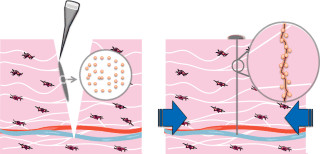
https://www.researchgate.net/figure/Scheme1-The-concept-of-nanobridging-for-wound-closure-Left-A-droplet-of-nanoparticle_fig2_261702063
https://pubs.rsc.org/nr/article-abstract/9/24/8418/572066/Developing-a-tissue-glue-by-engineering-the?redirectedFrom=fulltext
Nanoscale (2017) 9 (24): 8418–8426.
Developing a tissue glue by engineering the adhesive and hemostatic properties of metal oxide nanoparticles
Martin T. Matter
Despite decades
of research, wound complications remain a major cause of
postoperative mortality, especially in the face of
multiple comorbidities. Addressing the issue of
anastomotic leakages and impaired wound healing from a new
angle is of great interest with the prospect of having
direct impact on patient outcome. Recently, aqueous
suspensions of silica and iron oxide nanoparticles have
been employed to connect biological tissue by serving as
an adhesive layer eventually leading to macroscopic gluing
of tissue. In this work, we explore the prospects of this
effect by introducing bioactive tissue adhesives composed
of nanoparticles produced via scalable and
sterile flame spray pyrolysis. We investigate six
different metal oxides on cytocompatibility, hemostatic
activity and adhesive properties in a small intestine lap
joint model. While bioglass nanoparticles show
exceptionally strong procoagulant and adhesive properties,
the cell membrane integrity is impaired at high particle
concentrations. Interestingly, when bioglass is combined
with ceria, a material that has well-documented
cytoprotective effects, the resulting hybrid particles
exhibit the same beneficiary effects as bioglass while
featuring superior cytocompatibility. Taken together, we
demonstrate highly modular synthesis of nanoparticles
expressing adhesive properties in conjunction with
tailored bioactivity. Such bioactive nanoparticles as
adhesion nuclei in wound healing have a wide range of
potential applications in surgical wound care and
regenerative medicine.
https://www.mdpi.com/2079-4991/11/9/2337
Iron Oxide Nanoparticles in Regenerative Medicine and
Tissue Engineering
by Ralf P. Friedric, Iwona Cicha, Christoph Alexiou
[ PDF ]
https://www.tandfonline.com/doi/full/10.2147/DDDT.S375541
https://doi.org/10.2147/DDDT.S375541
Recent Advances in Nano-Formulations for Skin Wound Repair Applications
Yue Lin, et al
[ PDF ]
Abstract -- Skin injuries caused by accidents and acute or chronic diseases place a heavy burden on patients and health care systems. Current treatments mainly depend on preventing infection, debridement, and hemostasis and on supplementing growth factors, but patients will still have scar tissue proliferation or difficulty healing and other problems after treatment. Conventional treatment usually focuses on a single factor or process of wound repair and often ignores the influence of the wound pathological microenvironment on the final healing effect. Therefore, it is of substantial research value to develop multifunctional therapeutic methods that can actively regulate the wound microenvironment and reduce the oxidative stress level at the wound site to promote the repair of skin wounds. In recent years, various bioactive nanomaterials have shown great potential in tissue repair and regeneration due to their properties, including their unique surface interface effect, small size effect, enzyme activity and quantum effect. This review summarizes the mechanisms underlying skin wound repair and the defects in traditional treatment methods. We focus on analyzing the advantages of different types of nanomaterials and comment on their toxicity and side effects when used for skin wound repair.
US11383004 -- METHODS FOR ADHERING TISSUE SURFACES AND MATERIALS AND BIOMEDICAL USES THEREOF
The present invention relates to methods for adhering tissue surfaces and materials and biomedical uses thereof. In particular the present invention relates to a method for adhering a first tissue surface to a second tissue surface in a subject in need thereof, comprising the steps of adsorbing a layer of nanoparticles on at least one of the tissue surfaces, and approximating the surfaces for a time sufficient for allowing the surfaces to adhere to each other. The present invention also relates to a method for adhering a material to a biological tissue in a subject in need thereof, comprising the steps of adsorbing a layer of nanoparticles on the surface of the material and/or the biological tissue and approximating the material and the biological tissue for a time sufficient for allowing the material and the biological tissue to adhere to each other.
US8536281-- METHOD FOR SYNTHESIZING SUPRAMOLECULAR MATERIALS
The present invention relates to a method for synthesizing a supramolecular material comprising: 1—the reaction of at least one carboxylic diacid, or ester or chloride of such a diacid, with, on the one hand, at least one modifier compound bearing both reactive functional groups capable of reacting with the carboxylic acid, ester or acid chloride functional groups and associative groups capable of associating with one another by hydrogen bonds, in a molar ratio of the reactive functional groups to the carboxylic acid, ester or acid chloride functional groups of between 0.10 and 0.50, and, on the other hand, at least one polyamine, said reactions being carried out successively or simultaneously, and 2—the reaction of the polyamide obtained at the end of step 1 with urea. The present invention also relates to the resulting material, and also to the uses thereof.
US2011104073 -- IRON/IRON OXIDE NANOPARTICLE AND USE THEREOF
The present invention is a nanoparticle composition composed of an iron core with an iron oxide shell which is optionally coated with a micro-emulsion. The disclosed nanoparticle compositions are disclosed for use in hyperthermia treatment and imaging of cancer.
US8445025 -- Hybrid Superparamagnetic Iron Oxide Nanoparticles and Polyethylenimine as a Magnetocomplex for Gene Transfection
Disclosed are the nanoparticle and the method for the same, and the preparing method includes steps of mixing polyethylenimine (PEI) with the poly(acrylic acid)-bound iron oxide (PAAIO) to form a PEI-PAAIO polyelectrolyte complex (PEC) and mixing the PEI-PAAIO PEC with genetic material such as plasmid DNA to form the PEI-PAAIO/pDNA magnetic nanoparticle. The PEI-PAAIO/pDNA magnetoplex is highly water dispersible and suitable for long term storage, shows superparamagnetism, low cytotoxicity, high stability and nice transfection efficiency, and thus the PEI-PAAIO PEC can replace PEI as a non-viral gene vector.
CN103531323 -- Preparation method for magnetic liquid without surfactants
The invention belongs to material technology field, be specifically related to the preparation method of surfactant-free magnetic liquid.The technical problem that the present invention solves is to provide a kind of preparation method of the magnetic liquid without surfactant. Technical scheme of the present invention is the preparation method of surfactant-free magnetic liquid, comprises the steps: the preparation of a, ferric oxide nano microparticulate phase; The preparation of b, decentralized medium carrier fluid; Synthesizing of c, magnetic liquid.The inventive method can be used for the preparation of magnetic liquid.
CN103288140 -- Method for simply regulating ferroferric oxide nanoparticle morphology
A kind of method of simple regulation and control ferriferrous oxide nano-particle pattern is that divalent iron salt and trivalent iron salt is soluble in water, adds NaOH again, and the pH value is adjusted to 10-12, stir, get Z 250, filter, water and ethanol alternately clean, and obtain spherical ferriferrous oxide nano-particle after the drying; Divalent iron salt and trivalent iron salt is soluble in water, add sodium lauryl sulphate and NaOH again, the pH value is adjusted to 10-12, and under visible light source, shine, get Z 250, filter, water and ethanol alternately clean, and obtain ferriferrous oxide nano-particle or the bar-shaped ferriferrous oxide nano-particle of cubic after the drying.That the present invention has is relatively simple, low production cost, pattern easy-regulating, is easy to realize the advantage of mass-producing.
CN102766267 -- Preparation method of chitosan hydrogel containing magnetic nanoparticle
The invention relates to a preparation method of chitosan hydrogel containing magnetic nanoparticle, which comprises the following steps of: (1) dissolving the chitosan powder in 0.5%-5% of acetic acid solution, mechanically stirring until clarification; taking 5-10ml of the mixture obtained in the step (1), adding 200ul-1000ul of magnetic nanoparticle dispersion with the iron content of 1.2g/ml-1.4g/ml, then adding 200ul-1000ul of crosslinking agent, reacting at room temperature for 2h-36h, and conducting Schiff reaction to produce the chitosan hydrogel containing magnetic nanoparticle. The magnetic nanoparticle is polyacrylic acid coated iron oxide nanoparticle. The crosslinking agent is glutaraldehyde or a mixture of polyethylene glycol and formaldehyde. The chitosan hydrogel containing magnetic nanoparticle is brown, transparent and has no significant precipitation and reunion internal, can be used as an auxiliary pressure material for masks used in the burn treatment, so as to enable the mask better fit the face of people and further strengthen the effect of pressure treatment.
CN102515283 -- Preparation method of magnetic iron oxide nanoparticle capable of stably dispersing in water
The invention discloses the preparation method of the magnetic ferric oxide nano particles of a kind of ability stable dispersion in water.Take by weighing the poly glycol monomethyl ether of polyoxyethylene glycol or the molecular weight of 10~30 gram triglycols or molecular weight from 600~20000 from 600~20000, add 0.15~3 gram additive, above raw material is packed in the there-necked flask; Place to be heated to 70~90 ? on the temperature control magnetic stirring apparatus, add 0.1~3 gram analytical pure ferric acetyl acetonade again, stirred 5~15 minutes with magnetic agitation; Pass to mobile argon shield in the heat-processed, and then be warming up to 150~320 ?, heated 20~600 minutes; Be cooled to below 60 ?; Add 50~70ml analytical pure toluene or acetone, twice of analytical pure acetone used in magnet absorption again; Resolution of precipitate in water, is obtained the magnetic ferric oxide nano particles of particle diameter in 3~50 nanometers.Reaction process of the present invention is simple, puts into production easily; Prepared magnetic ferric oxide nano particles can be used for fields such as biology, medicine, catalysis and power lubrication.
KR101141716 -- LARGE-SCALE MANUFACTURING METHOD OF HIGH-SURFACE AREA IRON OXIDE NANOPARTICLES
Disclosed is the manufacturing method of the large area iron oxide nanoparticle the iron oxide nanoparticle to the simple composition method the mass production.The manufacturing method of the large area iron oxide nanoparticle according to the present invention comprises the step of mixing (a) ferric nitrate precursor and organic solvent: the step of processing with ultrasonic wave with at a room temperature for 10 ~ 30 minute the solution mixed with (b) the above: the step of washing after doing the acquisition the ferric oxide precipitate it dips into the centrifuge: the step of obtaining the iron oxide nanoparticle it is dry: and step of in the nitrogen gas atmosphere of 100 ~ 600?, it is plasticized for 4 ~ 12 hours (e) iron oxide nanoparticle.
TWI344940 -- Method for manufacturing iron oxide nanorod
A method for manufacturing iron oxide nanorod comprises the use of FeC as the substrate, the polymer material as the carbon source, and the composition of metal catalyst are added as the precursor. It will form the iron oxide nanorod by specific temperature controlling conditions.