Soniculture
https://www.mdpi.com/2071-1050/15/3/2776
Effect of Audio Control Technology on Lettuce Growth
Su Wang, Qingqing Xiao
[ PDF ]
Abstract
The excessive use of pesticides and fertilizers reduces the quality of crops, harms human health, and causes environmental pollution, thus hindering the sustainable development of agriculture. In the process of realizing ecological agricultural production, audio control technology has increasingly become an area of concern. As a physical agricultural technology, it has become a combination of music acoustics and agricultural science. However, the research on the ecological role and function of audio control technology is still relatively lacking. In view of this, the authors studied the effects of audio control technology (specific frequency sound wave and different types of music) on the growth of lettuce, and showed that the specific frequency sound wave treatment produced by the plant acoustic frequency technology generator significantly increased the growth of lettuce compared with the condition of silent environment processing. Treatments of different types of music (electronic music, rock music, and classical music) promoted lettuce growth, especially the significant increase in the output of edible parts under the influence of electronic music. The research results further showed that the specific frequency sound wave treatment produced by the plant acoustic frequency technology generator enhanced the chlorophyll content of lettuce leaves (1.98 ± 0.15 mg/g), thus promoting photosynthesis. Different types of music had different effects on the photosynthesis of lettuce leaves; electronic music treatment increased the chlorophyll content of lettuce (1.48 ± 0.07 mg/g), and had the greatest impact.
https://www.mdpi.com/2076-0817/10/1/63
Pathogens 2021, 10, 63.
Plant Health and Sound Vibration: Analyzing Implications of the Microbiome in Grape Wine Leaves.
Wassermann, B.; Korsten, L.; Berg, G.
[ PDF ]
Abstract
Understanding the plant microbiome is a key for plant health and controlling pathogens. Recent studies have shown that plants are responsive towards natural and synthetic sound vibration (SV) by perception and signal transduction, which resulted in resistance towards plant pathogens. However, whether or not native plant microbiomes respond to SV and the underlying mechanism thereof remains unknown. Within the present study we compared grapevine-associated microbiota that was perpetually exposed to classical music with a non-exposed control group from the same vineyard in Stellenbosch, South Africa. By analyzing the 16S rRNA gene and ITS fragment amplicon libraries we found differences between the core microbiome of SV-exposed leaves and the control group. For several of these different genera, e.g., Bacillus, Kocuria and Sphingomonas, a host-beneficial or pathogen-antagonistic effect has been well studied. Moreover, abundances of taxa identified as potential producers of volatile organic compounds that contribute to sensory characteristics of wines, e.g., Methylobacterium, Sphingomonas, Bacillus and Sporobolomyces roseus, were either increased or even unique within the core music-exposed phyllosphere population. Results show an as yet unexplored avenue for improved plant health and the terroir of wine, which are important for environmentally friendly horticulture and consumer appreciation. Although our findings explain one detail of the long-term positive experience to improve grapevine’s resilience by this unusual but innovative technique, more mechanistic studies are necessary to understand the whole interplay.
https://www.worldscientific.com/doi/abs/10.1142/S0192415X99000173
Am. J. Chin. Med. 1999, 27, 131–141.
Applied studies of the plant meridian system: II. Agri-wave technology increases the yield and quality of spinach and lettuce and enhances the disease resistant properties of spinach.
Hou, T.Z.; Mooneyham, R.E.
Abstract
Agri-wave technology is composed of both a special frequency sound wave and a microelement fertilizer. In both components, the effect of sound waves on plants is more than that of fertilizers, but the best function is a combination of the two. Treatment by Agri-wave technology stimulated the growth rate and increased the yield of spinach. In small plot tests, the length and width of the treated spinach leaf was 50.8 cm and 20.3 cm, respectively, whereas the untreated leaves were 29.20 cm and 8.9 cm. The fresh weight of treated spinach was 0.42 kg. This was 5.5 times higher than that of the untreated spinach. In large area testing (17 hectares), the results of two tests show that the yields of the treated spinach were increased 22.7% and 22.2% over those of the control group. Sugar content of the treated spinach was increased by 37.5%, vitamin A, C, and B were increased 35.63%, 41.67% and 40.00%, respectively, above the levels of the control group. Niacin content was decreased by 7.69%. Of 33 elements analyzed in the spinach, 29 elements were increased by Agri-wave technology. The spinach was infected with "rot disease" in the control group while there was no disease present in the treated group. In greenhouse testing, the average weight of 3 species of lettuce treated by Agri-wave technology was increased 44.10% over that of the control group (P < 0.000 1). The average weight of 3 species of lettuce by only sound and only fertilizer treated separately increased 29.92% and 16.19% above that of the control group (p < 0.0001). Sampling survey results in the field test were comparable to the above mentioned greenhouse test. The fresh weight of treated lettuce by Agri-wave technology was increased 41.67% over that of the control group (p < 0.0001). The fresh weight of treated lettuce by only sound and only fertilizer was increased 30.88% and 19.61%, respectively, over the control group (both P < 0.0001).
https://www.sciencedirect.com/science/article/pii/S0927776502001522
Colloids Surf. B 2003, 29, 99–102.
Effect of sound wave on the synthesis of nucleic acid and protein in chrysanthemum.
Wang, X.J.; Wang, B.C.; Jia, Y.; Duan, C.R.; Sakanishi, A.
Abstract
Environmental factors can greatly influence the growth and development of plants, even the genetic character. It had been found that sound stimulation had an obvious effect on the growth and development of plants. But the mechanism of how sound affected the growth of plants is not clear so far. In this paper, we studied the effect of sound on the nucleic acid and soluble protein to explore the mechanism of the biological effect of sound. It was found that sound wave had no obvious influence on the content of DNA but accelerated the synthesis of RNA and soluble protein. By means of the assay of relation, the content of soluble protein had a very close relationship with that of RNA. This result indicated that some stress-induced genes might be switched on under sound stimulation and the level of transcription increased.
https://www.sciencedirect.com/science/article/pii/S0925521415300636
Kim, J.Y.; Lee, J.S.; Kwon, T.R.; Lee, S.I.; Kim, J.A.; Lee, G.M.; Park, S.C.; Jeong, M.J.
Sound waves delay tomato fruit ripening by negatively regulating ethylene biosynthesis and signaling genes.
Postharvest Biol. Technol. 2015, 110, 43–50.
Abstract
Regulation of tomato fruit ripening may help extend fruit shelf life and prevent losses due to spoilage. Here, tomato fruit were investigated whether sound treatment could delay their ripening. Harvested fruit were treated with low-frequency sound waves (1 kHz) for 6 h, and then monitored various characteristics of the fruit over 14-days at 23 ± 1 °C. Seven days after the treatment, 85% of the treated fruit were green, versus fewer than 50% of the non-treated fruit. Most of the tomato fruit had transitioned to the red ripening stage by 14 days after treatment. Ethylene production and respiration rate were lower in the sound-treated than non-treated tomatoes. Furthermore, changes in surface color and flesh firmness were delayed in the treated fruit. To investigate how sound wave treatment effects on fruit ripening, the expression of ethylene-related genes was analyzed by quantitative real-time RT-PCR analysis. The expression level of several ethylene biosynthetic (ACS2, ACS4, ACO1, E4 and E8) and ripening-regulated (RIN, TAGL1, HB-1, NOR, CNR) genes was influenced by sound wave treatment. These results indicated that sound wave treatment delays tomato fruit ripening by altering the expression of important genes in the ethylene biosynthesis and ethylene signaling pathways.
https://www.sciencedirect.com/science/article/pii/S209531191360492X
Advances in effects of sound waves on plants.
Hassanien, R.H.E.; Hou, T.Z.; Li, Y.F.; Li, B.M.
J. Integr. Agric. 2014, 13, 335–348.
Abstract
Sound waves technology has been applied to different plants. It has been found that sound waves were at different frequencies, sound pressure levels (SPLs), exposure periods, and distances from the source of sound influence plant growth. Experiments have been conducted in the open field and under greenhouse growing conditions with different levels of audible sound frequencies and sound pressure levels. Sound waves at 1 kHz and 100 dB for 1 h within a distance of 0.20 m could significantly promote the division and cell wall fluidity of callus cells and also significantly enhance the activity of protective enzymes and endogenous hormones. Sound waves stimulation could increase the plant plasma-membrane H+-ATPase activity, the contents of soluble sugar, soluble protein, and amylase activity of callus. Moreover, sound waves could increase the content of RNA and the level of transcription. Stress-induced genes could switch on under sound stimulation. Sound waves at 0.1–1 kHz and SPL of (70±5) dB for 3 h from plant acoustic frequency technology (PAFT) generator within a distance ranged from 30 to 60 m every other day significantly increased the yield of sweet pepper, cucumber and tomato by 30.05, 37.1 and 13.2%, respectively. Furthermore, the yield of lettuce, spinach, cotton, rice, and wheat were increased by 19.6, 22.7, 11.4, 5.7, and 17.0%, respectively. Sound waves may also strengthen plant immune systems. It has been proved that spider mite, aphids, gray mold, late blight and virus disease of tomatoes in the greenhouses decreased by 6.0, 8.0, 9.0, 11.0, and 8.0%, respectively, and the sheath blight of rice was reduced by 50%. This paper provides an overview of literature for the effects of sound waves on various growth parameters of plant at different growth stages.
https://www.mdpi.com/2076-2615/11/12/3572
Ciborowska, P.; Michalczuk, M.; Bie?, D.
The Effect of Music on Livestock: Cattle, Poultry and Pigs.
Animals 2021, 11, 3572.
[ PDF ]
Abstract
The welfare of animals, especially those kept in intensive production systems, is a priority for modern agriculture. This stems from the desire to keep animals healthy, to obtain a good-quality final product, and to meet the demands of today’s consumers, who have been increasingly persuaded to buy organic products. As a result, new sound-based methods have been pursued to reduce external stress in livestock. Music therapy has been known for thousands of years, and sounds were believed to improve both body and spirit. Today, they are mostly used to distract patients from their pain, as well as to treat depression and cardiovascular disorders. However, recent studies have suggested that appropriately selected music can confer some health benefits, e.g., by increasing the level and activity of natural killer cells. For use in livestock, the choice of genre, the loudness of the music and the tempo are all important factors. Some music tracks promote relaxation (thus improving yields), while others have the opposite effect. However, there is no doubt that enriching the animals’ environment with music improves their welfare and may also convince consumers to buy products from intensively farmed animals. The present paper explores the effects of music on livestock (cattle, poultry and pigs) on the basis of the available literature.
Wang, S.; Shao, Y.; Duan, J.; He, H.; Xiao, Q.
Effects of Sound Wave and Water Management on Growth and Cd Accumulation by Water Spinach (Ipomoea aquatica Forsk.).
Agronomy 2022, 12, 2257.
Abstract
Vegetable contamination by cadmium (Cd) is of great concern. Water spinach (Ipomoea aquatica) is a common leafy vegetable in many countries and has a strong ability to accumulate Cd. The work was conducted to study the effects of sound wave, water management, and their combination on Cd accumulation and growth of water spinach, using the following three experiments: a hydroponic trial with the treatment of a plant acoustic frequency technology (PAFT) generator in test sheds, a hydroponic trial with three music treatments (electronic music (EM), rock music (RM), and classical music (CM)) in artificial climate boxes, and a soil pot trial with treatments of PAFT and EM under non-flooded and flooded conditions. The results showed that the hydroponic treatments of PAFT and EM significantly reduced the Cd concentrations in roots and shoots (edible parts) of water spinach by 22.01–36.50% compared with the control, possibly due to sound waves decreasing the root tip number per unit area and increasing average root diameter, root surface area, and total root length. Sound wave treatments clearly enhanced water spinach biomass by 28.27–38.32% in the hydroponic experiments. In the soil experiment, the flooded treatment significantly reduced the Cd concentrations in roots and shoots by 43.75–63.75%, compared with the non-flooded treatment. The Cd decrease and the biomass increase were further driven by the PAFT supplement under the flooding condition, likely related to the alteration in root porosity, rates of radial oxygen loss, extractable soil Cd, soil Eh, and soil pH. Our results indicate that the co-application of plant acoustic frequency technology and flooded management may be an effective approach to reduce Cd accumulation in water spinach.
https://www.mdpi.com/2073-4395/8/7/127
Ozkurt, H.; Altuntas, O.
Quality Parameter Levels of Strawberry Fruit in Response to Different Sound Waves at 1000 Hz with Different dB Values (95, 100, 105 dB).
Agronomy 2018, 8, 127.
[ PDF ]
Abstract
All living organisms perceive mechanical signals, regardless of their taxonomic classifications or life habits. Because of their immobility, plants are influenced by a variety of environmental stresses, such as mechanical stress, during their growth and development. Plants develop physiological behaviors to adapt to their environment for long-term development and evolution. Sound-induced stress—an abiotic stress factor—is an example of mechanical stress and is caused by sound waves generated by different sources. This stress has a negative effect on the development and growth of plants. The strawberry plants evaluated in this study were exposed to three different sound intensity levels (95, 100, 105 dB) at a constant frequency of 1000 Hz. In strawberry plants, stress induced by sound waves is thought to trigger increased production of secondary metabolites as a defense mechanism. To determine the effect of sound applications, the fresh and dry weights of the roots and shoots were measured in strawberry plants, and the pH, total soluble solids (Brix), titratable acidity, vitamin C, total sugar, total acid, and total phenols were analyzed in the fruits. Results show that the sound stress, which was produced at a constant frequency (1000 Hz) and different sound levels (95, 100, 105 dB), affects the growth parameters of the plant and several quality parameters of the fruit.
https://cigrjournal.org/index.php/Ejounral/article/view/5841
Hassanien, R.H.E.; Li, B.M.; Hou, T.Z.
Dual effect of audible sound technology on the growth and endogenous hormones of strawberry.
Agric. Eng. Int. CIGR J. 2020, 22, 262–273.
[ PDF ]
ABSTRACT
Sound waves could improve the growth and increase yield. However, it could be a form of environmental stresses. Therefore, the aim of this study was to investigate the effect of audible sound on the growth and endogenous hormones of strawberry plants (Fragaria_ananassa). Five endogenous hormones, namely indole-3-acetic acid (IAA), gibberellin (GA), abscisic acid (ABA), jasmonic acid (JA) and Zeatin Riboside (ZR) have been investigated. Plants exposed to sound frequency of 0.1 - 1 kHz and sound pressure level (SPL) of 70 - 100 dB for 2 hours, 3 hours and 5 hours at different growth stages. Results revealed that plants have different responses to sound waves at different growth stages. Acoustic frequency could accelerate the blooming and the flowering rates in a short run. In contrast, exposing plants to sound for more than 3 hours per day for a long run more than 40 days could inhibit the growth. However, sound treatment could significantly accelerate the blooming and the flowering rates. The maximum concentration of ABA was in leaves of the treated plants for 90 days, each day for 5 hours. Whereas, mean of IAA levels in leaves of control plants was insignificantly higher than those of the treated plants for 5 hours and 2 hours after 90 days of sound treatment. Moreover, no significant difference was found in the concentration of JA in leaves between all treated plants and control plants after 75 and 90 days. In conclusion, audible sound could stimulate or inhibit the growth of strawberry plants.
http://www.pertanika.upm.edu.my/resources/files/Pertanika%20PAPERS/JST%20Vol.%2028%20(1)%20Jan.%202020/05%20JST-1745-2019.pdf
Hendrawan, Y.; Rizky, A.; Susilo, B.; Prasetyo, J.; Damayant, R.
The Effect of Javanese Gamelan Music on the Growth of Chinese Broccoli.
Pertanika J. Sci. Technol. 2020, 28, 69–90.
[ PDF ]
Abstract
Plant acoustic frequency technology (PAFT) is a technology that utilizes sound waves in the form of frequencies within the audiosonic threshold. The purpose of this study was to test PAFT by using Javanese gamelan music entitled puspawarna on the productivity of vegetative growth in Kailaan (Brassica alboglabra) plant. PAFT exposure time was given to plants during the morning and evening. The frequencies ranged in 3-5 kHz, 7-9 kHz and 11-13 kHz. In addition, sound exposure times were for 1 hour, 2 hours and 3 hours. Based on the statistical analysis, the results indicated that the frequency and sound exposure time had a significant effect on plant wet weight, plant length, and stomata openings. The best frequency for Kailaan plant growth was in 3-5 kHz with the best exposure time of 3 hours. The combination of frequency and sound exposure time resulted in the most optimal stomata openings (stomata diameter at the top of the leaves of 89.19~ 93.45 µm and stomata diameter at the bottom of the leaves of 136.69~ 140.74 µm) with chlorophyll of 80.86 chlorophyll content index (cci), plant length of 47.33 cm, plant wet weight of 84 g, area of leaves of 207.06 cm2, plant height of 9.4 cm, and number of leaves of 11 strands.
https://journals.sagepub.com/doi/pdf/10.1089/107555304322849039?cf-mal-redirected=true&cookieSet=17)
Creath, K.; Schwartz, G.E.
Measuring effects of music, noise, and healing energy using a seed germination bioassay.
J. Altern. Complement. Med. 2004, 10, 113–122.
Objective
To measure biologic effects of music, noise, and healing energy without human preferences or placebo effects using seed germination as an objective biomarker.
Methods
A series of five experiments were performed utilizing okra and zucchini seeds germinated in acoustically shielded, thermally insulated, dark, humid growth chambers. Conditions compared were an untreated control, musical sound, pink noise, and healing energy. Healing energy was administered for 15-20 minutes every 12 hours with the intention that the treated seeds would germinate faster than the untreated seeds. The objective marker was the number of seeds sprouted out of groups of 25 seeds counted at 12-hour intervals over a 72-hour growing period. Temperature and relative humidity were monitored every 15 minutes inside the seed germination containers. A total of 14 trials were run testing a total of 4600 seeds.
Results
Musical sound had a highly statistically significant effect on the number of seeds sprouted compared to the untreated control over all five experiments for the main condition (p < 0.002) and over time (p < 0.000002). This effect was independent of temperature, seed type, position in room, specific petri dish, and person doing the scoring. Musical sound had a significant effect compared to noise and an untreated control as a function of time (p < 0.03) while there was no significant difference between seeds exposed to noise and an untreated control. Healing energy also had a significant effect compared to an untreated control (main condition, p < 0.0006) and over time (p < 0.0001) with a magnitude of effect comparable to that of musical sound.
Conclusion
This study suggests that sound vibrations (music and noise) as well as biofields (bioelectromagnetic and healing intention) both directly affect living biologic systems, and that a seed germination bioassay has the sensitivity to enable detection of effects caused by various applied energetic conditions.
https://d1wqtxts1xzle7.cloudfront.net/125605750/JABB-02-00048-libre.pdf?1764674233=&response-content-disposition=inline%3B+filename%3DAudible_Sound_in_Form_of_Music_Can_Influ.pdf&Expires=1784484341&Signature=BzBDkBF58tT5HktOyAondeHfnVwIxCnuLQEzZCz-nCRbWIsVUO~kFSWcOPW9novhLWu8rW1mEsb8KQiT8jZ-s6ogt9VMUODPC20NVRJ3p1tq19AXMQkqc-7FrqLMUBEC2kuBr968Chg5FqLmXgFiZYn2SRNxPFtohqxuWrDnu1Ma1hoTymfi~tH2MLpZFpIc4SYo5W1u2hgdAdacRBafKCfVhrYMdSkqiYK3wHCSd1DlI2yyPW~GLK10RNWfoK8NP~IkA~YYr0oSAvuylJrwfjgZq76dLekyQbCWx0mUDbe5NJBtfboh9Gmq5~gSvH8g1B4YwYrMn~sUMTKmP4g-4A__&Key-Pair-Id=APKAJLOHF5GGSLRBV4ZA
J. Appl. Biotechnol. Bioeng. 2017, 2, 212–219.
Audible Sound in Form of Music Can Influence Microbial Growth; Metabolism and Antibiotic Susceptibility.
Sarvaija, N.; Kothari, V.
https://link.springer.com/article/10.1186/s13104-017-2643-4
BMC Res. Notes 2017, 10, 323.
The effect of frequency-specific sound signals on the germination of maize seeds.
Vicient, C.M.
Objective
The effects of sound treatments on the germination of maize seeds were determined.
Results
White noise and bass sounds (300 Hz) had a positive effect on the germination rate. Only 3 h treatment produced an increase of about 8%, and 5 h increased germination in about 10%. Fast-green staining shows that at least part of the effects of sound are due to a physical alteration in the integrity of the pericarp, increasing the porosity of the pericarp and facilitating oxygen availability and water and oxygen uptake. Accordingly, by removing the pericarp from the seeds the positive effect of the sound on the germination disappeared.
https://sciresol.s3.us-east-2.amazonaws.com/IJST/Articles/2016/Issue-48/Article162.pdf
Indian J. Sci. Technol. 2016, 9, 48–55.
The Effect of Sound Waves at Different Frequencies upon the Plant Element Nutritional Uptake of Snake Plant (Sansevieria trifasciata) Plants.
Ozkurt, H.; Altuntas, O.
[ PDF ]
Abstract
Objectives: The objective of this study was to determine how different sound frequency values effect on plant growth, development and nutrient element uptake of Sansevieria trifasciata. Methods/Statistical analysis: In the study, Sansevieria trifasciata plants were exposed to 3 different frequency values as 600 HZ sound wave in the first week, 1240 HZ in the second week and 1600 Hz sound waves in the third week at 90 dB adjusted as constantly. At the end of applications practiced each week, nutritional element and chlorophyll analysis were performed in leaf samples. Findings: The content of nitrogen, potassium, and phosphor increased in the plants at 90 dB that was kept as constant during the research process and 600 HZ that is the first frequency value when they underwent a stress. When the frequency level was increased to 1240 HZ, whereas phosphor and potassium uptakes decreased significantly than the control plants, the level of nitrogen was determined as nearly the same with the control plants. In terms of calcium, magnesium, and zinc element contents, zinc and magnesium at 600 HZ value was at a lower value than the control plants and calcium had a closer value to the control plants. Finally, there was no change at chlorophyll content in plants kept at the lowest frequency. However, as the frequency increased, in other words as the stress increased, the increase at the amount of the chlorophyll also appeared significantly. Application/Improvements: The results indicated that N, P and K uptake increased at 1600 Hz; and Mg, Ca and Zn uptake increased at 1240 HZ. Fe uptake was negatively affected at all frequency levels. The chlorophyll content found no significant at any frequency value.
https://www.proquest.com/openview/0dc952e88eb29da933bb9e5d31a47efa/1?pq-origsite=gscholar&cbl=1596357
Agric. Sci. Technol. 2012, 13, 2197–2201.
Effects of sonic waves at different frequencies on propagation of Chlorella pyrenoidosa.
Jiang, S.R.; Rao, H.J.; Chen, Z.J.; Liang, M.M.; Li, L.L.
Abstract [Objective]
The aim was to investigate the effects of sound wave on propagation of Chlorella pyrenoidosa to explore the optimal frequency for Chlorella pyrenoidosa.[Method] In the research, Chlorella pyrenoidosa was cultured for 7 d with sound waves at different frequencies and a control group was set to study effects of sound wave at different frequencies on growth of Chlorella pyrenoidosa.[Result] Growth of Chlorella pyrenoidosa was significantly improved by sound wave, especially for wave at 400 Hz.[Conclusion] Chlorella pyrenoidosa propagation would be promoted by sound wave at certain frequencies.
https://pakbs.org/pjbot/PDFs/46(6)/11.pdf
Pak. J. Bot. 2014, 46, 2015–2020.
Sound frequencies induce drought tolerance in rice plant.
Jeong, M.J.; Cho, J.I.; Park, S.H.; Kim, K.H.; Siddiqui, Z.S.
[ PDF ]
Abstract
To test the sound’s effect on plant and its contribution in drought tolerance, plants were subjected to various sound frequencies for an hour. After 24 h sound treatment, plants were exposed to drought for next five days. During the experiment it was observed that sound initiated physiological changes showing tolerance in plant. Sound frequency with? 0.8 kHz enhanced relative water content, stomatal conductance and quantum yield of PSII (Fv/Fm ratio) in drought stress environment. Hydrogen peroxide (H2O2) production in sound treated plant was declined compared to control. ThermaCAM (Infra-red camera) a software which was used to analyze the plant images temperature showed that sound treated plant and leaf had less temperature (heat) compared to control. The physiological mechanism of sound frequencies induce tolerance in rice plants are discussed.
https://d1wqtxts1xzle7.cloudfront.net/100048505/s0927-776528012900275-220230319-1-u5lp91-libre.pdf?1679249588=&response-content-disposition=inline%3B+filename%3DEffects_of_sound_field_on_the_growth_of.pdf&Expires=1784484887&Signature=eXmoDeJ-eIeNGLmBTPN8CuWFqmNcsqzKCJ1Kx8K2-1rm4ke2qfpfedBgsX5MalkRsXrOhJeDZq~wZqQODIDHW0CuxLUwQRPoxZCbiJ5uvt7x2wsPgXfuqR~AQOa37QYe0EFsM5hm-PpsFWD~ZW79fdPzcGCjRWidOyMvhtP94g8SxJRleA7eR~C3Q1OrkYh5gC2nm2gQ~Rs5QfG6bx4KUn0Rc~dKzMcDEEMn6xk-HXgyi0YWpw1u4r3MTapMHLVso5HojPawjnTI8I7VDwf6sLB4whJzJHSVcSQnNoi1~VInY0wnNwBH9eDILXks3EqWqDnQo9n-rD88z~8063aVDw__&Key-Pair-Id=APKAJLOHF5GGSLRBV4ZA
Colloids Surf. B 2002, 24, 321–326.
Effects of sound field on the growth of Chrysanthemum callus.
Li, Y.Y.; Wang, B.C.; Long, X.F.; Duan, C.R.; Sakanishi, A.
[ PDF ]
Abstract
The effects of sound field on Chrysanthemum callus were studied. The field of alternative stress was generated through a strong sound field system set up in our lab, and the activity of SOD, the content of soluble proteins, the activity of IAA oxidase and the absorption rate of calcium were measured. We found that the sound field stimulation has dual effects, which can enhance or inhibit the growth of Chrysanthemum callus, the growth effects of sound field on Chrysanthemum callus depended greatly on the intensity and frequency of sound field. The activity of SOD, the content of soluble proteins and the absorption rate of calcium in callus increased with the intensity and frequency increasing. However, those indexes began to decrease when the intensity and frequency went beyond the limit of 100 dB and 800 Hz, respectively. However, the changing tendency of IAA oxidase activity was reversed to the above three indexes. We draw a conclusion that the optimal stimulation conditions are 100 dB and 800 Hz. Under the conditions, the sound field can distinctly enhance the growth of Chrysanthemum callus. We think that moderate stress stimulation can enhance the assimilation of tissues or cells, improve their physiological activity and accelerate the growth of plants, this moderate stress stimulation is helpful to the growth of plant tissues.
https://www.researchgate.net/profile/Tae-Wan-Kim-15/publication/261028227_Biochemical_and_physiological_changes_in_plants_as_a_result_of_different_sonic_exposures/links/02e7e53310a6aac5ee000000/Biochemical-and-physiological-changes-in-plants-as-a-result-of-different-sonic-exposures.pdf
Ultrasonics 2003, 41, 407–411.
Biochemical and physiological changes in plants as a result of different sonic exposures.
Qin, Y.C.; Lee, W.C.; Choi, Y.C.; Kim, T.W.
[ PDF ]
Abstract
The effects of two different sonic exposures on two vegetables, namely Chinese cabbage and cucumber at two growth stages, including seedlings and mature plants were investigated. The 3 h exposures included either 20 kHz sound waves or “green music” that comprised classic music and natural sounds such as those of birds, insects, water, etc. Analysis of variance between groups (ANOVA) was used to determine the appropriate statistics parameters for the different treatments. Both exposures caused significant elevations in the level of polyamines (PAs) and increased uptake of oxygen O2 in comparison with the controls. For Chinese cabbage the highest PAs’ levels were determined for both seedlings and mature plants that were exposed to “green music”. The oxygen uptake in Chinese cabbage also increased as a result of sonic exposures, and the highest oxygen uptake was also observed after “green music” treatment. For cucumber, the highest content of PAs for both seedlings and mature cucumber plants was determined as a result of 20 kHz ultrasound exposure. 20 kHz exposure of mature plants also resulted in the highest level of oxygen uptake. No statistically significant differences in the vitamin C level were determined between the different sonic treatments and sham exposed vegetables.
https://www.sciencedirect.com/science/article/abs/pii/S0927776502000371
Colloids Surf. B 2003, 27, 65–69.
Effect of sound stimulation on roots growth and plasmalemma H+-ATPase activity of chrysanthemum (Gerbera jamesonii).
Jia, Y.; Wang, B.C.; Wang, X.J.; Duan, C.R.; Yang, X.C.
Abstract
Chrysanthemum seedlings are treated by sound wave with a certain intensity (100 db) and frequency (1000 Hz) for 3, 6, 9, 12 and 15 days, respectively, and each day for 60 min. The results show that the activity of roots and the content of soluble protein increase greatly under sound stimulation. The activity of plasmalemma H+-ATPase increases while stimulated by sound wave. The concentration of Ca2+, the Ca2+ passage blocker (Verapamil) and the Ca2+ carrier (A23187) can affect the activity of plasmalemma H+-ATPase and the protein kinase inhibitor (Staurosporine) can decrease the activity. The results indicate that the phosphorylation–dephosphorylation process probably regulates the activity of plasmalemma H+-ATPase under sound stimulation.
https://www.nature.com/articles/s41598-017-02556-9.pdf
Sci. Rep. 2017, 7, 2527.
Positive regulatory role of sound vibration treatment in Arabidopsis thaliana against Botrytis cinerea infection.
Choi, B.; Ghosh, R.; Gururani, M.A.; Shanmugam, G.; Jeon, J.; Kim, J.; Bae, H.
[ PDF ]
Abstract
Sound vibration (SV), a mechanical stimulus, can trigger various molecular and physiological changes in plants like gene expression, hormonal modulation, induced antioxidant activity and calcium spiking. It also alters the seed germination and growth of plants. In this study, we investigated the effects of SV on the resistance of Arabidopsis thaliana against Botrytis cinerea infection. The microarray analysis was performed on infected Arabidopsis plants pre-exposed to SV of 1000 Hertz with 100 decibels. Broadly, the transcriptomic analysis revealed up-regulation of several defense and SA-responsive and/or signaling genes. Quantitative real-time PCR (qRT-PCR) analysis of selected genes also validated the induction of SA-mediated response in the infected Arabidopsis plants pre-exposed to SV. Corroboratively, hormonal analysis identified the increased concentration of salicylic acid (SA) in the SV-treated plants after pathogen inoculation. In contrast, jasmonic acid (JA) level in the SV-treated plants remained stable but lower than control plants during the infection. Based on these findings, we propose that SV treatment invigorates the plant defense system by regulating the SA-mediated priming effect, consequently promoting the SV-induced resistance in Arabidopsis against B. cinerea.
https://www.researchgate.net/publication/336677121_Render_a_sound_dose_Effects_of_implementing_acoustic_frequencies_on_plants'_physiology_biochemistry_and_genetic_makeup
IJCS 2019, 7, 2668–2678.
Render a sound dose: Effects of implementing acoustic frequencies on plants’ physiology, biochemistry and genetic makeup.
Joshi, N.; Nautiyal, P.; Papnai, G.; Supyal, V.; Singh, K.
[ PDF ]
Abstract
Like other environmental factors, Sound vibrations also reported to greatly influence the plants at physical, biochemical and gene level. Based on relevant literature, this manuscript discusses the influence of Sound vibration in stimulating various growth and developmental parameters in plants like seed germination, root elongation, photosynthesis, nutrient uptake, yield, post harvest shelf-life, and also highlights various researches carried out to support influence of acoustic frequencies in defense, metabolism, cell cycle, and production of secondary metabolites, hormones and enzymes. Application of wide range of sound frequencies, infrasonic to ultrasonic, could provide myriad possibilities in advancement of future agriculture; however, a more comprehensive knowledge on signalling and regulation mechanisms is required to exploit the full potential.
https://www.tandfonline.com/doi/pdf/10.1080/15592324.2017.1368938?__cf_chl_tk=qeA6oWeCo_FPEHa23QmsQIl3r.c9D4hjIzGuQtmNWAE-1784481811-1.0.1.1-L7iHbj3JQtfMIwERMX9K_QfBQIWlNF9R5lqp4dwxO2A
Plant Signal. Behav. 2017, 12, 10.
Drought tolerance induced by sound in Arabidopsis plants.
López-Ribera, I.; Vicient, C.M.
[ PDF ]
Abstract
We examined the responses of sound-treated arabidopsis adult plants to water deprivation and the associated changes on gene expression. The survival of drought-induced plants was significantly higher in the sound treated plants (24,8%) compared with plants kept in silence (13,3%). RNA-seq revealed significant upregulation of 87 genes including 32 genes involved in abiotic stress responses, 31 involved in pathogen responses, 11 involved in oxidation-reduction processes, 5 involved in the regulation of transcription, 2 genes involved in protein phosphorylation/dephosphorylation and 13 involved in jasmonic acid or ethylene synthesis or responses. In addition, 2 genes involved in the responses to mechanical stimulus were also induced by sound, suggesting that touch and sound have at least partially common perception and signaling events.
https://link.springer.com/article/10.1134/S0026261715020125
Microbiology 2015, 84, 227–235.
Effect of audible sound in form of music on microbial growth and production of certain important metabolites.
Sarvaiya, N.; Kothari, V. E
Abstract
Effect of a type of Indian classical music (Raag Kirwani) comprised of the sound corresponding to a frequency range of 38–689 Hz, on microbial growth, production of certain important metabolites, and antibiotic susceptibility was investigated. All the bacteria and yeasts used as test organisms were found to register better (3.15–40.37% higher) growth under the influence of music, except Serratia marcescens. Music treatment was also found to affect production of bacterial pigments (prodigiosin and violacein) whose production is normally linked with quorum-sensing in the producing bacteria. All the test organisms exhibited an increased antibiotic susceptibility (increase ranging from 3.81–18.69%) under the influence of music. Chromobacterium violaceum and S. marcescens were found to degrade cephazolin at a faster rate when incubated with music. Membrane permeability of the test organisms seemed to get altered owing to music treatment. Intracellular concentration of cations (calcium and potassium) and protein content of the music treated cultures was also significantly different than the untreated control. The audible sound in form of music employed in this study was able to affect growth, metabolism, and antibiotic susceptibility of prokaryotic as well as eukaryotic microbes.
https://scijournals.onlinelibrary.wiley.com/doi/pdf/10.1002/jsfa.10077
Int. J. Mol. Sci. 2021, 22, 5739.
Sound Waves Promote Arabidopsis thaliana Root Growth by Regulating Root Phy-tohormone Content.
Kim, J.Y.; Lee, H.-J.; Kim, J.A.; Jeong, M.-J.
[ PDF ]
BACKGROUND
Sound waves are emerging as a potential biophysical alternative to traditional methods for enhancing plant growth and phytochemical contents. However, little information is available on the improvement of the concentration of functional metabolites like flavonoids in sprouts using sound waves. In this study, different frequencies of sound waves with short and long exposure times were applied to three important varieties to improve flavonoid content. The aim of this study was to investigate the effect of sound waves on flavonoid content on the basis of biochemical and molecular characteristics.
RESULTS
We examined the effects of various sound wave treatments (250?Hz to 1.5 kHz) on flavonoid production in alfalfa (Medicago sativa), broccoli (Brassica oleracea) and red young radish (Raphanus sativus). The results showed that sound wave treatments differentially altered the total flavonoid contents depending upon the growth stages, species and frequency of and exposure time to sound waves. Sound wave treatments of alfalfa (250?Hz), broccoli sprouts (800?Hz) and red young radish sprouts (1 kHz) increased the total flavonoid content by 200%, 35% and 85%, respectively, in comparison with untreated control. Molecular analysis showed that sound waves induce the expression of genes of the flavonoid biosynthesis pathway, which positively corresponds to the flavonoid content. Moreover, the sound wave treatment significantly improves the antioxidant efficiency of sprouts.
CONCLUSIONS
The significant improvement of flavonoid content in sprouts with sound waves makes their use a potential and promising technology for the production of agriculture-based functional foods.
https://scijournals.onlinelibrary.wiley.com/doi/pdf/10.1002/jsfa.10077
J. Sci. Food Agric. 2020, 100, 431–440.
Sound waves affect the total flavonoid contents in Medicago sativa, Brassica oleracea, and Raphanus sativus sprouts.
Kim, J.Y.; Kang, Y.E.; Lee, S.I.; Kim, J.A.; Muthusamy, M.; Jeong, M.J.
[ PDF ]
BACKGROUND
Sound waves are emerging as a potential biophysical alternative to traditional methods for enhancing plant growth and phytochemical contents. However, little information is available on the improvement of the concentration of functional metabolites like flavonoids in sprouts using sound waves. In this study, different frequencies of sound waves with short and long exposure times were applied to three important varieties to improve flavonoid content. The aim of this study was to investigate the effect of sound waves on flavonoid content on the basis of biochemical and molecular characteristics.
RESULTS
We examined the effects of various sound wave treatments (250?Hz to 1.5 kHz) on flavonoid production in alfalfa (Medicago sativa), broccoli (Brassica oleracea) and red young radish (Raphanus sativus). The results showed that sound wave treatments differentially altered the total flavonoid contents depending upon the growth stages, species and frequency of and exposure time to sound waves. Sound wave treatments of alfalfa (250?Hz), broccoli sprouts (800?Hz) and red young radish sprouts (1 kHz) increased the total flavonoid content by 200%, 35% and 85%, respectively, in comparison with untreated control. Molecular analysis showed that sound waves induce the expression of genes of the flavonoid biosynthesis pathway, which positively corresponds to the flavonoid content. Moreover, the sound wave treatment significantly improves the antioxidant efficiency of sprouts.
CONCLUSIONS
The significant improvement of flavonoid content in sprouts with sound waves makes their use a potential and promising technology for the production of agriculture-based functional foods.
https://academic.oup.com/pcp/article-abstract/32/5/729/1939977
Plant Cell Physiol. 1992, 32, 729–732.
Growth promotion by vibration at 50 Hz in rice and cucumber seedlings.
Takakashi, H.; Suge, H.; Kato, T.
[ PDF ]
Abstract
Vibrationat 50 Hz significantly stimulated seed germination and root elongation in both rice and cucumber plants. The vibration barely affbcted the elongation of cucumber hypocotyls but stimulated the elongation of rice coleoptiles...
https://pmc.ncbi.nlm.nih.gov/articles/PMC10581969/
The role of sound stimulation in production of plant secondary metabolites
Li Wu, ET AL
[ PDF ]
Abstract
Sound vibration is one of natural stimuli trigging physiological changes in plants. Recent studies showed that sound waves stimulated production of a variety of plant secondary metabolites, including flavonoids, in order to enhance seed germination, flowering, growth or defense. In this review, we examine the potential role of sound stimulation on the biosynthesis of secondary metabolites and the followed cascade of physiological changes in plants, from the perspective of transcriptional regulation and epigenetic regulation for the first time. A systematic summary showed that a wide range of factors may regulate the production of secondary metabolites, including plant species, growth stage, sound types, sound frequency, sound intensity level and exposure time, etc. Biochemical and physiological changes due to sound stimulation were thoroughly summarized as well, for secondary metabolites can also act as a free radical scavenger, or a hormone signaling molecule. We also discussed the limits of previous studies, and the future application of sound waves in biosynthesis of plant secondary metabolites.
https://www.researchgate.net/publication/308648628_Exposure_to_Sound_Vibrations_Lead_to_Transcriptomic_Proteomic_and_Hormonal_Changes_in_Arabidopsis
Sci. Rep. 2016, 6, 33370.
Exposure to sound vibrations lead to transcriptomic, proteomic, and hormonal changes in Arabidopsis.
Ghosh, R.; Mishra, R.C.; Choi, B.; Kwon, Y.S.; Bae, D.W.; Park, S.C.; Jeong, M.J.; Bae, H.H.
[ PDF ]
Abstract
Sound vibration (SV) is considered as an external mechanical force that modulates plant growth and development like other mechanical stimuli (e.g., wind, rain, touch and vibration). A number of previous and recent studies reported developmental responses in plants tailored against SV of varied frequencies. This strongly suggests the existence of sophisticated molecular mechanisms for SV perception and signal transduction. Despite this there exists a huge gap in our understanding regarding the SV-mediated molecular alterations, which is a prerequisite to gain insight into SV-mediated plant development. Herein, we investigated the global gene expression changes in Arabidopsis thaliana upon treatment with five different single frequencies of SV at constant amplitude for 1 h. As a next step, we also studied the SV-mediated proteomic changes in Arabidopsis. Data suggested that like other stimuli, SV also activated signature cellular events, for example, scavenging of reactive oxygen species (ROS), alteration of primary metabolism, and hormonal signaling. Phytohormonal analysis indicated that SV-mediated responses were, in part, modulated by specific alterations in phytohormone levels; especially salicylic acid (SA). Notably, several touch regulated genes were also up-regulated by SV treatment suggesting a possible molecular crosstalk among the two mechanical stimuli, sound and touch. Overall, these results provide a molecular basis to SV triggered global transcriptomic, proteomic and hormonal changes in plant.
https://horizonepublishing.com/journals/index.php/PST/article/view/677
Plant Sci. Today 2019, 6, 639–644.
Impact of different musical nodes and vibrations on plant development.
Singh, P.; Srivastava, N.; Joshi, N.; Shastri, I.
[ PDF ]
Abstract
The effects of ambient environmental factors on physiological attributes of plants have been explored extensively. Among all the factors, impact of sound on the plants is an interesting aspect to study. This review attempts to comprehend the impact of sound waves on the development and behaviour of the plants. Musical nodes with healing energy have a certain impact on seeds germination. This can enhance overall plant health by improving growth and resistance, beyond chemical triggers.. In past, seed growth and germination behaviour, influenced by different pre-treatments has been studied for different plants. This review is an effort to provide an indication of the recent results, constraints, and prospective applications of sound wave therapy as a physical trigger for modulating physiological characteristics and giving plants an adaptive benefit. Sound wave therapy is now emerging as a fresh promotion for protecting crops from harmful circumstances and maintaining plant fitness.
https://pubmed.ncbi.nlm.nih.gov/12091718/
Plant Cell Physiol. 2002, 43, 647–651.
Effects of mechanical vibration on seed germination of Arabidopsis thaliana (L.) Heynh.
Uchida, A.; Yamamoto, K.T.
Abstract
The effects of sinusoidal vibration (40-120 Hz, amplitude equal to or smaller than 0.42 mm) on seed germination of Arabidopsis thaliana were examined. When the amplitude of vibration was fixed at 0.42 mm, vibration with frequencies higher than 70 Hz increased the rate of seed germination. When the frequency of vibration was fixed at 100 Hz, vibration with amplitudes larger than 0.33 mm also increased the rate of germination. The increase in the rate of germination appeared dependent on acceleration calculated from the frequency and amplitude of vibration. Vibration with a maximum acceleration of 70 m s(-2) increased the rate of germination, but the promotive effects leveled off at higher accelerations. Vibration had little effect on seed germination in a starch-deficient mutant, pgm. Thus, the amyloplasts appeared to act as a susceptor that senses mechanical vibrations. No vibration-induced promotion of germination was seen in an ethylene-insensitive mutant, etr1, or in the wild type in the presence of aminoethoxyvinylglycine, an inhibitor of ethylene synthesis, suggesting that vibration increased the rate of seed germination through the action of ethylene.
https://pmc.ncbi.nlm.nih.gov/articles/PMC4830253/
Gu, S.; Zhang, Y.; Wu, Y.
Effects of sound exposure on the growth and intracellular macromolecular synthesis of E. coli k-12.
PeerJ 2016, 4, e1920.
[ PDF ]
Abstract
Microbes, as one of the primary producers of the biosphere, play an important role in ecosystems. Exploring the mechanism of adaptation and resistance of microbial population to various environmental factors has come into focus in the fields of modern microbial ecology and molecular ecology. However, facing the increasingly serious problem of acoustic pollution, very few efforts have been put forth into studying the relation of single cell organisms and sound field exposure. Herein, we studied the biological effects of sound exposure on the growth of E. coli K-12 with different acoustic parameters. The effects of sound exposure on the intracellular macromolecular synthesis and cellular morphology of E. coli K-12 were also analyzed and discussed. Experimental results indicated that E. coli K-12 exposed to sound waves owned a higher biomass and a faster specific growth rate compared to the control group. Also, the average length of E. coli K-12 cells increased more than 27.26%. The maximum biomass and maximum specific growth rate of the stimulation group by 8000 Hz, 80dB sound wave was about 1.7 times and 2.5 times that of the control group, respectively. Moreover, it was observed that E. coli K-12 can respond rapidly to sound stress at both the transcriptional and posttranscriptional levels by promoting the synthesis of intracellular RNA and total protein. Some potential mechanisms may be involved in the responses of bacterial cells to sound stress.
https://cjs.sljol.info/articles/10.4038/cjs.v47i4.7553
Munasinghe, D.S.P.; Weerakoon, S.R.; Somaratne, S.
The effect of Buddhist pirith chanting and Western pop music on growth performance of “Pranajeewa”, Codariocalyx motorius (Houtt.) H. Ohashi.
Ceylon J. Sci. 2018, 47, 357–361.
[ PDF ]
Abstract
Response of Codariocalyx motorius to Western pop music and Pirith chanting was examined by conducting an experiment with three months old C. motorius saplings, kept in a sound proof confined chamber. Completely Randomized Design (CRD) was used with five replicates. One week after planting, plants were exposed to three treatments; Western pop music, Pirith and silence. Music and Pirith were played separately for an hour, 30 cm distance away from plants with a sound level of 58 – 63 dB for two months continuously, maintaining equal environmental conditions. Measurements on growth performance were taken once in a fortnight. Percentage difference of parameters was calculated and data were analysed using ANOVA. Significant differences (p < 0.05) between the treatment of Pirith and Western pop music were observed for plant height, leaf width, leaf area, and chlorophyll content and leaflet length. However,thin layer chromatographic profiles observed under UV light and Anisaldehyde spray reagent exhibited no difference in chemical components. Magnitudes of the percentage difference between measured parameters of C. motorius under Pirith chanting and Western pop music indicated that there was discernible effect of Pirith chanting on the measured plant parameters in the study implying that rhythmic chanting of Pirith is the most appropriate type of music which improved the growth performance of C. motorius.
https://sljb.sljol.info/articles/10.4038/sljb.v3i1.17
Munasinghe, D.S.P.; Liyanage, K.C.M.; Weerakoon, S.R.; Somaratne, S.; Dissanayake, D.M.L.C.
A preliminary study on effect of Buddhist pirith chanting and pop music on the growth and yield performance in rice (Oryza sativa L.).
Sri Lankan J. Biol. 2018, 3, 44–51.
[ PDF ]
Abstract
Music influences the growth of plants through either promoting or restricting the growth of plants. The effects of Pirith chanting and pop music were focused in the present study. Seeds of Two (02) rice varieties (Bg300 and Kaluheenati) were subjected to dormancy break treatment, kept in a soundproof confined chamber and arranged in Completely Randomized Design (CRD) with two (02) replicates and 10 seeds per replicate. Seeds were allowed to germinate under the sound rhythms; pop music, Pirith chanting and silence separately in sound proof chamber. A set of pop songs and Thunsuthra in Pirith chanting were chosen as the two (02) sound rhythms. Seeds were kept under silence served as the control. Music and Pirith were played separately for an hour, at 30cm distance away from the seeds with an intensity of 55-60 dB for seven (07) days continuously, maintaining equal environmental conditions. Following seven (07) days, the percent germination was recorded. The same germinated seeds were planted in plastic pots filled with paddy soil, up to ¾ of the total depth and pots were arranged in Completely Randomized Design (CRD) with two (02) replicates and five (05) plants per replicate. Following one week, plants were subjected to the sound rhythm treatments and silence separately for three (03) months continuously. Measurement on growth and yield performance were recorded every fortnight. Significantly different (p < 0.05) in growth and yield performances were observed under Pirith and pop music. Considerably higher rates of growth and yield were observed for varieties exposed to Pirith and comparatively, the effect of Pirith on growth and yield performance was higher with respect to pop music thus implying that the rhythmic chanting of Pirith is the most appropriate type music that improved the growth performance of Oryza sativa.
https://www.researchgate.net/publication/226416083_Plant_gene_responses_to_frequency-specific_sound_signals
Jeong, M.J.; Shim, C.K.; Lee, J.O.; Kwon, H.B.; Kim, Y.H.; Lee, S.K.; Byun, M.O.; Park, S.C.
Plant gene responses to frequency-specific sound signals.
Mol. Breed. 2008, 21, 217–226.
Abstract
We identified a set of sound-responsive genes in plants using a sound-treated subtractive library and demonstrated sound regulation through mRNA expression analyses. Under both light and dark conditions, sound up-regulated expression of rbcS and ald. These are also light-responsive genes and these results suggest that sound could represent an alternative to light as a gene regulator. Ald mRNA expression increased significantly with treatment at 125 and 250Hz, whereas levels decreased significantly with treatment at 50Hz, indicating a frequency-specific response. To investigate whether the ald promoter responds to sound, we generated transgenic rice plants harboring a chimeric gene comprising a fusion of the ald promoter and GUS reporter. In three independent transgenic lines treated with 50 or 250Hz for 4h, GUS mRNA expression was up-regulated at 250Hz, but down-regulated at 50Hz. Thus, the sound-responsive mRNA expression pattern observed for the ald promoter correlated closely with that of ald, suggesting that the 1,506bp ald promoter is sound-responsive. Therefore, we propose that in transgenic plants, specific frequencies of sound treatment could be used to regulate the expression of any gene fused to the ald promoter.
https://indjst.org/articles/the-effect-of-sound-waves-at-different-frequencies-upon-the-plant-element-nutritional-uptake-of-snake-plant-sansevieria-trifasciata-plants
J. Basic Appl. Sci. Res. 2016, 6, 9–15.
The Effects of Sound Waves upon Plant Nutrient Elements Uptake of Sword Fern (Nephrolepis exaltata) Plants.
Ozkurt, H.; Altuntas, O.; Bozdogan, E.
Abstract
Objectives: The objective of this study was to determine how different sound frequency values effect on plant growth, development and nutrient element uptake of Sansevieria trifasciata. Methods/Statistical analysis: In the study, Sansevieria trifasciata plants were exposed to 3 different frequency values as 600 HZ sound wave in the first week, 1240 HZ in the second week and 1600 Hz sound waves in the third week at 90 dB adjusted as constantly. At the end of applications practiced each week, nutritional element and chlorophyll analysis were performed in leaf samples. Findings: The content of nitrogen, potassium, and phosphor increased in the plants at 90 dB that was kept as constant during the research process and 600 HZ that is the first frequency value when they underwent a stress. When the frequency level was increased to 1240 HZ, whereas phosphor and potassium uptakes decreased significantly than the control plants, the level of nitrogen was determined as nearly the same with the control plants. In terms of calcium, magnesium, and zinc element contents, zinc and magnesium at 600 HZ value was at a lower value than the control plants and calcium had a closer value to the control plants. Finally, there was no change at chlorophyll content in plants kept at the lowest frequency. However, as the frequency increased, in other words as the stress increased, the increase at the amount of the chlorophyll also appeared significantly. Application/Improvements: The results indicated that N, P and K uptake increased at 1600 Hz; and Mg, Ca and Zn uptake increased at 1240 HZ. Fe uptake was negatively affected at all frequency levels. The chlorophyll content found no significant at any frequency value.
https://www.harvestharmonics.com/effects-of-sound-waves-in-plants/
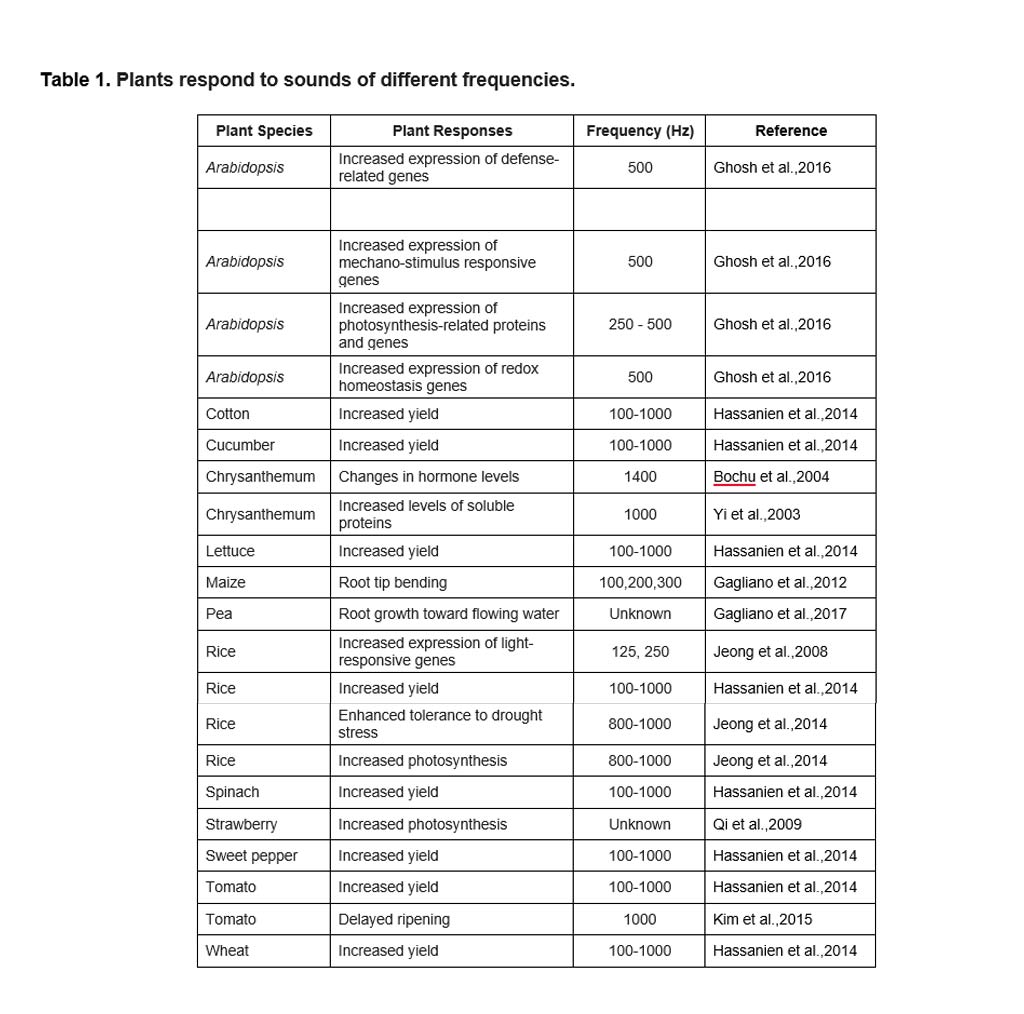
Effects of frequencies on plants
https://www.semanticscholar.org/paper/Application-Progress-of-Plant-Audio-Control-in-Jun-fang/136703733d8875a4c430effb431b017db66361a3
Application Progress of Plant Audio Control Technology in Modern Agriculture
Zhang Jun-fang
Abstract
The functional principle of plant audio control technology was briefly introduced. Application in modern agriculture was summarized, including enhancing photosynthesis and absorbing ability of plants, promoting plants growth and development,achieving the goal of yield increase,high quality and disease resistance. At last, development prospect of plant audio control technology was introduced in this paper.
https://www.semanticscholar.org/paper/Effect-of-automatic-plant-acoustic-frequency-(PAFT)-Zakariya-Rivai/481f9b8b14d6dbe5bf99e1912978ff9a4f6520b3
Effect of automatic plant acoustic frequency technology (PAFT) on mustard pakcoy (Brassica rapa var. parachinensis) plant using temperature and humidity parameters
Fahmi Huda. ZakariyaM. ,RivaiN. Aini
Abstract
Plant Acoustic Frequency Technology (PAFT) is a tool with the method of using acoustic waves to stimulate the opening of stomata, the purpose is to intensify the absorption of nutrients needed by plants through the leaves. The purpose of this research is to design and make PAFT for plant growth stimulus by utilizing the principle of photosynthesis process in plants, so as to improve the quality and increase the crop yield. The research method used is the design and manufacture of tools and experimental studies by conducting a descriptive research approach. The results of PAFT test using mustard pakcoy was able to increase the average of plant height by 10,4%, increase the leaf area by 30,9%, increase the stomatal opening by 28,4%, increase the total chlorophyll content higher by 27,7%, increased the absorption of nitrogen (N) content by 25,36% and increased the absorption of potassium (K) by 34,42% from the control treatment, and able to increase the yield of greater harvest weight than the control treatment, that is fresh weight of 25,6% and dry weight 58,7%
https://www.iioab.org/articles/IIOABJ_7.S2_447-458.pdf
https://www.semanticscholar.org/paper/THE-EFFECT-OF-SOUND-AND-MUSIC-ON-SOME-PHYSIOLOGICAL-Alavijeh-Sadeghipour/9e2c0b4af4dd09ddb194d7aec6c48308dc0e0152
THE EFFECT OF SOUND AND MUSIC ON SOME PHYSIOLOGICAL AND BIOCHEMICAL TRAITS , LEAF NUTRIENT CONCENTRATION AND GRAIN YIELD OF COWPEA
R. Z. Alavijeh, O. Sadeghipour, H. Riahi, Sayed Vahid
Abstract
The present study was conducted to examine the effect of music on the growth and yield of Kamran cultivar of in the summer of 2013 in District 7 of Tehran. This study was conducted in pot in a completely randomized design with six music treatments (Nature, classic, traditional, techno, noise, and control) in four replications. The results of this study showed that playing different types of music has significant impact on all studied traits. As a result of playing classical music compared to control treatment (non-music), traits such as grain yield in single plant (33%), stomatal conductance (21%), relative water content of leaf (21 percent), chlorophyll (47 percent), leaf area of single plant (30%), plant height (38%), sub-branch (52 percent), gibberellin hormone (81 percent), nitrogen (44%), and calcium (21%) increased. However, some traits reduced by playing classical music compared to control (non-music), that rate of their reduction for these traits was respectively: proline (13%), abscisic acid hormone (8%), and auxin hormone (2%). Generally, it can be said that as result of playing classical music, plant found better growth conditions, but playing traditional and techno music, and noise had negative impact on growth of cowpea plant, indicating that the plant as human reacts negatively to sad, unquiet, and stress creating music. It should be noted that the objective observations showed that plants against playing techno music found greater distance from sources of noise and even the arrangement of leaves (the angle of the leaves on the petiole and main stem was more open) was different than other treatments. The results of this study showed that classical music treatment improved cowpea yield and its growth through increased stomatal conductance, chlorophyll content, relative water content, and content of gibberellin hormone. Thus, according to the results of the current study, classical music treatment could be used in order to improve the growth and yield of cowpea.