John C. BEDINI
Motor / Generator / Charger
US6392370 ~ Device & Method of a Back-EMF Electromagnetic Motor Generator
US6545444 ~ Device and Method for Utilizing a Monopole Motor to Create Back-EMF to Charge Batteries
US6677730 -- Device and method for Pulse Charging a Battery...
US6392370 -- Device and method of a back EMF permanent electromagnetic motor generator
J. Bedini: KeelyNet / Escribe BBS Comments
KeelyNet Forum
OtherPower.com Forum
Battery Test
PESWiki.com: "School Girl" Science Fair Bedini Motor Replication
Images
Updates 2026
Bedini SG -- 'School Girl' Generator -- The Complete Beginner's Handbook
Bedini SG -- The Complete Intermediate Handbook
Bedini SG -- The Complete Advanced Handbook
Free Energy Generation Circuits & Schematics
John C. Bedini (1980s)
s
US6392370 -- Device and Method of a Back EMF Permanent Electromagnetic Motor GeneratorAbstract --- This invention is a back EMF permanent electromagnetic motor generator and method using a regauging process for capturing available electromagnetic energy in the system. The device is comprised of a rotor with magnets of the same polarity; a timing wheel in apposition to a magnetic Hall Effect pickup switch semiconductor; and a stator comprised of two bars connected by a permanent magnet with magnetized pole pieces at one end of each bar. There are input and output coils created by wrapping each bar with a conducting material such as copper wire. Energy from the output coils is transferred to a recovery rectifier or diode. The magnets of the rotor, which is located on a shaft along with the timing wheel, are in apposition to the magnetized pole pieces of the two bars. The invention works through a process of regauging, that is, the flux fields created by the coils is collapsed because of a reversal of the magnetic field in the magnetized pole pieces thus allowing the capture of available back EMP energy. Additional available energy may be captured and used to re-energize the battery, and/or sent in another direction to be used as work. As an alternative, the available back EMF energy may be dissipated into the system.
Abstract -- A back EMF monopole motor and method using a rotor containing magnets all of the same polarity and in a monopole condition when in momentary apposition with a magnetized pole piece of a stator having the same polarity, said stator comprised of a coil with three windings: a power-coil winding, a trigger-coil winding, and a recovery-coil winding. The back EMF energy is rectified using a high voltage bridge, which transfers the back EMF energy to a high voltage capacitor for storage in a recovery battery. The stored energy can then be discharged across the recovery battery through the means of a contact rotor switch for further storage.
FIG. 1 is a perspective side view of a monopole back EMF motor with a single stator and a single rotor.
http://www.Energenx.com
US6677730 -- Device and method for Pulse Charging a Battery...
A two-phase solid-state battery charger can receive input energy from a variety of sources including AC current, a battery, a DC generator, a DC-to-DC inverter, solar cells or any other compatible source of input energy. Phase I is the charge phase and phase II the discharge phase wherein a signal or current passes through a dual timing switch that controls independently two channels dividing the two phases. The dual timing switch is controlled by a logic chip or pulse width modulator. A potential charge is allowed to build up in a capacitor bank, the capacitor bank is then disconnected from the energy input source and then pulse charged at high voltage into the battery to receive the charge. The momentary disconnection of the capacitor from the input energy source allows for a free-floating potential charge in the capacitor. Once the capacitor has completed discharging the potential charge into the battery, the capacitor disconnects from the battery and re-connects to the energy source thus completing the two-phase cycle.
US6392370 -- Device and method of a back EMF permanent electromagnetic motor generator
This invention is a back EMF permanent electromagnetic motor generator and method using a regauging process for capturing available electromagnetic energy in the system. The device is comprised of a rotor with magnets of the same polarity; a timing wheel in apposition to a magnetic Hall Effect pickup switch semiconductor; and a stator comprised of two bars connected by a permanent magnet with magnetized pole pieces at one end of each bar. There are input and output coils created by wrapping each bar with a conducting material such as copper wire. Energy from the output coils is transferred to a recovery rectifier or diode. The magnets of the rotor, which is located on a shaft along with the timing wheel, are in apposition to the magnetized pole pieces of the two bars. The invention works through a process of regauging, that is, the flux fields created by the coils is collapsed because of a reversal of the magnetic field in the magnetized pole pieces thus allowing the capture of available back EMP energy. Additional available energy may be captured and used to re-energize the battery, and/or sent in another direction to be used as work. As an alternative, the available back EMF energy may be dissipated into the system.
Bedini Comments @ KeelyNet / Escribe
Some of the reports on the Energizer coming in
From: John34
Date: Fri, 12 Nov 2004 19:07:08sPeter, It may be a little premature for me to say this but so far I have noticed that my useless batteries are charging faster than the first battery is discharging. These batteries would not take a charge to the point they are now. I have not done a load test as they are still charging. It may be slow (it increased when I replaced the four magnet rotor with the 6) but there is clearly something unusual happening with this circuit. There is no way that motor could run so long and not discharge. I could understand the first battery powering the spinning and then running out. But how could it also charge the two batteries at once? Here we have power necessary to move the wheel (I don't see how there could be any more power to charge the other batteries beyond this with regular electricity). Then we have one battery charging faster than the discharge of the first. And then another battery is also charging slightly faster than the same discharge.
So I have seen several very interesting things so far. And if the above continues to be true, and if useless batteries are recovered, and possibly improved, then we have something very remarkable. Time will tell, and is telling, that more energy is coming out than going in. I wonder what would happen if I had good batteries hooked up? There may be something with my CD setup that works better than others because the bearing allows for faster spinning. I think if we reduce friction and wobble and air flow resistance then we will see a more noticeable result. I do believe that the objects of this project are accomplished. I am wondering if it is worthwhile to attempt to add several coils to my latest unit to increase the charge (as I read somewhere it was possible, and as I have seen pictures on this group
http://photos.groups.yahoo.com/group/Bedini_SG/lst
Are these pictures with the same curcuit and coils? Or did they use an imporved circuit? (And is Burts "Improved Bedini Circuit" really that?) I have finished making another coil and circuit and was attempting to hook it up to my latest bike wheel when, after a few minutes of adjustments, I hit the magnets and knocked three off. Before that happened I noticed increased speed and less wobble and a faster volts charge (I have not been measuring amps yet). I hooked both circuits up to the same two batteries as I had no other batteries to use. When the magnets came off I decided to rip the others off and place them in a position to allow for 16 to fit. I am about to start that up soon. How should I wire these? Should I use the same battery to power both circuits? And should I use the same other battery to receive charge from both? or should I add one or two more batteries to them? I ran out of wire to make any more coils but I could use the other coil and circuit to have three on this system.Are the improvements that can be made to this charger just a matter of adding minor componants like capacitors (as it appears from John's web site), or is it a much more invloved production? I watched carefully both of your videos and it would be far beyond me to reproduce anything like you explained there, unless it was made easy enough as with this project. If someone would show me what parts to buy and how to hook everything up, I would be very interested in doing that.
I suppose that one reason for taking time before rushing on to a system that puts out more charge, beyond wanting everyone to really understand what is going on, is that higher output comes with a risk of more danger. If people do not understand what is taking place, and are making adjustments to it, then a more powerful unit may be dangerous if one does not know what they are doing.
Looking forward to the next steps. Thank you,
RickSterling,
Your conclusions in this post are on the right track. The purpose of this project is to demonstrate a motor with an energy recovery system. You have succeeded in building the system correctly. The only relavant questions are:
1) Does the second battery charge as the first battery goes down?
2) Does the second battery charge faster than the metered current suggests it should?
3) Does the unmeterable portion of what is charging the second battery ALMOST make up for the losses in the system? If your test data suggests that the answer to these questions is "yes", then you have succeeded with the project. That is all this "school girl motor" was ever meant to do, and all we ever said it would do. As far as we can tell, your very first test data showed all the necessary truths. Do you know of any other system that does this well or better? If someone out there is reading this, and knows of a better system,then please bring it forward. A number of people who have been working with this system quietly, are beginning to see the performance enhancements that appear in the battery. That is where we said it would show up. There is NO meterable OU coming out of the machine. I hope this helps people stay focussed on what is real and possible with this project.
Peter Lindemann


What Charges The Batteries --- John
From: John34
Date: Thu, 11 Nov 2004 21:38:23The Question was asked on the SG group. My answer:
Yes I have done this experiment, buy doing this you invoke the 'lamellar' currents" rule, this is from Kron not me. This means that you break up the currents into branches. Each 'lamellar' scalar current" is additive to equal the sum of the total. The Heaviside current surrounds the wire, this is almost like reactive power, the digital meter has a very hard time reading this. The system is a "Unity System", what you put in you get out, but you are loosing a lot with clip leads and bad wiring. If you want to see what is charging your batteries you need a scope. The output wire positive is run through the center of a solenoid coil of many turns this will couple at 90 degrees with the Heaviside current. What you will see is a ringing wave that is charging the battery, it is not electricity in a true form it is pieces of electricity.
What is this current? It is made up of mostly scalars this couples in the batteries when it meets the next scalar that it can couple with, this is what charges your batteries. You wanted to know so here it is. The next part of the system is more mysterious, I will save this for a later time. I did show Susan today what this wave looks like.The idea here is to charge the secondary batteries as fast as possible from one primary battery. The faster the charge, the more power you can use. This means speed with the motor/energizer. The energizer is a open loop system so it can expand this type of wave. You must have this type of wave with a Radiant type systems, just look at a Tesla Coil output you will see it, in many ringing waves. It takes Quaternion math to see this, along with the magnetic fields of the Motor/energizer.
John BediMy answer to them all on that group --- John Bedini
From: John34
Date: Thu, 21 Oct 2004 19:14:28To all, I just want to keep the story straight so here is what I said.
JohnKoen, Horace, Etc,
To all in question, this is why I will not supply Stefan any charts, waveforms, etc... It is simply not true, as I have been posting this information for years on my Internet site. All one must do is LOOK. If I read the answers from Stefan carefully, it looks like he is unwilling to devote his attention to anything I have said to him. I have answered his questions with complete honesty at every turn. I told Stefan that we use a very special meter to determine the charge in the secondary battery. That meter is called a BK Precision Battery Capacity Analyzer, Model 600. What is so hard to understand about this and what more proof do you need that the battery is REALLY CHARGED, knowing the meter reads the battery's capacity in amp-hours? The second thing here is this. The circuit is right in front of your eyes. This circuit does unexpected things. You can only discover these things by building one and testing it on your own lab bench. No amount of "thinking about it" will penetrate the mysteries. Coming to criticize me over Stefan's problem is not the answer here, because it goes much deeper then this. Stefan has a vast lack of knowledge in this field, and apparently, so do you. The ONLY way for you to remedy this, is to build the device and study what it does.This is what I have done for 35 years!
I have stated plainly that I want nothing to do with Newman or his theory or his test results, and the machine is not over unity in any way. How many times must I say this?
I will say this in plain English again for you both. Go through My pages. You will see pictures of the wave-forms. You will see every machine I have ever experimented with, including the "bucking field" generator. You will see everything I talk about. I do not just sit here and draw diagrams that do not work. I test everything. I do original work, and patent it. When I "duplicate" someone else's device, I report it and give credit to the inventor, like my "Adams" replication. I don't obscure other people's work, like Stefan's goofy "Easy Meg", which has no technical similarities to the monumental work of Tom Bearden.
I did not give Sterling bogus information when he arrived here to see if my devices were real. I sat right here and let his engineer watch batteries charging, hooked up to the scope so he could see the wave-forms. I sat right here and showed him how the circuits work. I sat right here and explained everything I could within reason. But this company has millions of dollars worth of stockholders. Sterling and his group signed "Non-Disclosure Agreements" before the demonstrations. I gave Sterling permission to start his public replication project for the "School Girl Motor." The idea that I have some nebulous obligation to disclose everything about this technology on the Internet is pure fantasy. When I DO give you "step one" on the path to this discovery, you refuse to take it. This proves you are not even ready to take "step two", much less a complete disclosure. The fact is, you wouldn't understand what I am doing now, anyway. So why disclose it?
I have posted the Kron work on my pages, along with the wave-form pictures. You obviously don't know what it all means.
These systems do NOT capture "back EMF". Back EMF is not capturable. My patents say that my motor captures Back EMF because THAT is the only claim the Patent Office would accept. In reality, Back EMF is a term in electrical science that refers to the effect that reduces the current draw in a traction motor as the motor speeds up and generates a counter voltage that opposes the applied current. THAT is "back EMF." My systems do NOT use this process.
Koen, you are correct when you say that I am quoting Tesla correctly. But it goes much deeper than that. I actually understand what Tesla was saying and my systems tap the same Radiant Energy that Tesla discovered. Stefan is clueless as to how this works, and has never listened to my suggestions about how this works.
There is NO free electricity produced in these systems, or any other system that I know of. I have stated this repeatedly. The only thing these systems produce are a series of "high voltage spikes" that have no current associated with them. Voltage without current is the nature of Radiant Energy. This is what Tesla said. I call this "reactive power" because it does not represent voltage and current simultaneously, that could be measured as WATTS. This Radiant Reactive power WILL charge batteries, light light-bulbs andother things but it DOES NOT meter as REAL POWER. This is why your math is useless! So please, quit quoting your theories and analyses to me. My light-bulbs are on. Are yours? You are welcome to believe in your theory, but I KNOW that Tesla was right about the nature of electricity, and how to successfully tap its useful fractions. If you would just build the motor the way I have said, you could begin to learn about this too.
Beyond this, I am done CHATTING with you. Leave the people alone who are trying to learn this. Your ignorant comments are of no use. That's as nice as I can be about it.
John Bedini
X123 Sends Message --- John34
From: John34
Date: Sat, 9 Oct 2004 18:58:17
Jerry, John,Sorry can't seem to append to the thread, however, I believe something to consider is the recent work by NASA and others in the study of lighting. At a conference in 1999 I remember seeing data showing there is a constant return current flowing from all over the earth back into the sky resulting from lightning strikes hitting the earth. This current is very, very, small --- around 10-12 amps per square meter and varies slightly depending on temperature and wind conditions. The measured potential was 100 volts per meter as I remember, however, the high resistance of air normally masks us from any felt effects. An example was given saying one of the basketball players has about a 200 volt potential at the top of his head. I would think a 300' conductive antenna transmission line would make a really big difference. Also, a vertical arrangement would make more sense than a horizontal one.
X123To All,
Lets make this much simpler then it is, and no one will get hurt doing the experiment. Just put up your 200 ft of coax 40 feet high supported between two fiber glass poles, this should give 1000 volts potential charge. Next take an SCR 800 volts, leave the high voltage capacitor where it is connected, now face the SCR cathode towards the positive pole of the battery and ground the negative side of the battery with an 8 ft ground. Connect a neon bulb between the anode and the gate, at 90 volts the neon will fire and the battery will get a "real radiant charge" (Conversion is backwards from electrostatic to radiant should see saw tooth wave, much stronger). The faster you fire this bulb the better the battery will charge. It's important to leave the .00047 uf 5000 volt capacitor between the cable or connected to the anode and ground, it's important to use a capacitor something like mica or a glass tinfoil capacitor. If looking at it with a scope be careful just look between anode and cathode. Please be very careful with this experiment.
John Bedini
Radiant System --- John BediniFrom: John34
Date: Thu, 7 Oct 2004 18:45:25Ken, It looks like to me that your really getting into Tesla's work, What if, Tesla was dead wrong and all the power we are calling Longitudinal is not that at all. What if I said to you that Radiant energy when transformed is longitudinal and all information can be contained in that wave, and that the next transformation process is nothing more then reactive power?.... Then what if Emmett, in what he told you turns out to be after the transformation process total reactive power looking like a square wave, or more like a PWM wave at very low frequency and that reactive power can charge your storage battery. The next question is what if your cookbook math does not fit the transformation process that takes place, would you add numbers to make the equation balance? What if I told you that the engineers do not understand what a magnetic field is when it is used in the transformation process between radiant and reactive power. I do understand that you must use the math, and I'm not asking for any math here in your answers, simple terms on how you see all this, so those that are having a hard time following us can understand what we are talking about. It could be that we are all saying the same thing which just boil's down to charge in the end and how we get it. I also understand that you do electromagnetic engineering so you have seen many different things in your work. One more thing, if the process starts at the Radiant level and then proceeds to longitudinal and then moves to reactive and then to a square wave and from that point moves to the sing wave in the end would you agree with this?. That these are the transformations we must go through? I have a reason for asking these questions when I start to add something different to this equation, but I'm going to keep this on a simple level as much as I can. Also this is not any kind of contest in any way to see who knows what, but I want to get down to the basics of a full functioning radiant system that anybody can build with junk parts. I have found that most people do not understand the basics in electronics and want to keep it very simple. As I have stated before I will not use the terms Free Energy or Over Unity because I see none anywhere, even Tesla was going to use the generators to power his reactive power system tuned to certain frequency in a high Q pickup like you said in your post, no free energy here, just a nice transmission of power free for the taking, so Morgan said your not milking my cow for free. By the way, this system is already in use.
Radiant Motor --- John34
From: John34
Date: Tue, 5 Oct 2004 21:03:34To All, Roamer, Brett, Ken, Etc.
To answer Roamer, that's right, that's all it takes to do this, its just the
basic system.Brett, You have had this so many times, but your just trying to do this so fast. your answer, It is in the upward spike that contains the Radiant energy, would you like a test tube, or are you going to fly on one of those airplanes for a visit? Expanding this system, Take 100 ft of coax cable RG59U and do the same hookup you will be surprised, watch the frequency it will be high. It will have uniform capacitance and low inductance, just like Tesla said. The problem in coil design, is the current through the coil, the more the magnetic field the more the heat. That means the bigger the coil is the more the waste the lower the frequency, so why do we need Iron in the system at all? This is the problem that Tesla faced at high frequency with iron, Pulsed Radiant Discharge was the answer and no iron. EV Gray had the same problem in his motor, his test stand was an iron-less coil to blow off the magnets under Pulse Radiant Discharge. The answer to the problem was a very sharp spike on the leading edge. This does not take rocket science to get the job done, and then a few little light bulbs for all to read by.
Ken, If I could just find a power supply to bake people, what a great device. only kidding. But these devices have been known since the early 60's, but as time will tell its just to be used for mass sheep control in some sinister way, you'll see, hope you got your graphite shields up.
Just a comment sent to me from another researcher, talking about the motor: "The electrons in the coil just get slapped and squeezed by the pulse. The pulse is so strong and the resistance high that a choking effect occurs. But the voltage is highly elevated in the coil from this effect. I think...the radiant energy must happen during coil brake down, between pulses. I cant see it on my meters. All I know, it is very, very powerful. I just don't understand why this is not being used. Surely other folks have built these designs. I use mine everyday."
John34
Bedini pages updated again, an answer --- John34
From: John34
Date: Fri, 1 Oct 2004 21:03:40Ken, I want to try to answer you but I do not know where to start. I guess we must start at the basics of my work 35 years ago. As a new engineer out of school, I had the opportunity to work in the semiconductor field, while working in this field I had seen many strange things that semiconductors do, so a little background. I think what I'm trying to explain to everybody is that I have changed my attitude on what is termed "free energy" and "over unity". It's not that I do not agree that there is no free energy, because there is, windmill, solar panels, water power, it just takes money to get there. What I have found out is that the energy machines that produce this Radiant Reactive Power are strange indeed, let's take an example, the G-Field generator. Looking at this machine indicates as if more power is being consumed then is coming out of the machine. When the waveforms are looked at, the power being produced is "Reactive" and of no use as real power goes, but it does light lights and it speeds up under load, when built right. The next thing is that when the machine is hooked to a storage battery it charges the hell out of that battery and speeds up even faster so the input power goes way down. This is the same thing I have noticed with the Mono-Pole motor, I have studied these wave forms until I could not see straight and all the time my mind refusing to see the truth about what it was I was looking at. I noticed that it charged capacitors very good and charged batteries and the power was really there except my meters could not measure it. This led me into studies of the coil that I was winding for these machines. Even if I had the machine working I still was not convinced something was charging the batteries I could not measure, it was not until about 15 years later I knew that I had to do something to find out what it was, just at that time Peter Lindemann's book, The Free Energy Secrets of Cold Electricity, so I bought three books and called Peter or Peter call me I can't remember, but so what. Any way Peter and I joined forces to explore what it really was that these machine were doing. So after working with Peter and building every possible machine, these are My conclusions, There is no "Free energy", there is no "Over Unity" in any of these machines that can be measured with normal scopes and meters and we are just all assuming uncles Joe's theory to be right. When I put up the new pages I did not want to debate anybody about what I posted. I only wanted to try to explain what I found to be the proof of what everybody is calling Free Energy/ Over Unity, as it turns out to be "Radiant Reactive Power", so term it as you will, di/dt or whatever it is all the same in the end. If the machine can produce this Radiant spike before the switch turns on and the spike is reactive and if it tapped off at the right time and sent to the battery in the proper polarity, it will charge your battery. I'm not going to by into all these theories about unproven experiments unless the experiment is done in front of me, as I have posted enough experiments to show everyone what it is.
One step further on this is that, I know some of the people did try to build my motor's and did not get the results expected, but I can say that enough people have been to my shop to see the proof of what I say I have built and have watched these motors and solid state devices charging batteries. So I'm saying that the power you seek is "Radiant Reactive Electricity", and it takes an input to get it in some amount, that is all there is in these machines and strange devices. The riddle has been solved in my book.
John Bedini
An Answer to a question John 34
From: John34
Date: Fri, 10 Sep 2004 21:47:16
-
Michael, If we start
here in the paragraph below by Kron, we can see why this motor
must recharge the battery.
Kron, Gabriel. "...the missing concept of "open-paths" (the dual of "closed-paths") was discovered, in which currents could be made to flow in branches that lie between any set of two nodes. (Previously & #8212; following Maxwell --- engineers tied all of their open-paths to a single datum-point, the 'ground'); That discovery of open-paths established a second rectangular transformation matrix... which created 'lamellar' currents..."... "A network with the simultaneous presence of both closed and open paths was the answer to the author's years-long search."
So what is it that
Kron is talking about, What is very common to this in
nature, and what took so long for Kron to find out. Here is
how I see it, Kron is talking about branch currents. Nature
has many branch currents but we do not talk about them in
electrical terms. Example, a river can not flow if the
little streams (branch currents) are not feeding it. A tree
can not have a trunk if it had no branches. Nature has given
us all the examples, but we must make use of the meaning as
we see it before there can be any invention, and then it
must follow all physical laws in that universe. For example
what is the word " lamellar" mean, it means the stacking of
plates , wires and so on, in a battery the number of plates
give rise to many branch currents that make up one high
current output in the end result. Flowing between the plates
are "lamellar" currents provided by the chemical reaction,
only at the speed which nature works best at, this does not
mean that the battery needs massive currents to charge it,
it's quit the opposite. What is it that the meters read when
we measure something, simple wasted energy that has just
been dissipated out of that system. You can only measure
that and nothing more, so the only thing that you can
measure is the primary circuit, because this is the closed
loop in this system. Kron goes on to say that currents were
made to flow in branch currents between nodes in the primary
circuit, so what is wrong with the coil in this motor, what
is missing, and how could it be changed to act like the
river?, you already have the second node away from the
primary circuit to the battery that will collect it. The
meter can not measure the longitudinal wave from these
currents to the second battery, for these currents are
radiant in nature and can only be translated by the chemical
reaction in that second battery, this process does not boil
the battery so there is no water loss, for if you loose the
water in that battery you will have no electricity at all.
But you can use your volt meter to see the charge on that
secondary battery. We never got anything but a volt meter
after all these years did we. More later on this subject.
John Bedini
Keelynet
The Bedini Patent
From: William Alek
Date: Sat, 4 Aug 2001I've been looking over Mr. Bedini's patent, WO 01/52390 A1
No where in the patent am I seeing claims of over-unity? What I am seeing is the "possibility of over-unity" suggested there in (page 5, line 13), but
NOT actual or real over-unity produced by his device! Now, Mr. Bedini does mention (page 12, line 4), "... the motor to produce an energy level of COP = 0.98, more or less, depending upon configuration, circuitry, switching elements and the number and size of stators, rotors and coils that comprise the motor." includes ONLY the electrical and electronic components, however, does NOT mention or include the efficiency, or inefficiency of charging the battery. Battery charge inefficiencies would most certainly lower his overall COP value!I would think that his systems (including motor, rotor, and batteries) would have an overall efficiency of around 85%, or COP = 0.85. This isn't too bad
for modern systems, however, this is a long way from being a "self-runner", which of course is the ultimate goal.William S. Alek
INTALEK, INC.
3506-43rd. Place
Highland, IN 46322-3129 USA HOME PAGE: <http://www.intalek.com
FAX: 219.924.2793
OFFICE PHONE: 219.924.2742
Advanced Bedini Motor/Energizer
Date: Fri, 3 Dec 2004
Hello All,
Just wanted to let everyone know my experience with an ADVANCED version of the Bedini Schoolgirl motor/energizer. John gave me a schematic a few weeks ago of a device that he said would put the issue of radiant energy battery charging to rest.
Having built several other versions of his devices successfully, I was very excited to receive the schematic. I built the device EXACTLY as John said with ABSOLUTELY NO CHANGES!!!!
The first spin the device spun up to around 800 rpm's on a 22" bicycle wheel; and that's fairly fast. The device achieved resonance and the current drain dropped by about 20%, maintaining the rotation speed, and even got a bit faster.
The input battery was a 12v, 1.2aH battery, and as John suggested, I put 4 on the output side. Within a few minutes, the batteries began to rise in voltage. There has been some big debate for awhile about this "radiant charge" producing only a surface charge on the batteries. Well my friends, this is NO SURFACE CHARGE.
The charge was held for 30 minutes at rest, and when I tested the batteries with the Computerized Battery Analyzer by West Mountain Radio, the batteries produced a steady drain for an extended period, after being previously dead, with readings as low as 8 volts per gel cell. They were NOT charged prior to the test with a conventional charger!!! They were completely dead.
In a conversation with John, we were discussing the issue of larger batteries. I told John that I had 2 garden tractor batteries that were completely sulfated and would NOT take a charge at all with a conventional charger.
Tested with the CBA, the batteries produced 1 amp for less than 1 second. I tried charging the batteries 4 different times with a regular automotive battery charger, first on the 6 amp rate for 6 hours, and then overnight on the 2 amp rate. I tried this 4 separate times with no luck. The voltage of the batteries would rise to 14 volts but the current was not even 1 amp when loaded, and then the voltage would drop to 8 or 9 volts under load immediately.
Then John advised that I attach 2 diodes to the output of the newest advanced device that I had built. That would give me 2 isolated branches to charge with. So, I did exactly that. He said to put a steady power supply on the input so as to produce steady input for an extended time, and simply walk away from the machine and the batteries.
The following evening, I stopped the Advanced Energizer Circuit. I removed the recovery batteries. Now, listen closely! The 2 garden batteries that were completely useless and would have otherwise been thrown away are now producing as much as 7 amps of current for several minutes at a time before being discharged to 11.4 volts.
Now, one secret to the Bedini process is the cycling of the batteries in the device. Each cycle, the batteries become less and less sulfated. I am compiling tests of each battery that I use in the device for increases in usefulness. Having proven the smaller devices last year, I am now proving the usefulness of the larger and more advanced Bedini circuitry.
It seems that John has been right all along, and nobody has been listening or following his directions. I have seen engineers argue the Ohms law, and all of that other taught discipline in electrical theory. When these people forget the conventional way of thinking and just do the experiments and quit listening to incompetent people who fail, then there will be more advanced devices that will provide useful power to, otherwise helpless people. You will NOT measure a 1 amp drain in the circuits with a 4 amp output!!! I REPEAT, the circuits do NOT indicate with conventional meters any gain!!! But the batteries become fully charged!!! When all of you forget meters to show this energy, you will see in the load tests that the energy has charged the batteries. It is provided as extra watts in the load tests. That's where you will see it. Perhaps some of you have been looking at this energy all along, but did not know what to look for. Or perhaps, some have been just following the words of a few unsuccessful people who could not walk and chew bubblegum at the same time. If I can do it, ANYONE CAN!!!
I have PROVEN 100%; and I have the analyzer load tests, that these batteries were useless. And now they are resurrected to a useful level. And that increases with each charge and discharge in the unit. Now, if the battery will supply one amp of current for a period of time, perhaps into the hours, then these batteries have been saved, at least enough to charge more batteries with the machine. The way I see it, $50 worth of wire and transistors, scrap PVC for a frame, and some Radio Shack magnets and a scrap bicycle wheel , has begun recovering $50 worth of batteries within 24 hrs.
I have posted some pics of the new, advanced device on www.nuscam.org . I have blocked out some areas of Bedini's proprietary circuitry, until such time that he wishes to release it, then I will replace with the untouched photos. But that is his decision, not mine. The general description of the circuits are in his patents. The schematic that was provided to Sterling Allen and others is a start. Learn the technology, and how it works, then perhaps the more advanced circuits will be available in the future.
Best regards,
Harlan Sanders
Keelynet
Another Bedini Device that "Works"
From: DMBoss1021
Date: Wed, 31 May 2000 08:13:39
This is a prelim report that another Bedini deive has
been replicated by two of us, and not only works, but after
we built it to his specs, and gained a
basic understanding of why/how it may work, could then
predict changes to the design which improved it's
functioning.
It is, in my opinion, imperative to follow his
construction details closely, for first replication.
This is necessary, as I believe he has an intuitive,
or objective grasp of some advanced concepts, or properties
of the interaction of magnetic fields, and oscillating ones,
and how they interact
with reality, and or - space-time; the ZPE; or the
aether depending on what you call it.
And yes, at times his details are difficult to
comprehend. But it is not his task to give a basic
course in electronics, or static/dynamic magnetics.
Also some concepts of correct functioning of certain devices
may run counter to what we have been led to believe by
conventional theory - so even if
something he specifies doesn't make sense - try it first,
then after it works, figure out why.
That said, the device / effect we have replicated is found here:
http://www.amasci.com/freenrg/bedini.txt
I built it exactly as shown, as i have these size magnets (RS does not sell these large ones anymore, but they are available elsewhere)
I had a suspicion, from the comments about this
pencil thin "scalar beam" or effect, that this may be the
same or similar to what is described on my site
as the "Primary Energy".
Once built, and the motor turned on, there is indeed
a "beam" of energy emitted from the sides where the magnet
faces oppose each other (bucking).
This beam was exactly the same as the Primary Energy (PE)
beams that can be made with a container of inert gas, and a
magnetic field.
In the case of just the running device, in open air,
emitting a beam, I surmised that this field arrangement and
modulation was exciting the argon
atoms in the air (Ar is 1% of air) - so to see if this is
the case, I placed a tube of another inert gas, at
this location (the place where the "beam"
comes out of the magnet interface) - and a VERY powerful PE
beam was created --- much more powerful than if the tube is
simply placed against the magnets, without the modulation.
And in addition, with the addition of a 25 ohm, wire
wound rheostat in the circuit, to vary the motor's speed,
(and hence the FREQ of the pulse signal,
thru the coil), the PE beam strength, varies as the FREQ is
varied, and there are several resonant "nodes" where a small
FREQ range, makes a much large beam effect, as this FREQ
range is passed, while changing the speed. There are
several of these resonant points.
This has been replicated many times, by myself, now, and by another, using a different magnet size/shape, with similar results.
Both of us independently have found that our current
crude, "measurement" of an anomalous quality which seems to
be related to this energy (and not
thermal, or EM sources) is affected in the same way, by
these "scalar" beams, augmented with a xenon flashtube. (not
flashed) (this objective measurement, is separate from the
subtle sensing of "feeling" of the PE, and will be detailed
later, as we get a better handle on it)
I am working on a write up for a post to my web site - in next few days, with all the details.
The magnetic field analysis, using QuickField, shows that this arrangement of permanent magnets, with the modulator coil is making the same field shape, and relative flux density gradients, as that of the "Magnetic Beam Amplifier" shown on my site, and detailed in US patent # 5,929,732.
In this case, it is a "dual beamer" as opposed to the
"quad beamer" shown on the patent, and the "hex beamer"
shown on my site. The two bucking or
opposing magnets, are like the radial "focusing" plane,
described in the patent, and the modulating coil forms the
field of the axial magnet - and
this axial field is pulsed, or alternated (if any back EMF's
from the motor, cause complex AC harmonics in the
modulation).
In the "beamer" field configuration - there is found
a "null" zone where the bucking fields intersect, or
"collide" as Bedini describes it. And with the
modulation, this null zone then is caused to move front and
back, along the same axis as the coil. And the overall
beamer field shape is also caused to
move back and forth, and if AC is present, will flip or
mirror on each oscillation. (our theory is this a
severe "aether stretch", and forms a
resonant cavity for the PE)
Now with reference to the "Hyper Light Speed Antenna"
patent:
http://www.escribe.com/science/keelynet/m8147.html
There is also similar reports of bio effects, which are reported from this device's "beam" or field, and by the PE.
And notice that this device also used a set of
bucking magnetic fields, with a modulation injected.
And this patent's author describes the interface
between the bucking magnetic fields as like a "window" to a
higher dimension.
One more note on the bedini "scalar field, or beam"
device: --- I noticed in the field analysis that the field
strengths of the coil, and magnets were
greatly mismatched - and surmised that if this "beamer field
shape" was responsible for the effect, in some measure, that
increasing the current to
the coil should then make it perform better. (better
matching of magnetic field strengths)
So I did a test with applying a mechanical load to
the motor shaft (and measured the current) - the current
could be increased 5 fold this way, and
the resulting beam was greatly increased in intensity, and
followed the current level in a proportional manner.
Also, I noticed that while applying this load to the
motor, by hand, that a PE emanation was present at the motor
housing, and shaft! So I believe there
is some kind of subtle "current" at work here, and some
feedback, and resonance within the electrical conductors may
occur, (the PE can be
"carried" on a good conductor, as shown in other
experiments). So this crude modulation method, may in
fact be a critical factor to achieving this!
An armature type permanent magnet motor, has pemanent
magnets as the stators, and a rotating armature, of coils -
that are sequntially energized by the action of the brushes
on the armature. This creates a sparking effect at the
brush/armature connection (and in this case, a spark, was
observed,
indicating a plasma present) - and air is also
present. So (possibly) another PE emanation is being
created in the motor as well as it functioning
as the pulse generator!
And this may be indicative as to why some older methods to make certain effects work, while newer, "modern" methods do not. (when you use the sparks gaps, and electro - magnetic - mechanical systems - the effect is not necessarily the same as a "solid state" method!
I believe Bearden commented on this - that many times
a jury rigged device has stumbled upon a method, material,
impurity, or configuration, which is
the key to an effect, but more modern, clean, or pure
methods may not have the right elements to accomplish this.
A note of caution - any who are following the PE, and
experimenting with it --- this beam method is VERY powerful,
and may pose some dangers to body exposure. This is
evidenced by my feeling the strong tingling, in the sense
hand, turning into a strong numbness in the hand and arm,
which then lasted for over an hour after each
exposure! This numbness felt like the effect of using
a "hammer drill" to drill many successive holes in concrete
- the
strong mechanical vibrations making the arms/hands feel numb
for a time after this work.
As stated, I am working on the drawings, a field analyses, and writing up this info, and will inform when this is done.
The Primary Energy site: http://hometown.aol.com/dmboss1021/NEWPH/Index.html
Sincerely,
DMBoss102
YOU WANT O.U. - HERE IT IS!!!
From:
Jerry Decker - KN
Date:
Sat, 27 Nov 2004 17:53:31
Hola Folks!
Not exactly sure what happened, but Emmett sent the
following which did not make it to the list or archive, so
I'm reposting.
I think the problem was the photos he mentions since this
list doesn't accept attachments as per the guidelines page
at;
http://www.keelynet.com/discuss.htm
So Emmett, if you'll send me the photos, I'll put them up on a webpage with your comments and a link to your email for private correspondence;
Good Afternoon All,
TO START: I believe O.U. does indeed exist.
There are some different ways to do this, some simple, and a little energy - some abit, how shall I say more complex, but unbelievable amounts of energy, I know, been there and have done it.
HERE IS A SIMPLE WAY TO ACHIEVE THIS!!!
BUT FIRST; As I always give credit where credit is due, First and formost to John Bedini for his motor/energizers, Tom Bearden for the math and help in seeing what isn't always obvious, on his website, to my friend, Stan Mayer, for thoughts, encouragement and how to do things with what few electronic parts are available in my area, i.e. radio shack, and to all the greats before me, Maxwell, Faraday, Stubblefield and especially Tesla
NOW ON TO BUSINESS: I will provide a brief description and as you all can see there are photos, and if any are in my area or want to come to my shop, I will be glad to let you see, tinkker and phootograph to your hearts desire, on this project anyway.
1). We will start with Johns school girl
energizer(simplified) first. There are many of you out there
that I know of that have achieved minor
o.u. in the .01-.1-.2 volt range for periods of time, there
are those of you who have achieved a 1-1 unity, i.e.,
trading the same voltage back and forth between batteries
over time and the voltage does not go up or down altho in
practical situations(not this) it would normally go down
over time due to resistance in the wires, resistance in the
bearings, air resistance of the rotor rotating, and general
quality of workmanship,
there are those of you who are close to 1-1 unity but are only losing .1-.3 volts over a 24 hr. period, that is good too, but not good enough but not to worry.
I have included in the pictures, photo1, of my sg energizer, "the black widow" so you can see all the wires and circuitry etc. nothing hidden, nothing magical.
Photo #2). rear view with a small coil with a screw thru the center attached to a copper/PVC pipe stand, the leads are attached to a home-made 4-diode, simple full wave bridge rectifier, (4)in4003 diodes, or a stand alone manufactured one will work also with a cap. connected across to smooth out the spikes.
I originally used a reed switch but they have a tendancy to burn shut and last only so long, so I asked my buddy, Stan Mayer, what I could substitute, thanks Stan.
Yes I know the pictures are dark, using an old polaroid instamatic, flash burnt out, but wanted pictures, NOW, you will notice that the leads from the fullwbrid.rec. are connected to a DVM and it reads 6.13 volts.
Now this little coil is made from a screw about an inch long and 3/16" in dia. wrapped with radio shack 28g wire about 200' worth. This is far in excess of those who are losing .1-.13 volts every 24 hrs or so O.U. IN MY BOOK...BUT IT GETS BETTER.
Photo # 3). is just a side view.
Photo #4). now some of you have found that you don't need your wheel to rotate at all, that by just stacking your magnets on top and a few adjustments it becomes a resonate circuit and some of you are finding that it is still charging your batteries, both input and output at the same time, this is more than possible. Stan explained how the electronics do indeed do this thru a little window in time(pun intended).
Picture #4 is mine doing just that BUT IT GETS EVEN BETTER!!!
NOT ONLY DO YOU NOT NEED A ROTOR ROTATING, YOU DON'T NEED MAGNETS TO MAKE IT RESONATE, JUST ANOTHER COIL,
photo #5, show my coil sitting on top, it is smaller than the main coil, so needed to get it closer, altho sidfe by side it will still provide a voltage, just not as big, now!!
1, if you make your coils larger, the same size and attach the circuit I described above, you not only achieve O.U. in charging the two batteries, but you can run extra voltage even above, the DVM reads 2.579 volts in case u can't see it.
SO NOW YOU NOT ONLY HAVE O.U., IN ONE SYSTEM BUT A SECOND SYSTEM AND THERE IS NO MOVEMENT, POSSIBLY A SIMPLIFIED MEG WITH SIMPLIFIED STUFF, BUT I CAN'T NOT SAY FOR SURE, EITHER WAY IT IS A NON-MOVING GENERATOR THAT YOU ALL CAN BUILD EASILY IN A COUPLE OF HOURS!!!
I ask only one or two things, PLEASE, tell and send this to all your family, friends, other energy sights, Rense .com , papers, radio, tv, or whatever as the momentum needs to raise sharply, like the spike on a scope of radiant energy as some have seen, or this will die a very quick death and my other peripheral devices along these lines are not worth putting out and I shall go into quiet retirement.
ALSO.. any who want to come to my office and shop to see, tinker, experiment, and photograph etc. are more than welcome, I have NOTHING TO HIDE. my address is
Westwood/'Westside Apts. Office,
1015 Oakcrest St., .Iowa City, Iowa
8-6 or so Mon.,-Fri. and about 9:30 1:00 or so on Sat.
Best Regards,
Emmett L. Butler
www.wondermagnet.com // www.otherpower.com
~ Forum
Initiated by finsawyer
Mar 23rd, 2004
Measuring Output of Bedini Motors
When scanning this site I noticed some postings concerning Bedini motors but had no idea what they were like. When I finally found what they were I wasn't surprised by the basic idea, but I was by the claim that these things put out more power than is put in and by the controversy. It turns out that there may be a fairly easy way to determine the output power. This has to do with the energy storing properties of capacitors. The Bedini motor has an output capacitor that is charged and then discharged into a battery pack.
For a capacitor of value C farads the energy E stored in it as a function of its voltage V is E = 1/2xCxV^2. For instance, a capacitor of 1000 Microfarads with a voltage of 100 volts contains 5 joules of energy. The voltage across a capacitor then gives an unambiguous measure of its energy.
A Bedini motor when tuned turns at a constant rpm. This means that the pulses generated will be uniformly spaced in time. An oscilloscope can be used to monitor the voltage across the output capacitor. The drop in voltage when the capacitor is discharged then gives energy outputted: E = 1/2xCx(Vmax^2-Vmin^2). Multiplying this by the number of pulses per second (determined from the oscilloscope sweep) gives the total output in joules/second (watts). This method can be used for any capacitor pulse charging system.
Input power can be measured by putting a small resistor in series with the battery and measuring its waveform using the oscilloscope.
You're overlooking two other system components, the source and receiving batteries.
There is a specific relationship between the source battery and the motor, and also between the motor and the receiving battery.
The only real way to determine what's going on is to measure the REAL POWER that you can draw from the receiving battery VS the charge state of the primary. Then continue charging and repeat, over and over. This is just like what was done by the TUV testing labs on Bedini's prototype.
That's the only set of measurements that really count, in the end.
Measuring the other items you've mentioned will mostly serve to confuse due to certain anomolous behavior in the source/motor/receiver process.
But, as always, feel free to slap on the meters.
The power going into the receiving battery has to go
through the output capacitor. Determine that power and
you've put a limit on the power into the receiving battery.
There is no other route for energy to get into the receiving
battery. Otherwise get rid of the capacitor and the
wires to the battery. Let the energy flow through the
ether or hyperspace or whatever. The device exists in our
space and can be tested in our space.
GeoM
Most electrically "educated" people have a very rigid set of preconceived notions when it comes to understanding various circuit behaviors. I can charge any kind of battery that I want, with a simple capacitor discharge system, mechanical or electronic. Still, I have met with much resistance from many "learned" people along the way, most of them INSISTING that IT WON'T WORK, in one way or another. It really doesn't matter since I'm just sharing my observations from my hobby experiments.
As for measuring the motor, I'm only telling you what I see happening, like it or not.
The relationship between the motor, the capacitor and the batteries is not as simple as you might, at first, assume.
Casting aspersions about dabbling with "hyperspace" won't answer your measurement questions.
Slapping meters and resistors all over the thing might offer some insight into HOW it works and whether or not it's tuned properly. But, the BEST and MOST EFFECTIVE way to measure the input vs. output is to run the motor and do your final empirical testing by measuring real wattage available from the receiving battery vs charge dissipation in the primary battery. That's all I'm saying.
By all means, measure everything. After all, there's no reason not to.
While you're at it, make sure you also do some mechanical loading tests in parallel with the power in/out tests. Even more interesting stuff crops up.
How much power ends up in the battery?
Just hook up a simple load (perhaps a 20 watt lamp), a precision resistor, measure the voltage drop, and time the whole thing until the battery is discharged.
Replace the battery on the motor, recharge, and repeat.
More on anomolous behaviour: http://www.amasci.com/tesla/tesceive.html
It's mighty fun to play with - at any rate at the very least I now have a pretty efficient DC motor on my desk....
Having fun,
Ted.
That link is interesting. The concept of an EM absorption field in relation to the Bedini motor is even more interesting when you consider what's on this link...
http://www.stormwise.com/striking.htm
This is steady EM power transmission via nature's own processes. Seems like it's just beggin' to be "received".
Hi Charged,
Kinda what I was thinking. I made that comment the other day about holding a small neo magnet near the motor when it's running. It almost vibrates right out of your hand - up to a foot away. That's one illustration that there's a field built around it when it's running. It will be interesting to carry on with testing...
Ted.
I took a look at the site. No violation of conservation of energy or charge or mass there. Also the author uses normal devices and their characteristics. Measurements are implied.
In my original posting I said nothing about the magneto-mechanical aspects. The "motor" may act as a "tuned" "circuit" for all I know. My concern was with the capacitor and the power output. Since form follows function, the role of the capacitor appears to be temporary storage of energy. There is no indication that it is involved in the energy conversion process. That is done by the magnetic components. Hence the method I outlined should allow relatively straightforward determination of the output power. I noticed that at least one person building these things has an oscilloscope. It would be interesting to see what he finds.
Beyond this, if these Bedini Devices really are capturing energy, it behooves us to find out what the source is. If millions of these are built, it wouldn't be nice to find out that the earth's magnetic field is collapsing or its spin rate is slowing down or its orbit is decaying. There are a lot of potential sources of energy out there. We don't want to mess up any critical balances. If it comes from the solar wind or the expansion of the universe then maybe "Who cares". If it comes from the 60 cycle power distribution system then Tesla's dream of broadcast power is realized and we get a whole new set of rules, but also possibilities.
Just because something is anomalous doesn't
mean it can't be studied or measured. The people who
discovered that they could cause a spark in a coil at a
distance certainly had an anomalous situation. Look
where it led. I reject the notion that something mysterious
is happening between the output capacitor and the batteries.
GeoM
It's interesting stuff....
and lots of it's a bit over my head.
But to me, it seems very simple. If any of these systems
(Bedini Motors etc) are actually "capturing" some mysterious
outside form of energy... then why is it that we have yet to
see a motor that "runs" by itself? I realize there are LOTS
of folks who make the claim that this has been done.... I
remain highly skeptical till I see it with my own eyes
though.
On a different note...
Often when I see claims of overunity type motors and that
"sort of thing" I jump to the pre-judgment that whoever is
making the claims is either a con artist, or... doesn't know
what they're talking about. I looked a bit into Bedini's
webpages and career... and being a "vintage hi-fi"
enthusiast, I was quite impressed by the really nice audio
amplifiers he designed and manufactured. It appears they are
possibly still manufacturing hi-end "vintage style" tube
amplifiers!
According to Bearden, the electrical energy that's powering everything around you is ALREADY a 1:1 release of "vacuum energy" (zpe, radiant, etc...).
In other words, we're burning up fossil fuels to
FORCE the capture of this energy in heating elements, lamps,
batteries, etc...
This is what he means about allowing the captured energy
(working power) to also destroy the dipole (generator charge
separation). This then requires more physical input to drive
the generator to produce more charge separation to keep the
ZPE release going to power your load.
So if drawing ZPE is going to slow down the planet or something, it's already happening every time you make french toast. I'm more interested in finding ways not to have to choke on noxious fumes from expensive fuels.
Anyway, the Earth's magnetic field is almost zero at this point in time, so what would it matter? ;)
Bearden's idea sounds a little like the negative energy accelerating the expansion of the universe that astronomers have come up with. I prefer to stick with Beaty's ideas which show no contradiction with established knowledge.
It struck me that the Bedini Device has a basic similarity with an atom. The electrons in an atom are moving in circles around the atom. The magnetic poles are also moving in circles. In both cases time varying electromagnetic fields will exist around the structures. These fields could interact with existing electromagnetic waves in the surrounding medium out to sizable distances. So the Bedini device could conceivably act as a collector of energy. But it's not then doing anything really mysterious. This leads to the further consideration: The most likely source of collected energy would be the 60 cycle energy that pervades our environment. This leads to some ideas for experimentation.
At 60 hz a wavelength is 3100 miles. For a Bedini device to be scaled at the same size as an atom it would have to have a wheel diameter of about 3000 feet. Okay, not too practical. One could instead build a power system running at 60,000 hz with a three foot wheel. This could be done on a small scale.
Another question involves interactions between Bedini devices. If each unit has a magnetic footprint out to large distances will two close units interact, and how. How close is close?
Also, a Bedini device may have a best frequency (greatest output power). At what frequency does this occur? Adjust the rpms while monitoring the power output by the method that I suggested.
Finally, by this analysis it should be possible to have the device function without a battery on the input by looping the output back in some manner.
If Bedini wants to sell a large number of these
devices all he has to do is start a rumor that they rob
power from the power companies. They'd sell like hotcakes.
GeoM
Things are only mysterious until they are properly investigated. I suppose that curiousity is why I built one of these things.
From what I've seen so far there are two things going on here - one is the EMF energy collection thing, and the other is the charging of the second battery. There may be something there in pulse charging vs. regular 'brute force' as Tom W called it. There's posts in lots of locations on the board about that subject.
About the frequency of operation - you're right it does bear investigation. The main current consumer is the driving circuit. If a load is attached to the spinning wheel, the current consumption actually goes down substantially. My unit spins at about 2,900 rpm unloaded, and uses about 280 MA off the powering battery. I have tried a 5" diameter x 2" high squirrel cage blower wheel mounted directly to the Bedini rotor. That fan slows the motor down to about 1,000 RPM and the current draw for the driving circuit drops to around 90 MA.
I have the secondary stage of this unit set up with a 555 timer and rheostat pulsing circuit so the cap can be pulsed into the battery at lower voltage and faster pulses, or higher voltage (per pulse) and lower frequencies. There is a sort of sweet spot where you can adjust the pulse frequency and actually watch the voltage measured across the battery under charge rise.
So far I can tell you that the voltage measured across the battery under charge rises to about 15 volts after the motor has been running for 10 minutes or so. It doesn't seem to make much difference whether the fan is attached to the motor or not.
More investigation and trials are needed. I'd really encourage anybody who's the least bit interested to build one of these things and start observing and testing. It only took me about 4 hours to build mine, mostly out of parts in the electronic junk drawer.
Lots of fun in any case...
Ted.
BATTERY TEST SEQUENCE:
One lead acid gel-cell (12 volts, 450 milliamps) is being utilized as the primary source fully charged at 12.5 volts
Three (3) lead acid gel-cell batteries (12 volt, 450 milliamps) strapped in parallel are being used as the charge destination. The batteries are discharged to 10 volts for the test purposes.
Test #1 starts at 10:45 AM utilizing primary battery fully charged at 12.5 volts charging three (3) destination batteries paralleled. The destination batteries reach a charge capacity of 14 volts at 11:20 AM.
The destination batteries are then discharged to 10 volts under working load to prepare for Test #2.
Test #2 starts at 11:25 AM utilizing primary battery measured at 11.5 volts. Charging three (3) destination batteries paralleled. The destination batteries reach a charge capacity of 14 volts at 12:50 PM.
The destination batteries are then discharged to 10 volts under working load to prepare for Test #3.
Test #3 starts at 1:00 PM utilizing primary battery measured at 10.5 volts. Charging three (3) destination batteries paralleled. The destination batteries reach a charge capacity of 14 volts at 1:40 PM.
The destination batteries are then discharged to 10 volts under working load to prepare for Test #4.
Test #4 starts at 2:05 PM utilizing primary battery measured at 9.5 volts. Charging three (3) destination batteries paralleled. The destination batteries reach a charge capacity of 13 volts at 2:40 PM. The primary battery is now discharged to 9 volts under working load and unable to further run the
12 lead acid gel-cell batteries (12 volts, 450 milliamps each). This ratio is a 12 to 1 charging factor. The motor operation (work) being performed as this was done is not included as an additional factor in this test.

www.peswiki.com
"School Girl" Science Fair Bedini Motor Replication

Bedini's original model, September 2004
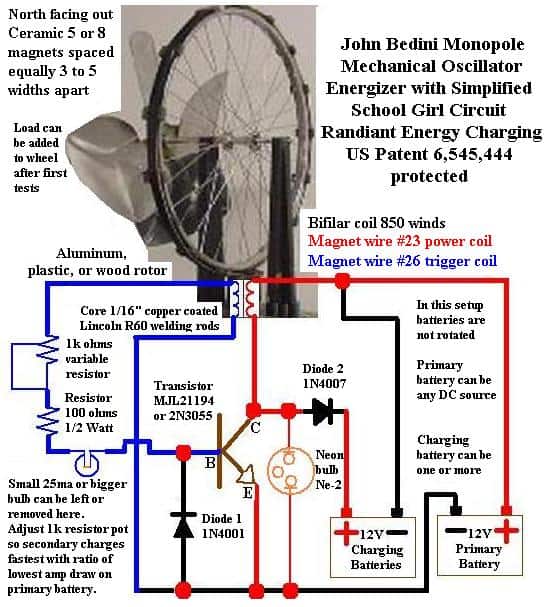
"The School Girl Radiant Energy Circuit and Motor is the most basic rendition of a patented circuit developed by John Bedini and researched by Dr. Peter A. Lindemann, based on the technology of Nikola Tesla, with follow-up work by Edwin Gray, Moray, and others. Bedini has done away with the need for a discharge gap. This "School Girl (Simplified)" design is the most basic presentation of the Bedini system. The circuit is run by an input battery, and charges an ouput battery, while turning a wheel, lined with magnets, that service to create a flux in the coils. There are some unusual characteristics observed in the process.
"Operation ~ The motor has to be started by an external push, after which it turns on its own from the firing of the coil electromagnet. It gradually increases in speeds until it reaches an optimum at around 300 rpm. Applying load to the wheel results in lower amperage going from the input battery because it is dependant on the rate of firing only.
"Features ~ Simple design. Inexpensive. Charger device whose oetput is friedly to batteries. Doesn't heat them, but actually refurbishes them. Charging takes less energy input by far than what is normally required, implicating Radiant (or whatever name is most suitable) energy infusion in the process. "
Assembly Notes ~
The Frame Stand needs to be non-magnetic, and mechanically stable front-to-back and left-to-right. The gap between the coil spool and wheel with magnets affixed (super-glue and tape) should be 1/8 inch. The gap should be variable for experimental purposes.
Determine the "North" end of the magnets with a compass, and label it. The "north" end of a compass needle will be attracted to the "south" pole of the magnet. All the magnets are mounted with the North pole facing out, toward the coil.
Equal-distance spacing of the magnets on the wheel's perimeter is not critical with one coil. There is a limiting minimum distance, but not a maximum. Spacing need not be uniform. If you plan to add more coils --- with a separate circuit for each coil --- spacing must be symmetrical for proper firing. Do not space the magnets closer apart than 1.5 to 2 widths.
Coils are loosley wound with approximately 450 turns. The two wires on the coil are wound together. The number of turns is not critical, but an accurate count is necessary for proper scientific recording.
Miscellaneous Tips & Precautions
Spacing of the magnets on the wheel's perimeter is not critical with one coil. There is a imiting minimum distance, but not a maximum. Spacing need not be uniform.
Do not draw power from the battery while it is being charged. Charge one bank of batteries, and discharge another bank, switching between them.
This design can shock, though not dangerously.
If the neon bulb is not in place, The transistor will burn out if the neon bulb is not installed, and if the device is run without a receiver-load (battery) for the radiant energy. The neon bulb serves as a "shock absorber" for excess output energy.
Circuit
Diagram (Drawn by Bedini) >>
C = Collector
E = Emitter
R1 = 680 Ohms resistor
D1 = 1N4001 Diode
D2 = 1N4007 Diode
B1 = Run Battery
B2 = Charge Battery
Analogous
Circuit >> 
Numbered
Analogous Circuit

Key
1 --- Solder junction (insulated base [same for
2,3,4]) joining (a) wire coming from (+) battery "in" and
(b) #20 magnetic wire to coil and then to collector
2 --- Solder junction joining (a) wire coming from (-)
battery "in" and (b) emitter and (c) Diode 1N4001 and (e)
#23 magnetic wire going to coil then resistor then base.
3 --- Resistor 680 Ohms, between (a) Base/Diode1N4001 and
(b) #23 magnet wire going to coil then collector.
4 --- Solder junction joining (a) diode {19} (1N4007) and
(b) wire to battery receiving charge.
5 --- Insulated wire coming from (+) battery "in"
6 --- #20 magnetic wire from (+) battery "in" to coil and
then to collector
7 --- Insulated wire coming from (-) battery "in"
8 --- #23 magnet wire coming from emitter to coil to
resistor.
9 --- Wire connecting 1N4001 diode to junction {2}
10 --- Transistor emitter, connected to junction {2}
12 --- Wire connecting 1N4001 diode to (a) base and (b)
resistor {3}.
13 --- Transistor base: connected to resistor and diode
1N4001
14 --- Resistor connected to #23 magnet wire going to coil
then to emitter.
15 --- from resistor to #23 magnet wire to coil to emitter
16 --- #20 magnet wire (per Bedini SG specs) from
transistor's "collector" lead
17 --- connection of transistor's "collector" lead to wire
to Diode 19 and to #20 magnet wire 16 to coil to input
battery's positive lead
18 --- wire from transistor's "collector" lead to Diode 19
19 --- 1N4007 Diode 1000V
20 --- Insulated wire to positive terminal of battery
receiving charge
21 --- Transistor (Different one in this photo than is
called in these plans)
22 --- Aluminum plate heat sink
23 --- Neon bulb, between collector and emitter. (not shown
in picture, nor schematic, but that is where it goes, and
that is where it is situated on the school girl simplified
demonstrated in Bedini's shop).
Transistor
2N3055

https://www.energyscienceforum.com/forum/alternative-energy/john-bedini
John Bedini
The official John Bedini forum dedicated to his work in
multiple areas of energy including the SG Energizers,
Crystal Batteries, etc... Make sure to get a copy of Bedini
SG - The Complete Beginner's Handbook at http://bedinisg.com
https://makingcircuits.com/blog/how-to-recharge-discarded-lead-acid/
Make this Bedini Charger Circuit to Recharge Dead Battery
https://everycircuit.com/circuit/6037806463057920/-solid-state-bedini-
Solid State Bedini Charger Circuit
https://dr.ntu.edu.sg/entities/publication/3b1aa6c2-571d-4bf4-a118-966ceaeef965
Study and investigating John Bedini energizer for over
unity coefficient of performance and free radiant energy
Gay, Zheng Jie
s[
PDF ]
Abstract
-- The aim for this project is to study and learn the
working principle of John C. Bedini's Simple School Girl
(SSG) Energizer. John C. Bedini had released the source of
his systems to demonstrate the principle of "radiant" energy
for charging of batteries. The most popular design was the
Bedini SSG (Simplify School Girl) energizer as it was named
before a nine years old girl that build one of Bedini motor
and won a nodal science award.
Bedini process main objective is to receive free energy by
creating the COP>1 during the charging and discharging of
batteries in his systems. In other words, by using one
powering battery, the Bedini process are able to charge one
more batteries faster than discharging the batteries itself.
On the other hand, he also prove that during the charging
process. It can also produce rotating mechanism power from
the rotating rotor.
This process give rise of new type of technology to achieve
clean energy without consuming natural resources
(conventional) or used harmful chemical (nuclear cells or
etc) that bring harm to the environment
Therefore, the author will build a Bedini SSG for his FYP to
test on the COP>1 that claimed by John Bedini and while
doing so, the author will also achieved some basic knowledge
and skills from this project.
https://www.instructables.com/Bedini-Monopole-Mechanical-Oscillator/
Bedini Monopole Mechanical Oscillator
By petercd
https://www.youtube.com/watch?v=EFB0AuXPmfA
Bedini
SSG Battery Charger/Desulfator //
electronicsNmore
This
circuit uses a 12v battery to charge other 12v batteries to
a higher voltage. According to John Bedini, you are getting
more out of the circuit than you put into it(Which I have
not proven). The high voltage that is created to charge the
12v battery is created by the back EMF from the coil.
https://rpmgt.org/JoinBediniList.htm
The
Simplified School Girl (SSG) Project
Schematic | Parts Kit | Introduction | Instructions |
Materials | Parts Sources |
https://hartito.wordpress.com/wp-content/uploads/2009/07/20-bedini-bearden-years-free-energy-generation-2007.pdf
Experiments with a Kromrey & a Brandt-Tesla
Converter Built by John Bedini with Comments by Tom
Bearden
[
PDF ]
https://ieeexplore.ieee.org/document/6814494
Performance comparison of 4-Pole Neodymium Magnet Bedini
SSG free energy generator
Shahrel Fakhrurrazey, et al.
Abstract -- This paper presents the performance
comparison for 2 types of Bedini SSG free energy generator.
The Bedini SSG is one types of magnetic motor generators
based on zero point technology created and demonstrated by
John Bedini. This device acts as a self-battery charger. The
study involved the construction and performance of the
original Bedini Monopole Mechanical Oscillator SSG Energizer
and 4-Pole Neodymium Magnet Bedini SSG. This type of free
energy generator can be one of an alternative way to replace
the non-renewable energy sources that will run out in
future. In this paper, the Battery's Coefficient of
Performance (COP) for both designs will be identified.
Investigation and analysis were done for both types of
Bedini SSG. It was found that the replication design can
charge faster, had less power consumption and its COP
improved by 8% compared to the original design.
Design and analysis of a radiant charger using 5 coils and 5 poles of neodymium magnet as a rotor drive
M N Hidayat et al